


5 Best Agile Business Analyst Certifications Compared
Need More Help? Book Your FREE Strategy Session With Our Career Coaches Today!
For most analysts working in sprint-based teams, the best agile business analyst certification is AgileBA, taken at Foundation and then Practitioner level. If you want a fast introduction with no entry requirements, the BCS Professional Certificate in Agile Business Analysis takes about a week. If you already analyse for a living and want a credential that is not tied to one framework, IIBA-AAC is the stronger pick.
The trouble is that the names blur together. AgileBA, BCS, IIBA-AAC, IIBA-CPOA and the various "Certified Agile Business Analyst" titles all promise to prove you can do business analysis in an agile team. They differ in exam length, entry requirements, who awards them and how much they cost once training and resits are counted.
This article takes the five certifications that come up most often and sets them out the same way: what each covers, how you sit it, and who it suits. A final section compares them side by side, explains what drives the cost and online study options, and shows how to choose.
1. AgileBA (APMG International)
AgileBA is the most agile-specific qualification on the list. It teaches how business analysis works inside agile delivery, from strategy and stakeholder engagement to value-driven delivery. It has two levels, and the scheme is now on version 3.
What it covers and how you sit it
Foundation gives you the roles, processes and practices of an agile project. The exam is 50 multiple-choice questions in 40 minutes. Practitioner goes deeper into applying agile principles, managing requirements, and testing and estimating the delivery of benefits. You must hold Foundation first, and the Practitioner exam runs for roughly two and a half hours of complex multiple-choice questions.
Accredited training providers run both levels online, either in a live virtual classroom or at your own pace, so you can study around a job.
AgileBA is the safest all-round choice if your team already runs sprints.
Who it suits and what to know
Foundation suits product owners, Scrum Masters, project managers and agile team members who want to understand the analyst role, plus analysts moving from waterfall projects into agile. Practitioner is aimed at working analysts who need to apply the techniques daily.
There is no advanced level above Practitioner, so this is a two-step route rather than a long ladder. That is a strength if you want one clear target and a limitation if you want a senior credential later.
2. BCS Professional Certificate in Agile Business Analysis
The BCS certificate is the quickest route to a recognised agile analysis credential. BCS is widely recognised by UK recruiters, which helps if you plan to stay in the UK market.

What it covers and how you sit it
The course is introductory and has no entry requirements. You learn to break business goals down into smaller pieces, apply user story techniques, and judge whether an agile method fits the business problem in front of you.
Delivery is typically about three full days of online classes within a week, which makes it the lightest time commitment of the five. Check with your training provider how assessment is run.
If you need an agile credential on your CV within a week, this is the one.
Who it suits and what to know
It suits analysts, managers and others who plan or oversee business operations and want to understand how agile supports the analyst role. It also works well for people new to agile who want a structured introduction.
Because it is introductory, it carries less depth than AgileBA Practitioner. Think of it as a credible first step, not a mark of seniority.
3. IIBA Agile Analysis Certification (IIBA-AAC)
IIBA-AAC is aimed at analysts who work in agile environments but do not want a credential tied to one method. IIBA positions it as proof of agile analysis skills in any framework, which suits people who move between Scrum, Kanban and scaled setups.
What it covers and how you sit it
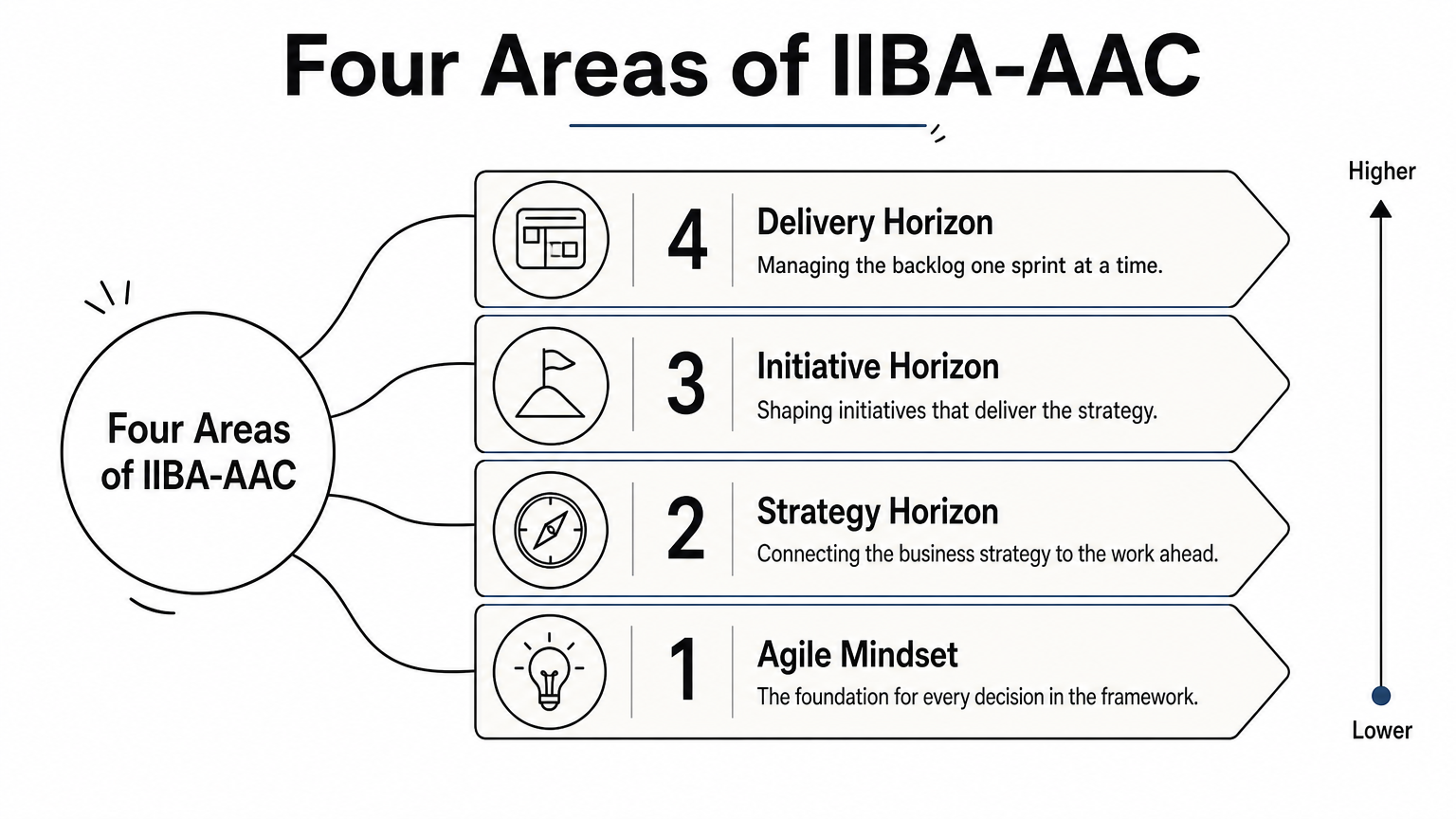
The content is organised around four areas: the agile mindset, the strategy horizon, the initiative horizon and the delivery horizon. That structure pushes you to think beyond a single sprint, from the business strategy down to the backlog.
The exam is a two-hour online test of 85 multiple-choice questions. Questions are scenario-based and cover situations such as categorising user stories or maintaining a product backlog. Check IIBA's page for current eligibility rules and renewal terms before you commit.
Choose IIBA-AAC when your agile practice spans several frameworks, not just one.
Who it suits and what to know
It suits experienced analysts, especially those who want an internationally minded credential from the same body that runs other widely held business analysis certifications. Self-study and prep courses are available online from independent providers.
It is less of a teaching course than AgileBA. You are expected to bring real project experience to the scenarios.
4. IIBA Certificate in Product Ownership Analysis (IIBA-CPOA)
IIBA-CPOA is the right pick if your agile career is heading towards product ownership. It is a certificate rather than a pure analyst credential, so it fits only part of the brief, but it comes up constantly in this search for good reason.

What it covers and how you sit it
It shows you understand how to combine business analysis with product ownership using an agile mindset. The focus is product ownership analysis, the discipline that helps teams reach good outcomes on product work.
Confirm the exam format, entry rules and renewal terms on IIBA's page, as these are the details most likely to have changed since a provider last published them.
CPOA suits the analyst who is becoming a product owner, not the one who plans to stay purely in analysis.
Who it suits and what to know
It suits product owners and analysts who want to join product development teams. If you already hold IIBA-AAC, CPOA is a logical second credential, because both come from the same body and share the agile mindset.
If you want to remain a pure analyst, skip it and put your money towards AgileBA Practitioner or IIBA-AAC instead.
5. iSQI Certified Agile Business Analysis
The iSQI certificate focuses on delivering features and producing satisfactory returns on enterprise investment. It is less well known in the UK than AgileBA or BCS, but it covers the day-to-day situations analysts meet in agile teams.
What it covers and how you sit it
The course looks at situations analysts regularly run into in an agile context. It includes modules on avoiding project waste and stimulating team collaboration, which makes it practical for analysts who sit between the business and delivery teams.
You need basic business analysis knowledge and an agile mindset to qualify, so it is not a first certification. Confirm exam format and cost with the training provider.
Check who actually awards a "Certified Agile Business Analyst" before you pay.
Who it suits and what to know
It suits business analysts, product owners and business change managers who already have some experience. Titles similar to "Certified Agile Business Analyst" are issued by more than one provider, so confirm the awarding body and how recruiters in your market regard it.
How to compare cost, online study and value
All five can lead to a stronger CV, but they are not interchangeable. Compare them on exam length, entry requirements and what you will realistically pay in total, not just the headline course price.
Side-by-side comparison
| Certification | Format or exam | Entry requirement | Best for |
|---|---|---|---|
| AgileBA Foundation | 50 multiple-choice questions, 40 minutes | None, entry level | Agile team members, product owners, analysts moving to agile |
| AgileBA Practitioner | About 2.5 hours, complex multiple choice | AgileBA Foundation | Practising analysts |
| BCS Professional Certificate | About three days of online classes | None | A fast, recognised introduction |
| IIBA-AAC | 2-hour online exam, 85 multiple-choice questions | Confirm with IIBA | Experienced analysts across frameworks |
| IIBA-CPOA | Confirm with IIBA | Confirm with IIBA | Analysts moving into product ownership |
| iSQI Certified Agile Business Analysis | Confirm with provider | Basic BA knowledge and agile mindset | Analysts, product owners, change managers |
What drives the cost
Agile BA certification cost varies widely by provider and format, so compare like with like. Ask each provider for an all-in price that answers these questions:
- Is training included, or are you buying the exam only?
- Is the exam fee in the course price?
- What does a resit cost if you fail?
- Do you need a paid membership of the awarding body?
- Does the certificate expire? Some are for life and others lapse after a year or two.
Online study usually saves the most money. Live virtual classes keep you accountable, while self-paced courses suit irregular schedules.
Which one to pick
Choose by your situation. If you are in a Scrum team now, start with AgileBA Foundation, then Practitioner. That is two exams, 40 minutes and about 2.5 hours, and they give you both the concepts and the applied skills. If you work across several frameworks, take IIBA-AAC, which is one two-hour exam. If you need something fast and recognised, take the BCS certificate.
If you have no analysis background yet, build the fundamentals first, because Practitioner and iSQI expect working knowledge. Transform Learning Academy's Business Analysis Programme prepares you for the BCS Business Analysis Foundation exam over about three months at roughly 5 hours a week, with no prerequisites and live project experience.
Fundamentals first, then the agile credential that matches how your team really works.
Choosing your next step
The right agile business analyst certification depends on where you are now. AgileBA is the best fit for most analysts in sprint-based teams, the BCS certificate is the fastest start, IIBA-AAC suits experienced analysts across frameworks, and CPOA and iSQI serve narrower needs. Whatever you choose, compare total cost, confirm renewal terms and check which credential employers in your market ask for.
If you are still building your analysis foundations, start with business analysis training at Transform Learning Academy and add an agile certification once you have real project experience.


