


BCS Business Analysis Foundation Certificate: Exam and Cost
Need More Help? Book Your FREE Strategy Session With Our Career Coaches Today!
If you are weighing up the BCS Business Analysis Foundation Certificate, you probably want three answers: what it covers, what the exam costs, and where to book training. You also want to know if it is worth your money. That is a fair question when you are changing careers and have no tech background.
Here is the short version. The certificate is an entry-level qualification from BCS, The Chartered Institute for IT, and it tests your grasp of core BA techniques through a one-hour multiple-choice exam. Many people choose it as their first recognised credential because it needs no prior experience. Costs vary, as exam fees and training course prices are set separately by each provider.
Below, we break down the exam format, the syllabus, typical costs, and how to choose a BCS business analyst course that suits you. At Transform Learning Academy, we train career changers such as teachers, pharmacists, and police officers to become Business Analysts, so we also cover how the certificate fits into a real job search.
Why the BCS Foundation Certificate matters for career changers
When you have no BA job title on your CV, you need proof that you speak the language. The BCS Business Analysis Foundation Certificate is one of the quickest ways to show it. It is also one of the few entry-level qualifications that needs no prior experience or degree.
A credential UK employers already recognise
BCS is the Chartered Institute for IT, and its name carries weight with hiring managers in banking, insurance, government and consultancy. A BCS business analysis certification tells a recruiter you have learned the standard BA toolkit: stakeholder analysis, business cases, requirements and process modelling. That helps when your last job title was "teacher" or "pharmacist" and the screener has 200 applications to get through.
You also gain a shared vocabulary for answering business analysis interview questions. You can explain what a requirement is, why stakeholders disagree, and how you would compare options, without bluffing your way through.
What it proves, and what it does not
Be realistic about the limits. Passing a one-hour multiple-choice exam shows you understand the theory. It does not show that you can run a workshop or write a clear user story under deadline pressure. Recruiters know this, so the certificate alone rarely lands the job, and the people who get hired usually have practical examples to talk about.
The certificate gets your CV noticed, but hands-on project experience is what gets you hired.
That is why a good business analyst foundation course should include practical exercises as well as exam prep. If you can say "I mapped a process and wrote requirements for it" in an interview, the qualification suddenly carries far more weight.
How it fits your background
Most career changers already use BA skills without calling them that. The certificate gives those skills a professional frame.

| Your background | Skill you already use | What the certificate adds |
|---|---|---|
| Teacher | Managing parents, staff and pupils with competing needs | Formal stakeholder analysis and BA terminology |
| Pharmacist | Accuracy, compliance, following procedure | Process modelling and the BA lifecycle |
| Police officer | Gathering evidence, interviewing, writing reports | Requirements elicitation and documentation |
It is also a first rung, not a dead end. Once you hold Foundation, you can move on to BCS Practitioner certificates and, later, the International Diploma in Business Analysis as your career develops.
How to get the certificate: course or exam only
You have two routes to the BCS Business Analysis Foundation Certificate. You can take an accredited training course that includes the exam, or you can book the exam on its own and study by yourself. Both routes lead to the same qualification. What changes is the support you get, the time you need and the price you pay.
The training course route
Most career changers choose a BCS business analyst course run by an accredited training provider. Courses come as live online classes, in-person days or self-paced modules, and the exam is often bundled into the fee. A good one gives you a trainer to ask questions, practice papers and a clear study plan. Check that the provider is BCS accredited before you pay, because that is what keeps the exam booking simple.
The exam-only route
Self-study suits you if you already work close to BA, perhaps in a PMO, operations or systems role. You get the official syllabus and sample papers, learn the material alone, then book the exam. It looks cheapest on paper, but you carry the risk. A failed attempt means paying for a resit, and nobody tells you which topics you misunderstood.
If you have never seen a requirements document, pay for a trainer. If you write them weekly, exam-only can work.
Comparing the two routes
| Course with exam | Exam only | |
|---|---|---|
| Support | Trainer, mock exams, feedback | None |
| Best for | Career changers with no BA background | People with BA-adjacent experience |
| Pace | Set schedule or guided modules | Entirely your own |
| Upfront cost | Higher | Lower |
| Resit risk | Lower, thanks to practice and coaching | Higher |
For most readers of this guide, I would pick the course. A BCS business analysis certification is only half the battle when you have no BA title, so choose a provider that adds practical exercises to the exam prep. Then you leave with the certificate and examples you can talk about in interviews.
Exam format, syllabus and pass mark explained
The exam is short, and it is closed book, so you need to know the material rather than look it up. Here is what to expect on the day, and what you need to revise.
The exam format at a glance
The BCS Business Analysis Foundation Certificate exam is a single paper made up of multiple-choice questions. You answer them under timed conditions, with no notes. Confirm the details with your training provider before you book, because BCS can update them.
| Detail | What to expect |
|---|---|
| Question type | Multiple choice, one correct answer each |
| Number of questions | 40 |
| Duration | 60 minutes |
| Pass mark | 26 out of 40 (65%) |
| Materials | Closed book |
That gives you 90 seconds per question, which is generous if you know the terminology. Most candidates who run short of time do so because they second-guess answers they got right the first time.
What the syllabus covers
A good business analyst foundation course will teach the whole BCS syllabus. The main areas are:
- The BA role, and how it fits into an organisation
- Strategic context, including tools such as SWOT and PESTLE
- Investigating a business situation, using interviews, workshops and observation
- Stakeholder analysis, to work out who matters and why
- Modelling business processes and describing how work gets done
- Requirements: eliciting, documenting and prioritising them, for example with MoSCoW
- Building a business case, by comparing options and their benefits
BCS revises its syllabus from time to time, so download the current version from the BCS website and check topic weightings against it.
The pass mark and how to revise for it
A 65% pass mark means you can get 14 questions wrong and still pass. That sounds forgiving, but the questions are often scenario-based. You may be asked which technique suits a situation, not just what a term means.
You can drop 14 questions and still pass, but only if you know which technique fits which situation.
So practise with scenarios, not flashcards alone. Aim for 80% or more on mock papers before you sit the real one, because nerves will cost you a few marks.
How much the exam and training courses cost
Prices for the BCS Business Analysis Foundation Certificate are not fixed, because each accredited provider sets its own. Treat the figures below as rough UK ranges, and get a written quote before you pay.
Typical price ranges
Expect the exam on its own to cost in the low hundreds of pounds. A full course with the exam bundled in usually runs from about £800 to £2,000, and live classes cost more than self-paced modules. These are indicative figures, so check current prices with BCS and your chosen provider, and ask whether the quote is inclusive of VAT.

| Route | Indicative cost | Usually includes |
|---|---|---|
| Exam only | Low hundreds of pounds | Exam booking, nothing else |
| Self-paced online course | Around £800 to £1,200 | Materials, mock papers, exam |
| Live online or classroom course | Around £1,200 to £2,000 | Trainer, mock papers, exam |
Costs people forget
Hidden extras catch out many first-time buyers. Before you book any business analyst foundation course, ask these questions:
- Is the exam fee included, or billed separately?
- Is VAT included in the price you were quoted?
- What does a resit cost, and is one included?
- Are mock exams, course books and recordings included?
- Can you pay in instalments, or claim funding from your employer?
A cheap quote can turn expensive fast. If the exam and a resit are billed separately, a £300 saving can vanish after one failed attempt. The same applies if you must buy practice papers elsewhere.
The best-value route is the one that gets you through the exam first time, not the one with the lowest headline price.
So weigh the full cost of your BCS business analysis certification against what you receive. A slightly dearer course with a trainer, mock papers and practical exercises often costs less overall than a bare exam booking you have to repeat.
How to prepare and what to do after you pass
Passing comes from steady practice over a few weeks, not last-minute cramming. What you do afterwards matters just as much, because the BCS Business Analysis Foundation Certificate only pays off once employers can see it and you can talk about it.
A simple four-week revision plan
Most people with a job and a family need about four weeks. Test yourself early rather than saving mock papers for the end, and use every mock your business analyst foundation course provides.
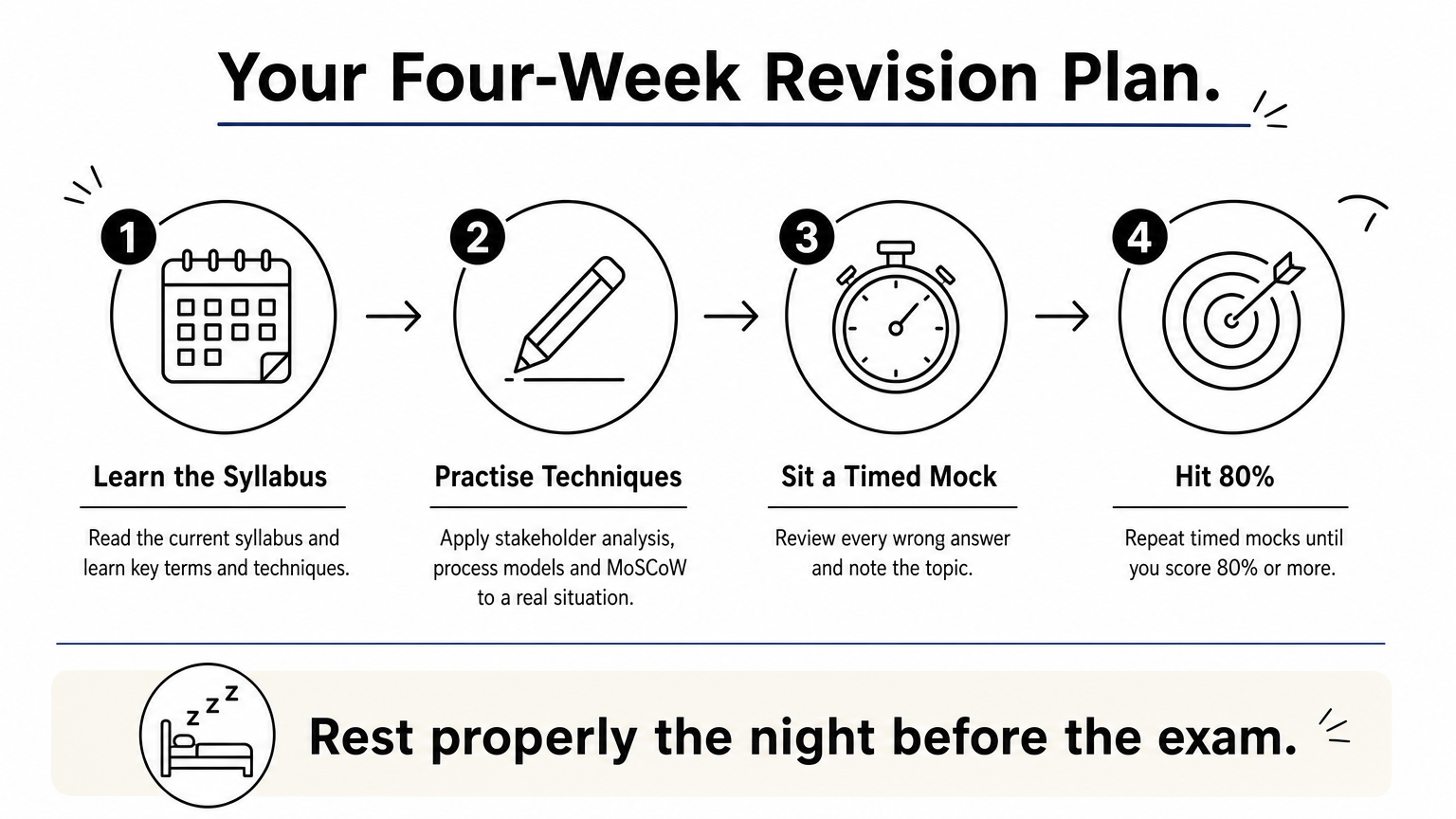
- Week 1: Read the current syllabus and learn the key terms and techniques.
- Week 2: Practise stakeholder analysis, process models and MoSCoW on a real situation, such as your old workplace.
- Week 3: Sit a full timed mock, then review every wrong answer and note the topic.
- Week 4: Repeat timed mocks until you score 80% or more, then rest properly the night before.
What to do once you pass
Act within the first week, while the result is fresh. Add the certificate to your CV and LinkedIn headline, then back it up with evidence of practical work, because recruiters want to see you can apply the theory.
- List the qualification near the top of your CV, and mention it in your summary.
- Write two or three short examples, such as a process you mapped or requirements you documented for a real problem.
- Apply for junior Business Analyst, business systems analyst and similar entry roles, and tell recruiters you are retraining.
- Plan your next step, such as a BCS Practitioner certificate, once you have some project experience.
Treat the pass as the start of your job search, not the end of your studying.
If you took a course, ask your trainer for CV feedback. A second pair of eyes often spots where your old career already shows BA skills.
Is the BCS Foundation right for you?
If you are changing careers with no BA title, the BCS Business Analysis Foundation Certificate is a sensible first step. It asks for no prior experience, it takes about four weeks of steady revision, and UK employers recognise the BCS name.
Remember its limits, though. The certificate proves you know the theory, but practical examples are what win interviews. Choose an accredited course with mock exams and real exercises, check exactly what the quote includes, and aim for a first-time pass rather than the lowest headline price.
Ready to go beyond the exam? Our Business Analysis Programme at Transform Learning Academy combines professional certification with hands-on project experience and career support. You finish with the qualification and the proof employers look for. Book an enquiry call and see whether it fits you.


