


What Is BCS Business Analysis? Levels, Exams and Costs
Need More Help? Book Your FREE Strategy Session With Our Career Coaches Today!
BCS business analysis is the modular certification route run by BCS, The Chartered Institute for IT, for people who work or want to work as business analysts. It has five levels, from Foundation to Expert, and each level maps to the SFIAplus skills framework. Most people start with the Foundation Certificate in Business Analysis, move to the Practitioner Certificate in Business Analysis Practice, and can then stack modules towards the International Diploma.
This article explains why the certification matters, how the levels and exams fit together, what drives the cost of a UK business analyst certification, and how to choose a training provider. You will finish knowing which exam to sit first and what to ask before you pay anyone.
We teach career changers who have no tech background, so we see the same question often: do I need this, and in what order? Our Business Analysis programme includes the BCS Foundation exam, which shapes how we answer it below.
Why BCS business analysis certification is worth considering
A BCS certificate is worth having because employers recognise the name and because it gives you a shared vocabulary for the job. It does not replace experience, but it gets a career changer past the first CV filter.
What employers read in the certificate
BCS is the chartered body for IT in the UK, and it reports that over 100,000 people worldwide hold its business analysis certifications. A hiring manager does not need to research the qualification. The levels also map to SFIAplus, so a recruiter can see roughly what you can do at each stage. At Foundation (SFIAplus Level 3) you carry out a broad range of tasks and plan your own work. At Practitioner (Level 4) you handle complex activities.
Pay gives the practical context. BCS puts the average salary for a business analyst with four to five years' experience at around £50,000, citing ITJobsWatch, Reed, Indeed and Glassdoor. Certification will not guarantee that figure, but it shows you understand the work that earns it.
What it will not do
A Foundation pass proves you know the principles and techniques. It does not prove you have run a stakeholder workshop or written requirements that developers could build from. Employers know the difference, so pair the exam with practical work.

- Practise the techniques on a real or simulated project.
- Keep examples of the documents you produced.
- Be ready to explain how you handled a difficult stakeholder.
A BCS certificate opens the door, but project evidence is what gets you through it.
How to progress through the BCS business analysis levels
Start with the Foundation Certificate, apply it on real work, then take Practitioner modules towards the International Diploma. The route is modular, so you never commit to the whole ladder at once.
The five levels at a glance
| Level | SFIAplus | Example certificates | Who it suits |
|---|---|---|---|
| Foundation | 3 | Business Analysis; Digital Business Change; Organisational Behaviour; IS Project Management | Newcomers building broad understanding |
| Practitioner | 4 | Business Analysis Practice; Requirements Engineering; Modelling Business Processes; Data Management Essentials; Benefits Management and Business Acceptance | Working BAs showing specialist practical skills |
| Professional | 5 | Agile Business Analysis; Business Architecture; Data Analysis; Stakeholder Engagement; Advanced Requirements Engineering | Experienced BAs influencing their organisation |
| Consultant | 6 | Advanced International Diploma in Business Analysis | Senior BAs leading business change |
| Expert | 7 | Expert BA Award | Senior BAs at management and leadership level |
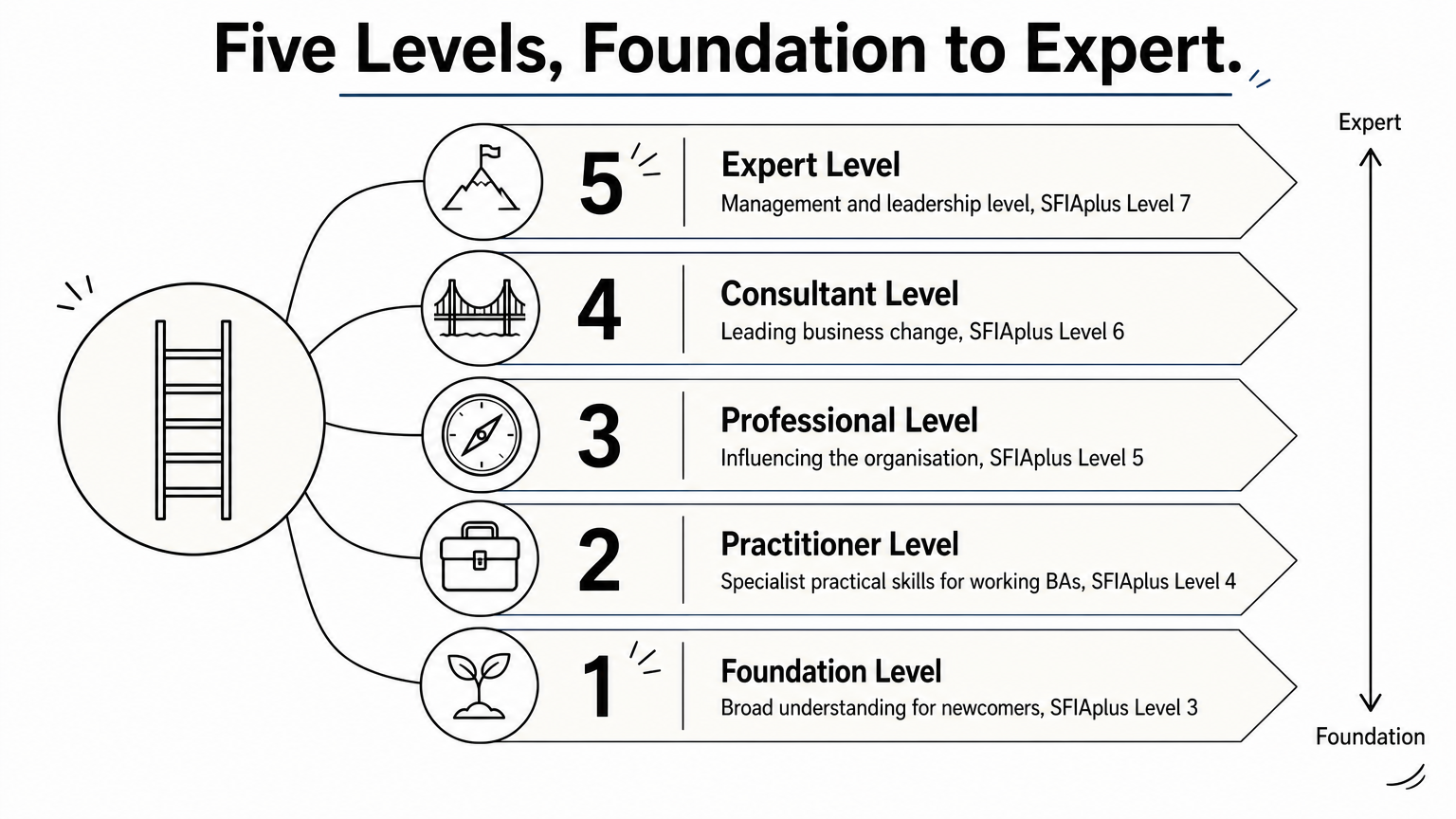
Foundation Certificate: where most people start
The Foundation Certificate in Business Analysis is the entry point and, as far as BCS lists, has no prerequisites. It covers the core principles and techniques of the role, and the exam is multiple-choice. The related Foundation certificates in Digital Business Change, Organisational Behaviour and IS Project Management are separate qualifications. If your goal is a BA job, the Business Analysis one is the one to take.
Practice Certificate and the International Diploma
The Practitioner Certificate in Business Analysis Practice is designed for people already in a business analysis role who want deeper strategy and application skills. Treat it as the second step, taken once you have real work to draw on. The International Diploma in Business Analysis is awarded after four practitioner modules. Training providers describe it as four courses and exams followed by an oral examination.
Beyond that, the Advanced International Diploma needs four professional-level certificates. The Expert BA Award was developed with the Chartered Management Institute and the BA Manager Forum. BCS says Consultant-level completion gives you a fast-track route to Chartered IT Professional registration.
What drives the cost of BCS certification in the UK
There is no single UK business analyst certification cost, because BCS exams are bought through accredited providers who set their own prices. What you pay depends on the level, the delivery format and what the fee includes.
Costs you will meet
| Cost element | What to check |
|---|---|
| Course fee | Classroom, live online or e-learning; trainer-led formats usually cost more than self-study |
| Exam fee | Whether it is included or charged on top |
| Resit | Often an extra charge, so ask before booking |
| Membership | BCS membership is optional but sits alongside certification |
| Your time | Study hours and any days off work for live sessions |
Foundation is the cheapest entry, since it is one course and one exam. The Diploma is a different commitment. Treat it as four course-and-exam purchases plus an oral exam, not as a single qualification.
How to compare quotes
Ask each provider for the total to reach your target, not the headline course price. A cheaper course that excludes the exam and charges for every resit can cost more than a fuller package. Payment plans change affordability, but check whether they carry interest.

Compare the all-in price to a pass, not the sticker price of the course.
How to choose a BCS business analysis training provider
Choose a BCS-accredited training provider that includes the exam and gives you practical experience beyond lectures. Format and support matter as much as price.
What to check before you book
- Accreditation: confirm the provider is accredited by BCS for the exact certificate you want.
- Format: classroom, live online or self-paced study. Pick the one you will finish alongside your job.
- Exam inclusion: know whether the exam fee and a resit are covered.
- Trainers: look for working analysts, not only exam coaches.
- Practical work: a Foundation pass is stronger with a project behind it.
- Pass rate and reviews: ask for the first-attempt pass rate and read independent reviews.
How our programme handles it
Our Certified Business Analysis Training Course is built for career changers with no prerequisites. It runs for about three months at an average of five hours a week, which is roughly 65 hours of study. It includes two days of live training, the BCS business analysis Foundation certification exam and live project experience. Intakes run monthly.
On cost, you can split payments over 3, 6 or 12 months interest free, and courses carry a 14-day money-back guarantee. We do not provide re-sits, and any resit carries an additional cost. 98% of our delegates have passed their exams first time, so we tell students to treat the exam seriously from the first week.
The best provider is the one that gets you the certificate and the evidence to back it up.
Is BCS business analysis right for you?
If you want a UK business analyst career, the BCS Foundation Certificate is a sensible first step. It is recognised, mapped to SFIAplus and available without prior experience. Practitioner modules and the International Diploma make sense once you are working as a BA and want to prove deeper skills.
Cost depends on the provider, so compare total prices, exam and resit terms, and the practical experience on offer. Then take the exam with a project in your portfolio, because that combination is what employers hire.
If you are moving into the field from another career, see how our Business Analysis career-change programme combines the BCS Foundation exam with live project experience and career support.


