


Best Course for Business Analyst: 7 Picks by Career Stage
Need More Help? Book Your FREE Strategy Session With Our Career Coaches Today!
Finding the best course for business analyst work depends on where you start. If you have no experience, pick a beginner programme that ends in a recognised exam and gives you project practice, such as Transform Learning Academy's Business Analysis Programme or the IIBA's ECBA. If you already work in analysis, CCBA, CBAP or PMI-PBA prove your experience. A short Power BI or analytics course can then fill any skills gap.
The trouble is that "course", "certificate" and "certification" get thrown together in search results. A course teaches you something. A certification is an exam, and the higher levels also ask you to document years of work. Pay for the wrong one and you either study material you cannot yet use or sit an exam you are not eligible for. This article compares seven options in the same format, so you can see the time, entry requirements and ideal reader for each.
We run Transform Learning Academy and train career changers into business analyst roles, so we list our own programme first and say plainly where another option suits you better. Fees change often and depend on membership and exchange rates, so we do not quote them. Check each provider's page before you pay.
1. Transform Learning Academy Business Analysis Programme
Transform Learning Academy's Business Analysis Certification Programme is the strongest fit if you are changing career and want a recognised exam, live project experience and job-search help in one course. It is built for people with no tech background, and it asks for no prior experience or qualifications.

What you learn
The programme runs online and prepares you for the BCS business analysis foundation certification exam. It includes a two-day live business analysis training session and a live business analysis project. You finish with work you can describe at interview, not just a certificate. Practising analysts from UK tech and financial firms work alongside the students. According to the academy, 98% of its delegates pass their exams first time.
- BCS business analysis foundation certification exam
- Two-day live business analysis training
- Live business analysis project experience
- CV reviews, networking and job placement assistance
A certificate gets your CV past a filter, but a project gives you something to talk about at interview.
Who it suits
This course suits teachers, pharmacists, police officers and other career switchers who want to move into analysis without a degree in IT. Some former students from those backgrounds now work as business analysts. It is also a sensible choice if you worry about having nothing to show on your CV, because the project covers that gap.
It is not the right pick if you already have years of documented analysis work. In that case, go straight to CCBA or CBAP.
Time, cost and format
The estimated time is three months at an average of five hours a week. That works out at about 65 hours of study across 13 weeks. Classes are held online, either live or as self-study, and intakes run every month. You can split payments over 3, 6 or 12 months interest free, and a 14-day money-back guarantee applies. Resits are not included and cost extra, so treat the first attempt seriously. Current fees are on the programme page.
2. IIBA Entry Certificate in Business Analysis
The IIBA's ECBA is the best vendor-neutral exam for a complete beginner who wants a recognised credential and is happy to arrange their own study. It is an exam, not a course, so you need a separate way to prepare.
What you learn
ECBA tests foundation-level business analysis knowledge based on the IIBA's BABOK Guide. That covers business needs, stakeholders, requirements, change, value and solution thinking. The current exam has 50 situation-based and multiple-choice questions and gives you 75 minutes. The questions lean towards practical scenarios, so memorising definitions will not be enough.
- Business analysis planning and elicitation
- Requirements and design definition
- Strategy analysis and solution evaluation
Who it suits
ECBA suits beginners, students and career changers who like self-directed study. IIBA sets no minimum work history for it, which is why it works as a first rung before CCBA or CBAP.
Its weakness is that it gives you no practical experience. An exam pass with no project behind it is thinner than it looks on a CV.
Time, cost and format
Preparation usually takes a few weeks to a few months, depending on how much time you give it. You pay IIBA application and exam fees, and membership can change the price. Add any training course you choose, because the exam fee does not cover teaching. Check the current fee structure and requirements on the IIBA site before you book.
ECBA proves you know the framework, but it will not teach you the job.
3. IIBA CCBA and CBAP certifications
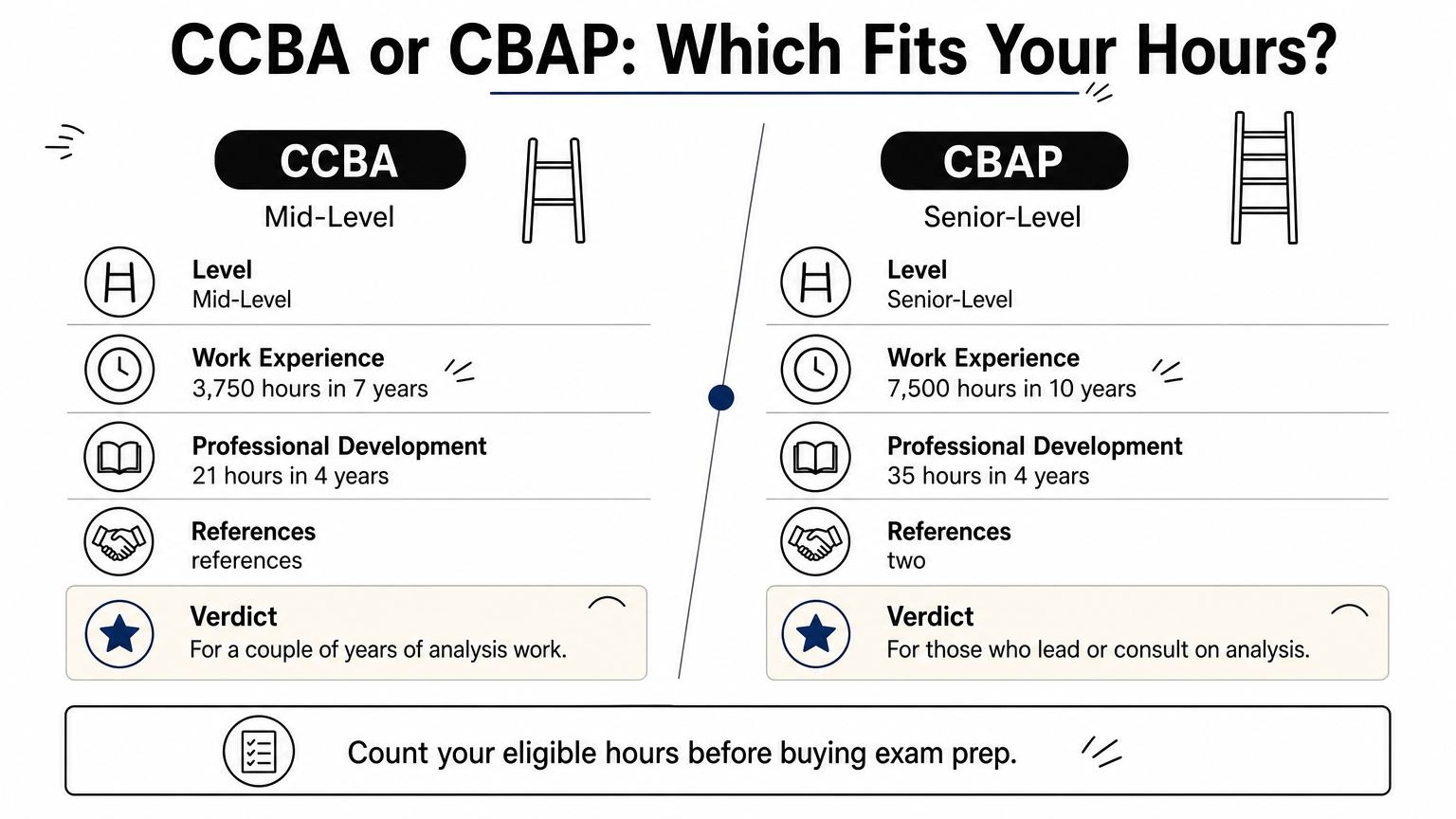
CCBA and CBAP are the best certifications for analysts who already have documented experience. They prove you have done the work, not just studied it. You cannot sit either as a beginner.
What you learn
Both exams draw on the BABOK knowledge areas, including elicitation, requirements lifecycle management, strategy analysis and solution evaluation. CBAP goes further into enterprise-level analysis and complex stakeholder work. Both need references and ongoing professional development, and both require recertification.
| CCBA | CBAP | |
|---|---|---|
| Level | Mid-level | Senior |
| Work experience | 3,750 hours in the last 7 years | 7,500 hours in the last 10 years |
| Professional development | 21 hours in the last 4 years | 35 hours in the last 4 years |
| References | Required | Two required |
Who it suits
Use CCBA if you have a couple of years of analysis work behind you. Use CBAP if you lead analysis work or consult on it. The hours must be genuine business analysis tasks, not general project support. A worked example: at 37.5 hours a week, 3,750 hours is 100 weeks, just under two years. 7,500 hours is 200 weeks, just under four years. That only holds if every hour counts as BA work, so most people need longer.
Time, cost and format
You first document your hours and references, then prepare for the exam. Expect months rather than weeks overall. Fees depend on membership status, so check the IIBA site for current figures.
Do not buy exam prep for CCBA or CBAP until you have counted your eligible hours.
4. PMI Professional in Business Analysis
PMI-PBA is the best certification for analysts whose work sits inside projects, with requirements traceability, delivery and project managers close by. It comes from the Project Management Institute, so it carries the most weight in project-heavy organisations.
What you learn
The exam covers needs assessment, planning, analysis, traceability and monitoring, and evaluation. It is long: 200 questions in 240 minutes. That tests stamina as well as knowledge. The content is less tied to the IIBA's BABOK framework, so if you hold or want an IIBA credential, expect some extra study.
- Needs assessment and business analysis planning
- Requirements analysis and traceability
- Solution evaluation
Who it suits
PMI-PBA suits business analysts who work next to project managers, and project managers who do a lot of requirements work. You need between two and five years of business analysis experience depending on your education, plus 35 contact hours of business analysis education. That rules out beginners.
Time, cost and format
Preparation means a structured study plan around the PMI exam outline. After you pass, you must earn 60 professional development units every three years to keep the certification. Fees differ for PMI members and non-members, so check PMI's page for the current price.
If your title says "project" more often than "analyst", PMI-PBA fits better than CBAP.
5. Coursera Business Analytics Specialization
The University of Pennsylvania's Business Analytics Specialization on Coursera is the best pick if the business analyst job you want is data-led. It teaches you how to use data to inform decisions, not how to run requirements workshops.
What you learn
The series covers customer analytics, operations analytics, people analytics and accounting analytics. It ends with a capstone project using real-world data sets. You finish with a shareable certificate from the university, not a professional certification with an exam body behind it.
- Customer and operations analytics
- People and accounting analytics
- Capstone project with real data
Who it suits
It suits beginners who want to understand how data shapes decisions in marketing, finance, operations and HR. It also helps analysts from non-data backgrounds who feel uneasy when a meeting turns to numbers. If you want classic BA skills such as elicitation, user stories and process mapping, pair it with another option.
Time, cost and format
The course is online and self-paced. Coursera usually offers a trial period and then charges a subscription or a fee per course, so your total cost depends on how fast you finish. Listings differ on how long the specialization takes, anywhere from one month to a few months, so check the current plan before you commit.
Choose this one for data skills, and add a requirements-focused course if you want the full BA toolkit.
6. LinkedIn Learning business analyst path
LinkedIn Learning's "Become a Business Analyst" path is the best low-risk first look at the role. It is short, you can try it free for a period, and it shows you whether you enjoy the work before you spend more.
What you learn
The path explains what a business analyst does and walks through the process from needs assessment and stakeholder identification to testing and release. You meet practical tools such as context diagrams, user stories and decision tables. It teaches you the vocabulary you will hear in your first BA interview.
- The role and the business analysis process
- Requirements elicitation techniques
- Context diagrams, user stories and decision tables
Who it suits
It suits anyone curious about business analysis, and people who want to test their interest in a few hours before enrolling elsewhere. It is not enough on its own to get hired. You get a certificate of completion, which employers do not treat as a professional credential, and you build no project to show them.
Time, cost and format
The path takes only a few hours of video, so you can finish it in a weekend. LinkedIn Learning is a subscription, and new users are usually offered a free trial period. If you finish the path inside the trial, it can cost you nothing. Check the current trial terms first.
Use it as a weekend test of the career, not as your qualification.
7. Udemy Power BI Desktop for business intelligence
The Microsoft Power BI Desktop course on Udemy, taught by Maven Analytics, is the best tool-skills add-on for a business analyst. It teaches a skill employers list in job adverts. It does not teach the analyst role itself.

What you learn
You work through Power Query, data modelling and relationships, DAX measures, report design and interactive dashboards. The capstone is a realistic project built on the AdventureWorks data set. By the end, you can turn raw data into a dashboard that answers a business question.
- Power Query and Power BI Desktop
- Data modelling and DAX
- Dashboards, KPIs and slicers
- AdventureWorks capstone project
Who it suits
It suits beginners who want a hands-on skill alongside a BA qualification, and working analysts who are asked to produce reports. It is narrow. It will not cover SQL or Tableau in depth, and some reviewers find the pace fast if you have never worked with data.
Time, cost and format
The course runs to around a dozen hours of video, which you can watch at your own pace, and Udemy keeps it available long after you buy it. Udemy courses are priced individually and often discounted, so check the current price. Completing it earns a certificate of completion, not an exam-backed credential.
A dashboard you built yourself is worth more in an interview than the certificate that came with the course.
How to choose the right course for your stage
Choose by experience first, then by the kind of analysis you want to do, then by budget. Hours of work history decide which exams you can sit, so check eligibility before looking at prices.
Match the course to your stage
| Your situation | Strongest pick | Why |
|---|---|---|
| No experience, want a job-ready route | Transform Learning Academy programme | Exam, live project and career support together |
| No experience, want a vendor-neutral exam | IIBA ECBA | No minimum work history |
| Unsure the career suits you | LinkedIn Learning path | Short and low risk |
| About 3,750 hours of BA work | CCBA | Mid-level proof of experience |
| About 7,500 hours of BA work | CBAP | Senior credential |
| BA work inside projects | PMI-PBA | Fits project delivery teams |
| Data-led analysis | Coursera or Udemy Power BI | Analytics and reporting skills |
Most people combine two. A beginner might take the academy programme for the exam and project, then add Power BI for a tool skill that makes the CV stand out.
Course, certificate or certification
A certificate of completion shows you finished a course. A certification shows you passed an exam set by a body such as IIBA, PMI or BCS, and the senior ones also check your work history. Employers value the second more, but only the first teaches you from scratch. Beginners usually need a course that leads to an exam.
Experience matters as much as either. A credential with no project behind it looks thin to a hiring manager, so favour courses that give you something to show.
Questions to ask before you pay
- Does it lead to an exam body's certification or only a certificate of completion?
- Is there a project, and is it live or a case study?
- What happens if you fail, and does a resit cost extra?
- Can you spread the payment, and is there a refund window?
- Does the provider help with CVs, networking or job placement?
Pick the course that ends in something you can show an employer, not the one with the longest syllabus.
Picking your first step
For most career changers, the best course for business analyst work is one that combines a recognised exam with real project practice. For people with experience, it is the certification that proves it. A short course such as the LinkedIn path or Power BI can sit alongside either, but should not replace them. Check eligibility, ask what you will have to show at the end, and compare the refund and resit terms before you commit.
If you are starting from scratch and want a route that includes the BCS exam, a live project and career support, take a look at the Transform Learning Academy Business Analysis Programme. Read what is included, then decide whether it fits your timetable.


