


6 Business Analyst Certification Training Options Compared
Need More Help? Book Your FREE Strategy Session With Our Career Coaches Today!
The right business analyst certification training depends on where you start. With no analysis experience, choose a structured programme with projects, such as Transform Learning Academy's, or IIBA's entry exam, the ECBA. With a few years of BA work behind you, aim for the CCBA or CBAP. If your analysis sits inside project delivery, look at PMI-PBA.
The problem is that these options are not the same kind of thing. Some are proctored exams with experience requirements. Others are courses that end in a completion certificate. Costs, entry rules and employer weight differ widely, so comparing them by name alone leads to bad choices, such as paying for CBAP when you cannot yet qualify.
This guide ranks six options and checks each one the same way: what you get, the requirements and format, the cost, and who it suits. A step-by-step route to certification follows the list. We train career changers into business analyst roles at Transform Learning Academy, so the advice is built around what helps people without a tech background get hired.
1. Transform Learning Academy Business Analysis Programme
Transform Learning Academy's Business Analysis Programme is a UK-focused online course that combines professional certification, project practice and career support. It is the only option here built for career changers with no degree, no IT certificate and no tech experience.

What you get
You learn alongside working analysts from UK tech and financial companies, so the teaching reflects how BA work happens on real projects. The programme pairs professional certification with hands-on project experience, which gives you something concrete to talk about in interviews. Career support covers CV reviews, networking and job placement assistance. The curriculum is updated to reflect current trends and tools.
A certificate opens the interview; project experience is what you talk about once you are in it.
Requirements and format
You need no degree, no prior IT certification and no technical background. Learning is online and flexible, so you can fit it around a current job. Practical projects and interactive discussions replace passive video watching, and trainers and a support team stay available throughout. That matters when you are learning business analyst certification training material from scratch.
Cost
Pricing is confirmed on an enquiry call rather than listed as a flat fee. Free training videos and live webinars let you see the teaching style before you commit, so you can judge the fit without paying first.
Best for
Adults in the UK moving from teaching, pharmacy, policing, retail or similar fields into a remote-friendly BA career. It also suits anyone who has tried to self-study and stalled because nothing gave them project practice. See the full Business Analysis Programme for details.
2. IIBA ECBA (Entry Certificate in Business Analysis)
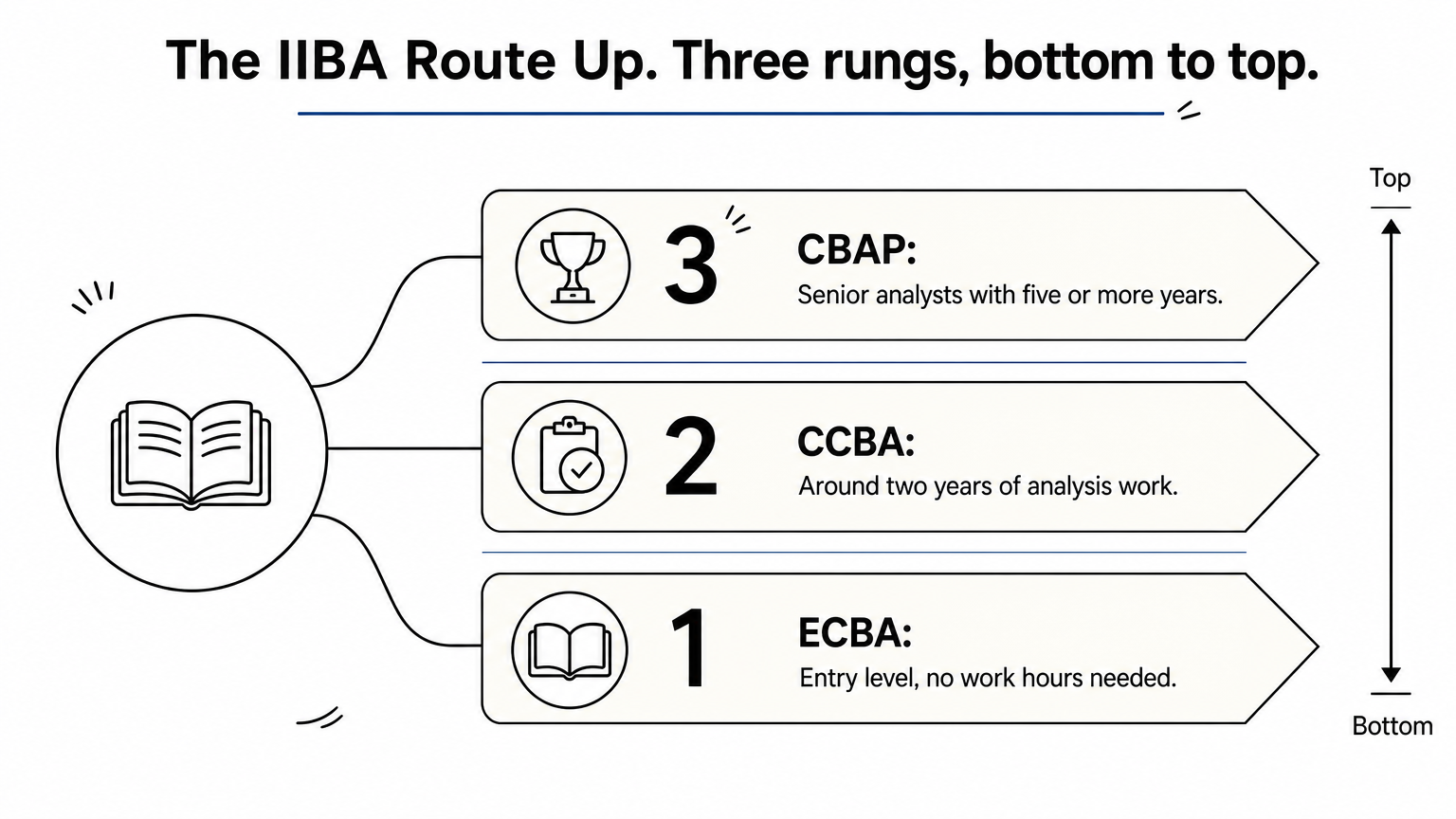
The ECBA is IIBA's entry-level credential, and it is the standard first exam for beginners. It tests foundational business analysis knowledge aligned with the BABOK Guide, which is IIBA's body of knowledge.
What you get
You earn a recognised third-party credential that shows you understand core BA concepts: needs, stakeholders, requirements, value and solution thinking. It does not prove you can do the job. Treat it as proof of structured learning, and a logical base before CCBA or CBAP.
Requirements and format
IIBA sets no minimum work-experience hours for the ECBA. The updated exam has 50 situation-based and standard multiple-choice questions and gives you 75 minutes. Expect more scenario questions than pure recall, so reading the BABOK Guide alone will not be enough. Practise applying concepts to short cases.
Cost
IIBA charges in US dollars, with an application fee and an exam fee for its core certifications. Membership can reduce the total. Budget a few hundred dollars for the exam before any training costs, and check IIBA's certification fees page for current figures, since they change.
Best for
Beginners, students and career changers who want a recognised credential and are willing to study independently or alongside a course. If you already have several years of BA work, skip it and look at the next two options.
3. IIBA CCBA (Certification of Capability in Business Analysis)
The CCBA is IIBA's mid-level certification for analysts with real project experience who are not yet at senior level. It sits between the ECBA and CBAP and is the most sensible next step if you have a couple of years behind you.
What you get
You gain a credential that signals applied capability rather than entry-level knowledge. It covers the BABOK knowledge areas, including elicitation, requirements lifecycle management, strategy analysis and solution evaluation. Many analysts use it as a stepping stone while they build the hours needed for CBAP.
Requirements and format
Eligibility is the main hurdle. IIBA asks for at least 3,750 hours of BA work experience within the last seven years, at least 21 hours of professional development within the last four years, and references. That is roughly two years of full-time analysis work. You log hours and development activity before you can book the exam, so start recording early.
With CCBA and CBAP, the paperwork takes longer than the studying, so log your hours from the first week.
Cost
The structure matches other IIBA core certifications: an application fee plus an exam fee in US dollars, with membership discounts. Add training or study materials on top, and remember that recertification brings further costs later.
Best for
Analysts with two to four years of hands-on experience who want formal validation. If you cannot document your hours cleanly, build your record first or pick a different route.
4. IIBA CBAP (Certified Business Analysis Professional)
The CBAP is IIBA's advanced certification for senior analysts, and it carries the most weight in BA communities. It suits lead analysts, consultants and business analysis managers who handle complex, enterprise-level change.
What you get
The credential signals depth across the whole BABOK framework: planning, elicitation, collaboration, requirements lifecycle, strategy analysis and solution evaluation. Hiring managers for senior roles recognise it. It can strengthen a case for promotion or a higher day rate, though experience still counts for more.
Requirements and format
IIBA positions CBAP for professionals with five or more years of experience. The eligibility rules ask for at least 7,500 hours of BA work within the last 10 years, 35 hours of professional development within the last four years, and two references. You must also recertify to keep it, so factor in ongoing development hours.
Cost
Expect the same fee model as CCBA: application fee, exam fee, possible membership, and your own prep costs. For a senior credential, the bigger investment is time. Most candidates need serious preparation because the exam tests judgement across complex scenarios.
Best for
Senior analysts who can document the full work history and want the strongest IIBA credential. If you are early in your career, aiming here wastes money and time.
5. PMI-PBA (PMI Professional in Business Analysis)
PMI-PBA is the Project Management Institute's business analysis credential, and it suits analysts whose work is tied closely to project delivery. If people search for PMI business analyst certification training, this is what they want to know about.
What you get
You gain a credential from a body that project managers already trust, which helps when your day-to-day work sits beside project managers and delivery teams. It covers needs assessment, planning, analysis, traceability and monitoring, and evaluation. It is less aligned with the BABOK framework than the IIBA route, so choose it for the project angle, not for general BA coverage.
Requirements and format
PMI's exam has 200 questions and lasts 240 minutes, so stamina matters. Eligibility depends on education: you need 24 to 60 months of business analysis experience depending on your degree level, plus 35 contact hours of BA education. A structured training course can provide those contact hours. To keep the certification you must earn 60 professional development units in each three-year cycle.
Cost
PMI sets its own exam fee, and prices differ for members and non-members. Check PMI's current fees before you budget, and add the cost of a training course for the contact hours if you have not already earned them.
Best for
Project business analysts, project managers who do BA work, and requirements managers in project-heavy organisations. If you want a broad BA credential, IIBA's core ladder is a cleaner fit.
6. Microsoft Business Analyst Professional Certificate (Coursera)
This is a course-based certificate from Microsoft, delivered on Coursera, aimed at general business analyst roles. It is a learning programme, not a proctored professional exam, and you should judge it on that basis.

What you get
The programme offers professional-level training from Microsoft and portfolio-ready projects, ending in a certificate that Microsoft positions as employer-recognised. The portfolio element is the real value. A set of finished projects gives career changers something to show when they have no job history in analysis.
Requirements and format
There are no experience hours, references or exam eligibility rules to meet. You study online at your own pace through Coursera. Because there is no independent exam, the certificate shows you completed the training, not that an external body assessed your competence. Employers know the difference, so pair it with projects you can explain.
Cost
Coursera programmes are generally subscription-based, so your total depends on how quickly you finish. Check the current price on the Coursera listing. Moving steadily through the material keeps business analyst certification training of this kind affordable, whereas a slow pace costs more.
Best for
Self-motivated learners who want a flexible, low-barrier start and a recognisable brand on their CV. It works best alongside a recognised credential such as the ECBA, not as a replacement for one.
How to choose and get certified step by step
The simplest route is to match the credential to your experience, then follow the same five stages whichever one you pick. Start with your hours of real BA work, because that decides which exams you can even sit.
A five-step route to certification
- Choose the credential. Match it to your documented experience, not your ambition.
- Read the exam blueprint. Review the competencies and sample questions for your exam so you know the question style.
- Prepare with the right material. Use the BABOK Guide for IIBA exams, or PMI's content outline for PMI-PBA. A structured course helps if you are new.
- Register and sit the exam. Core IIBA certifications need an application fee and an exam fee. Specialised IIBA certificates need only the exam fee.
- Maintain it. CCBA, CBAP and PMI-PBA all need ongoing development hours or units.
Free options exist for learning, such as introductory webinars and trial periods, but recognised exams always carry a fee. UK candidates should expect fees in US dollars for IIBA and PMI and should check exchange rates before booking.
Comparing the options side by side
| Option | Type | Experience needed | Fee model |
|---|---|---|---|
| Transform Learning Academy | Online programme | None | Confirmed on enquiry call |
| IIBA ECBA | Exam | No work hours | Application and exam fees (USD) |
| IIBA CCBA | Exam | 3,750 hours in 7 years | Application and exam fees (USD) |
| IIBA CBAP | Exam | 7,500 hours in 10 years | Application and exam fees (USD) |
| PMI-PBA | Exam | 24 to 60 months, plus 35 contact hours | PMI exam fee |
| Microsoft certificate | Course certificate | None listed | Coursera subscription |
Pick the credential you can qualify for today, then build towards the next one.
Choosing your route into business analysis
Business analyst certification training works best when the credential matches your experience and the learning gives you real project practice. Beginners should pair a structured programme with the ECBA. Analysts with experience should work towards CCBA or CBAP, or PMI-PBA if their work is project-led. The Microsoft course certificate adds skills and portfolio pieces but not an independent exam.
If you are changing careers and want training, projects and job support in one place, Transform Learning Academy's Business Analysis Programme is built for exactly that. Book an enquiry call and ask what the route from your current job to your first BA role would look like.


