


Business Analyst Certification Without Experience: 4 Picks
Need More Help? Book Your FREE Strategy Session With Our Career Coaches Today!
The best business analyst certification without experience is one with no entry requirements that also gives you something to show an employer. For most career changers, that means a structured programme with hands-on projects, such as Transform Learning Academy's Business Analysis Programme. If you only want a recognised exam, the BCS Foundation Certificate or the IIBA's ECBA are the safest picks. AgileBA suits agile teams.
Job adverts keep asking for experience you have no way to get yet. A certificate alone does not fix that. Employers hire people who can show they gather requirements, map processes and handle stakeholders. So the picks below are ranked by how well each one works for someone starting from scratch.
At Transform Learning Academy, we train career changers, including former teachers, pharmacists and police officers. We have seen which credentials help candidates get interviews and which ones only look good on a CV. We list our own programme first because it is what we know best. The other three are genuine alternatives, and each section says plainly who it suits.
1. Transform Learning Academy Business Analysis Programme
What it is

This is an online programme that combines professional certification, hands-on project work and career support. You learn alongside working analysts from UK tech and financial companies. The curriculum is updated to reflect current tools and trends. You practise real BA tasks rather than only reading about them: gathering requirements, mapping processes and running stakeholder discussions.
A certificate gets your CV past a filter, but project work is what gets you through the interview.
Who it suits
It suits adults with no IT degree, no tech certifications and little or no tech experience. Our students have come from teaching, pharmacy and policing. The online format fits around a current job. If you only want the cheapest exam on this list, one of the next two options will suit you better.
Cost, time and hiring value
We confirm price and schedule on an enquiry call, because they depend on the route you choose. This is the only option here that bundles CV reviews, networking and job placement assistance with the certification. That matters because a business analyst certification without experience only helps if you can also point to practical work. Our hands-on projects give you that evidence.
2. BCS Foundation Certificate in Business Analysis
What it is
This is the entry-level qualification from BCS, The Chartered Institute for IT, and it is widely recognised in UK job adverts. It covers the core business analysis toolkit: the BA role, strategic context, investigation techniques, stakeholder analysis, modelling and requirements. You prove your knowledge in a multiple-choice exam.
The BCS Foundation proves you know the vocabulary, not that you can do the job.
Who it suits
Pick it if you want a respected UK credential and you are happy to learn the practical side separately. It works well alongside a project portfolio or a course that gives you hands-on tasks. Self-studiers can sit it after an accredited training course.
Cost, time and hiring value
Fees vary by training provider and exam format, so compare accredited providers before you pay. Foundation level has no work-experience requirement, which makes it a genuine business analyst certification without experience. Treat it as proof of knowledge. Employers will still ask what you have actually done.
3. IIBA Entry Certificate in Business Analysis (ECBA)
What it is
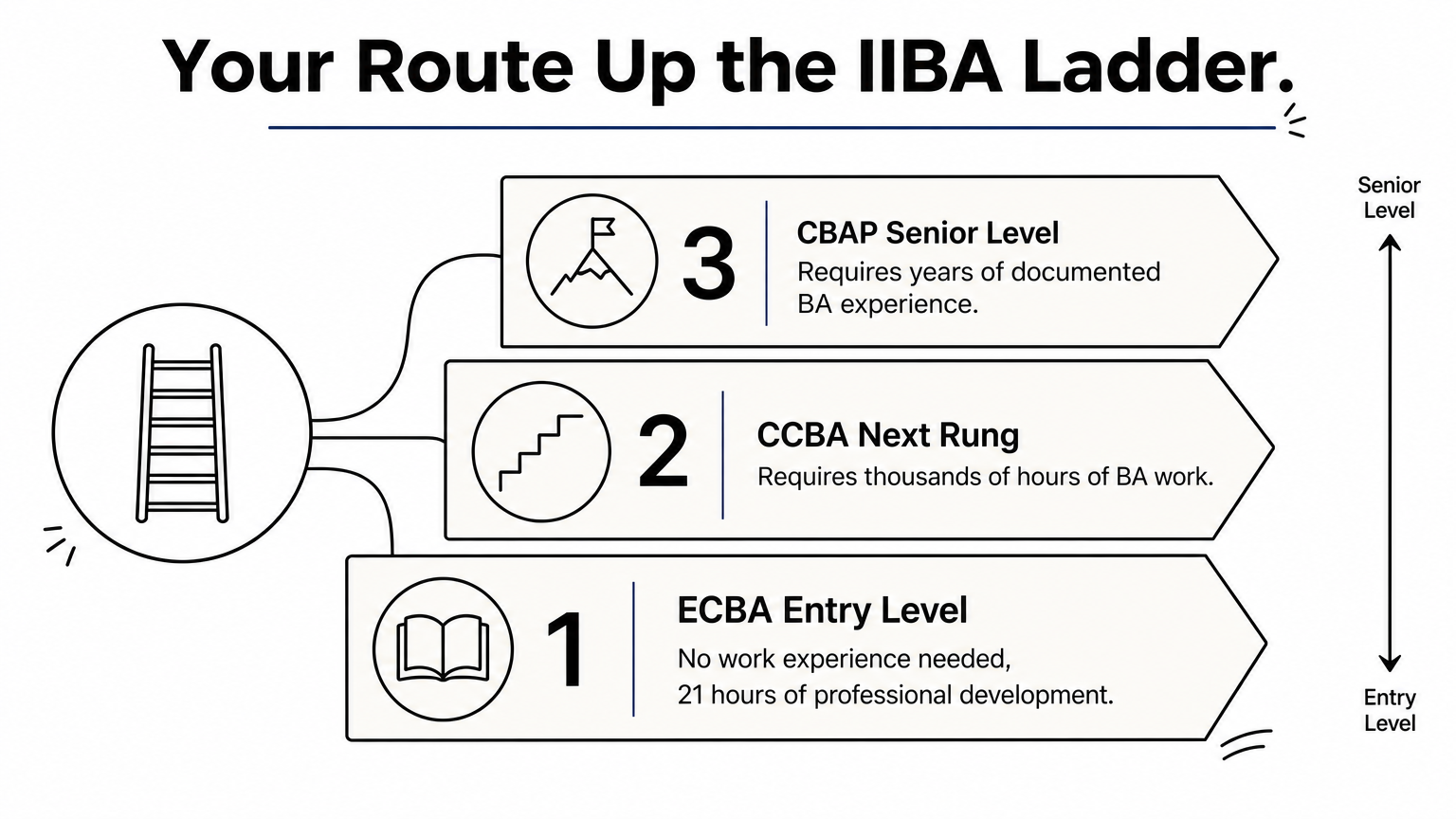
The ECBA comes from the International Institute of Business Analysis. It tests knowledge of the BABOK Guide, the international standard for business analysis. It is the only IIBA certification aimed at people with no BA work history.
The ECBA is the cheapest way to show you understand how BA is practised worldwide.
Who it suits
It suits people who want an internationally recognised credential, perhaps to work for global employers or move abroad later. It is also the first rung of the IIBA ladder. Later certifications such as the CCBA and CBAP require thousands of hours of BA work, so the ECBA is where you start.
Cost, time and hiring value
You need no work experience, but you do need 21 hours of professional development in the last four years. A course from an IIBA-endorsed provider normally covers that. Check the IIBA site for the current exam fee, as it changes. In the UK, BCS is mentioned more often in job adverts. The ECBA still helps if you target multinational firms.
4. AgileBA Foundation certificate
What it is

AgileBA is a business analysis certification built for agile delivery teams. It covers how a BA works within Scrum and similar frameworks: user stories, prioritisation, iterative requirements and constant stakeholder feedback. The Foundation level is the entry point and has no prerequisites.
If the job advert says Scrum or sprints, an agile credential speaks to it directly.
Who it suits
Choose it if you are aiming at software teams or digital transformation roles, where almost every BA works in an agile way. It is also a good second certificate after the BCS Foundation or ECBA. On its own, it assumes you already understand basic BA concepts.
Cost, time and hiring value
Prices depend on the training provider, so compare accredited ones. It adds the most value when your first certification covers general BA techniques and AgileBA shows you can apply them in sprints. It is a useful extra, but not the best first step for a complete beginner.
Where to start
If you have no experience, combine proof of knowledge with proof of practice. A recognised exam such as the BCS Foundation or ECBA shows you understand the discipline. Hands-on projects show you can do the work. An agile credential then sharpens your fit for specific roles.
The quickest way to cover both knowledge and practice is a programme that builds them together. If you want certification, real project experience and help with your CV and job search in one place, take a look at our business analysis training programme and book an enquiry call. We will talk through your background and tell you honestly which route fits.


