


Business Analyst Course Syllabus: 8 Core Modules to Expect
Need More Help? Book Your FREE Strategy Session With Our Career Coaches Today!
A good business analyst course syllabus covers eight areas: the BA role, strategy analysis, elicitation, requirements, process modelling, data analysis, Agile delivery and solution evaluation. The best syllabuses teach them through practice, not slides. If you are changing career with no tech background, pick a programme that ends in a recognised foundation certification and a live project. If you already work close to data, put more weight on the tooling modules.
The problem is that syllabuses look alike on sales pages. Some follow the IIBA body of knowledge, some read like a data science course with a business analyst label, and few say what each module lets you do at work. That makes two programmes very hard to compare.
This article walks through the eight modules in the order you normally meet them. For each one you get the topics, the tools and the skills it should leave you with. The last section gives you a checklist for judging any programme before you pay. We train career changers into business analysis at Transform Learning Academy, so the emphasis here is on what a newcomer needs to be employable.
1. Business analysis fundamentals and the BA role
The first module of a business analyst course syllabus explains what a business analyst does and how a change moves from problem to delivered solution. Every later module hangs off it, so it should be short and precise.
What it covers
This module separates the BA role from neighbouring jobs and introduces the business analysis process. IIBA's BABOK Guide, which many syllabuses follow, groups the work into six knowledge areas. Expect these topics:
- The BA role, and how it differs from project manager, product owner and developer
- The path from problem to solution, and who signs off at each step
- The six BABOK knowledge areas, from planning to solution evaluation
- Planning your approach and agreeing the scope of your analysis
Tools and techniques
Little software appears here. You work mostly with templates and a realistic scenario, and a good course makes you complete them rather than read about them.
- A business analysis approach document in Word or Confluence
- A glossary of project terms
- A stakeholder register in Excel
Skills you should leave with
You should be able to explain the role in an interview without jargon and plan the analysis activities for a small change.
- Describe a BA's day to a non-technical friend
- Name the six knowledge areas
- Draft a one-page analysis plan
Fundamentals matter because every other module assumes you know where your work starts and stops.
2. Strategy analysis and business context
Strategy analysis teaches you to understand why a change is wanted before you document what it should do. This module of a business analyst course syllabus is where weak programmes tend to skimp.
What it covers
You learn to describe the current state, the desired future state and the gap between them. Frameworks give you a structured way to look at the organisation and its environment.
- SWOT and PESTLE analysis
- Porter's Five Forces, in many syllabuses
- Defining objectives, critical success factors and KPIs
- Writing a clear problem statement
Tools and techniques
This is mostly frameworks on a page. Expect Word, PowerPoint or a whiteboard tool rather than specialist software.
- SWOT and PESTLE templates
- A gap analysis table
- A KPI list with owners and targets
Skills you should leave with
By the end you can link a request to a business goal. That protects you from building something nobody needs.
- Turn "we need a new system" into a stated problem
- Define two or three measurable success criteria
- Show how a change supports a strategic objective
Strategy analysis is the module that stops you documenting a solution to the wrong problem.
3. Stakeholder analysis and elicitation
Elicitation is the skill of getting accurate needs out of busy people. A strong business analyst course syllabus gives it a full module and real practice, because most project failures start with missed or misunderstood needs.

What it covers
You first work out who matters and how much, then choose a technique to draw out what they need.
- Stakeholder identification and the power and interest grid
- RACI charts for roles and responsibilities
- Interviews, workshops, surveys and observation
- Document analysis and prototyping
Tools and techniques
Most elicitation today happens remotely, so a good course uses Teams or Zoom for practice sessions, not just theory. Preparation is the real technique.
- Interview guides and question banks
- Workshop agendas and facilitation notes
- Stakeholder register in Excel
Skills you should leave with
You should be able to run a 45-minute interview and a short workshop, then record the outcome so others can act on it.
- Prepare open questions for an interview
- Handle a dominant voice in a workshop
- Write up decisions and open actions the same day
Elicitation is a people skill with a method behind it, so insist on practice, not slides.
4. Requirements analysis and documentation
This module turns what stakeholders say into requirements that a team can build and test. It is the heart of any business analyst course syllabus and usually the largest module.
What it covers
You learn the difference between business, functional and non-functional requirements, and how to write each so nobody can read it two ways.
- User stories, use cases and acceptance criteria
- Prioritisation with MoSCoW
- Traceability from need to requirement to test
- Validation and sign-off
Tools and techniques
Tools here are about storing and tracking requirements. The skill is in the wording, not the software.
- Jira for backlog items
- Confluence or Word for requirement documents
- An Excel traceability matrix
Skills you should leave with
The test is whether you can write a requirement that can fail a test. Compare these two:
- Weak: "The portal should be fast."
- Testable: "The account page loads in under three seconds for 95% of requests."
You should also be able to prioritise a list of 20 requirements with MoSCoW and defend your choices.
A requirement that cannot be tested is an opinion, and good courses train you to spot the difference.
5. Business process modelling
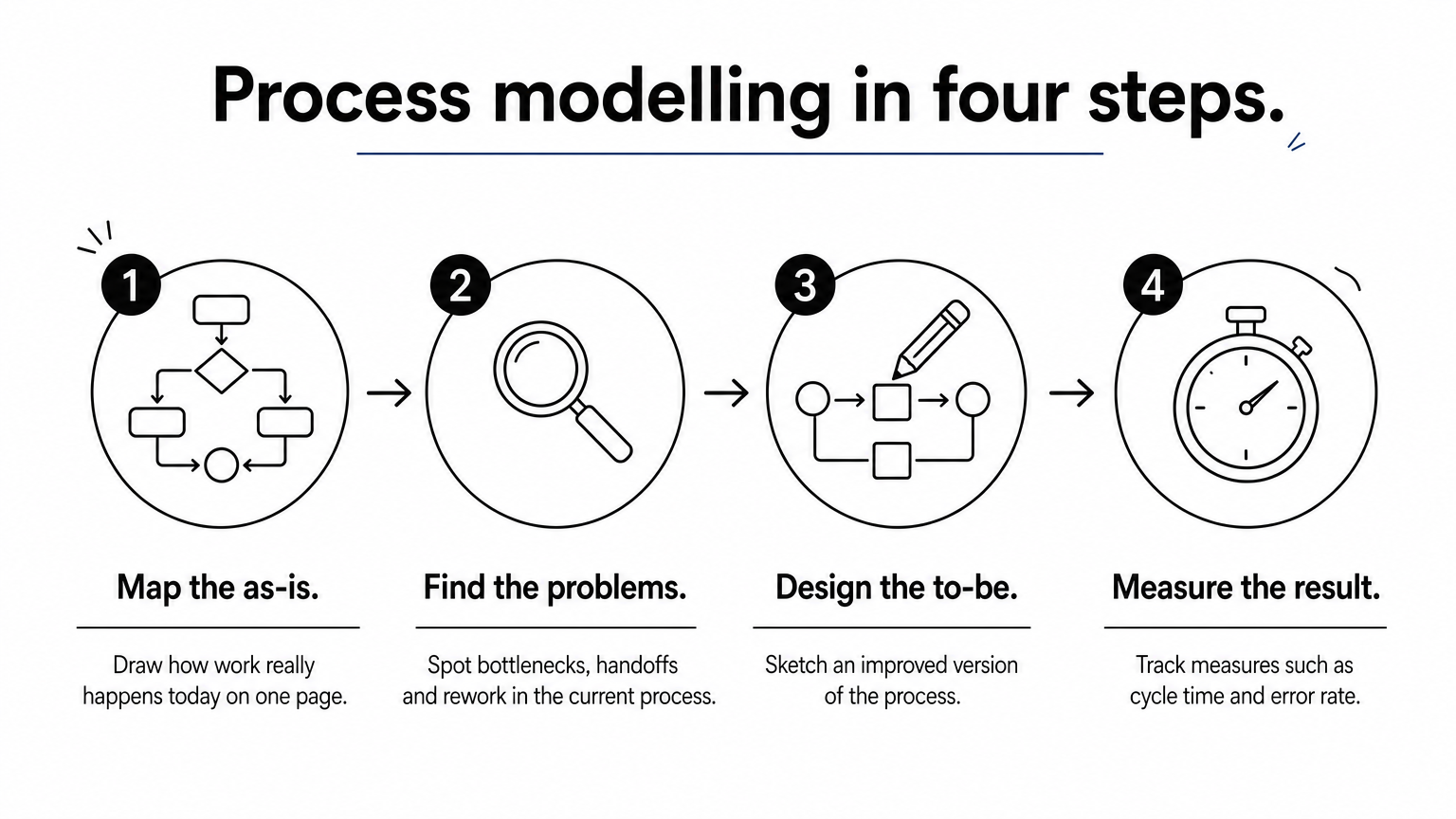
Process modelling teaches you to draw how work really happens and how it could happen better. In a business analyst course syllabus it is the module that produces the most visible portfolio pieces.
What it covers
You map an as-is process, find the problems, then design a to-be process. Notation matters less than clarity.
- Flowcharts and swimlane diagrams
- BPMN basics
- Finding bottlenecks, handoffs and rework
- Process improvement and measuring the result
Tools and techniques
Courses normally pick one drawing tool and stick with it. Expect Microsoft Visio, Lucidchart or Bizagi, and learn the principles so you can switch.
- Visio or Lucidchart for diagrams
- Bizagi for BPMN modelling
- Process measures such as cycle time and error rate
Skills you should leave with
You should leave able to map a process on one page that a manager can read in two minutes.
- Interview someone and draw their process
- Spot the three biggest delays in it
- Propose and sketch an improved version
A process model earns its place only if the person who does the work recognises it as accurate.
6. Data analysis and reporting
Business analysts do not need to be data scientists, but they must use data to support a case. This module of a business analyst course syllabus covers the tools that most job adverts ask for.
What it covers
Expect a practical grounding in Excel, SQL and a dashboard tool, plus the habit of checking data quality before trusting it.
- Excel formulas, lookups and pivot tables
- SQL basics for pulling data from databases
- Charts and dashboards in Power BI or Tableau
- Data quality checks and sensible KPIs
Tools and techniques
SQL is the item worth singling out, because a few lines let you answer questions without waiting for a developer. A typical beginner exercise looks like this:
SELECT region, COUNT(*) AS orders
FROM orders
WHERE order_date >= '2026-01-01'
GROUP BY region;
Skills you should leave with
You should be able to answer a business question with numbers and present the result clearly.
- Build a pivot table from a raw export
- Write a query with a join and a filter
- Make a one-page dashboard for a non-technical audience
For a BA, Excel and SQL carry most of the weight, and Python is a bonus rather than a requirement.
7. Agile and delivery methods
Most analysts now work in teams that deliver in short cycles, so this module teaches you to work inside Agile and waterfall projects. A business analyst course syllabus that ignores Agile is out of date.

What it covers
You compare plan-driven and iterative delivery, then learn how the BA contributes to each.
- Waterfall versus Agile, and hybrid setups
- Scrum roles, events and artefacts
- User stories and backlog refinement
- Working alongside a product owner
Tools and techniques
Teams usually track work in a shared tool, so expect hands-on practice with Jira and Confluence, and sometimes Trello. The user story format is the technique you will use most:
- "As a [type of user], I want [a goal], so that [a benefit]."
- Acceptance criteria written as clear pass or fail statements
- Story splitting to keep items small
Skills you should leave with
You should be able to write and refine stories a development team can estimate and test.
- Turn a requirement into three small stories
- Run a backlog refinement session
- Explain what a BA adds in a Scrum team
Agile does not remove the need for analysis, it moves analysis into every sprint.
8. Solution evaluation, business case and risk
The final module asks whether the change delivered what it promised. A complete business analyst course syllabus covers options, costs, risks and testing, not just design.
What it covers
You compare options, justify one with figures, and then check the result after delivery.
- Options appraisal and cost-benefit analysis
- Payback and return on investment
- Risk registers and mitigation
- User acceptance testing and benefits tracking
Tools and techniques
Most of this work happens in Excel and a risk register. Here is a worked case: a change costs £30,000 and saves £2,500 a month. The payback period is £30,000 divided by £2,500, which is 12 months.
- Excel model for costs and benefits
- Risk register with likelihood, impact and owner
- UAT scripts and defect logs
Skills you should leave with
You should be able to recommend an option and defend it to a sponsor who asks about cost and risk.
- Build a simple business case with a payback figure
- List the top five risks and a response for each
- Check delivered work against its acceptance criteria
Evaluation closes the loop, and it is what makes your recommendations credible next time.
How to judge a syllabus before you enrol
Judge a syllabus by what you will do, not what you will watch. A topic list proves little, so test every programme against the same few checks.
Check the content, tools and practice
Compare the syllabus with the eight modules above. A Python-heavy course with machine learning and deep learning is a data analyst course, whatever it is called.
| Check | Good sign | Warning sign |
|---|---|---|
| Core topics | Elicitation, requirements, process modelling, strategy | Mostly Python, machine learning, deep learning |
| Tools | Excel, SQL, Visio or Lucidchart, Jira, Power BI or Tableau | Tools named with no exercises |
| Practice | Live project, assignments with feedback | Videos and quizzes only |
| Certification | BCS Foundation or IIBA-aligned, exam fee stated | Certificate of completion only |
| Support | Named trainers, CV and job-search help | None stated |
Check certification and time
For a newcomer, the BCS Foundation Certificate in Business Analysis is a common starting point. IIBA's ECBA is its entry-level credential, while CCBA and CBAP suit people with work experience. Ask what happens if you fail an exam, because resit fees vary and ours are charged separately.
Also work out the hours. A course of three months at about 5 hours a week is roughly 60 to 65 hours of study. Compare that with your free time before you commit.
Where Transform Learning Academy fits
Our Certified AI Business Analysis Training Course is three months with no prerequisites. It has a 2 day live business analysis training session, preparation for the BCS business analysis foundation certification exam, and live business analysis project experience. You can run the checks above on it yourself.
Choose the programme that makes you practise the work and gives you a certificate employers recognise.
Choosing the syllabus that fits you
A strong business analyst course syllabus moves from the BA role through strategy, elicitation, requirements and process modelling to data, Agile delivery and evaluation. It adds a live project and a recognised certification. Treat anything that skips most of those modules, or buries them under advanced data science, as a different course with a different outcome.
Use the table in the last section to score the programmes you are considering. Then ask each provider to show you a sample deliverable from a project, since the quality of that work tells you more than the module titles do.
If you are changing career and want a three-month route with a live project and a BCS foundation exam, read the details of Transform Learning Academy's Business Analysis Programme and compare it against your checklist.


