


Contract Business Analyst Jobs: 5 UK Niches and Day Rates
Need More Help? Book Your FREE Strategy Session With Our Career Coaches Today!
The best business analyst jobs contract roles are the ones that match your domain experience and your tax situation, not simply the ones with the highest day rate. Financial services and ERP platforms pay well for specialists. Government and defence suit analysts who already hold security clearance. Data and digital transformation roles suit analysts who enjoy process and product work. Advertised rates mostly sit between £450 and £650 a day, with platform specialists going higher.
The difficulty is that job boards show hundreds of contract adverts with inconsistent rate labels, IR35 status buried in the small print and no hint of which niche fits you. This guide first explains how day rates, IR35 and contract length work. It then walks through five niches, each with what the work involves, typical rates and who it suits.
At Transform Learning Academy we train career changers into business analysis, so we know how many readers arrive here from a first BA role or a permanent post. Most contract adverts ask for several years of experience. Use this as a map of where that experience pays best.
How day rates, IR35 and contract length work
A contract analyst is paid for each day worked, so a headline rate means little until you know the IR35 status, the contract length and what the client expects on site. Read those three details before you compare any two adverts.
What a day rate is worth against a salary
Day rates look large because they exclude paid holiday, sick pay, pension and the gaps between contracts. Job-board data puts the average advertised business analyst salary at about £52,500, in a range of roughly £42,500 to £77,500. The table shows what common rates turn into over 220 billable days, which is about 44 working weeks.
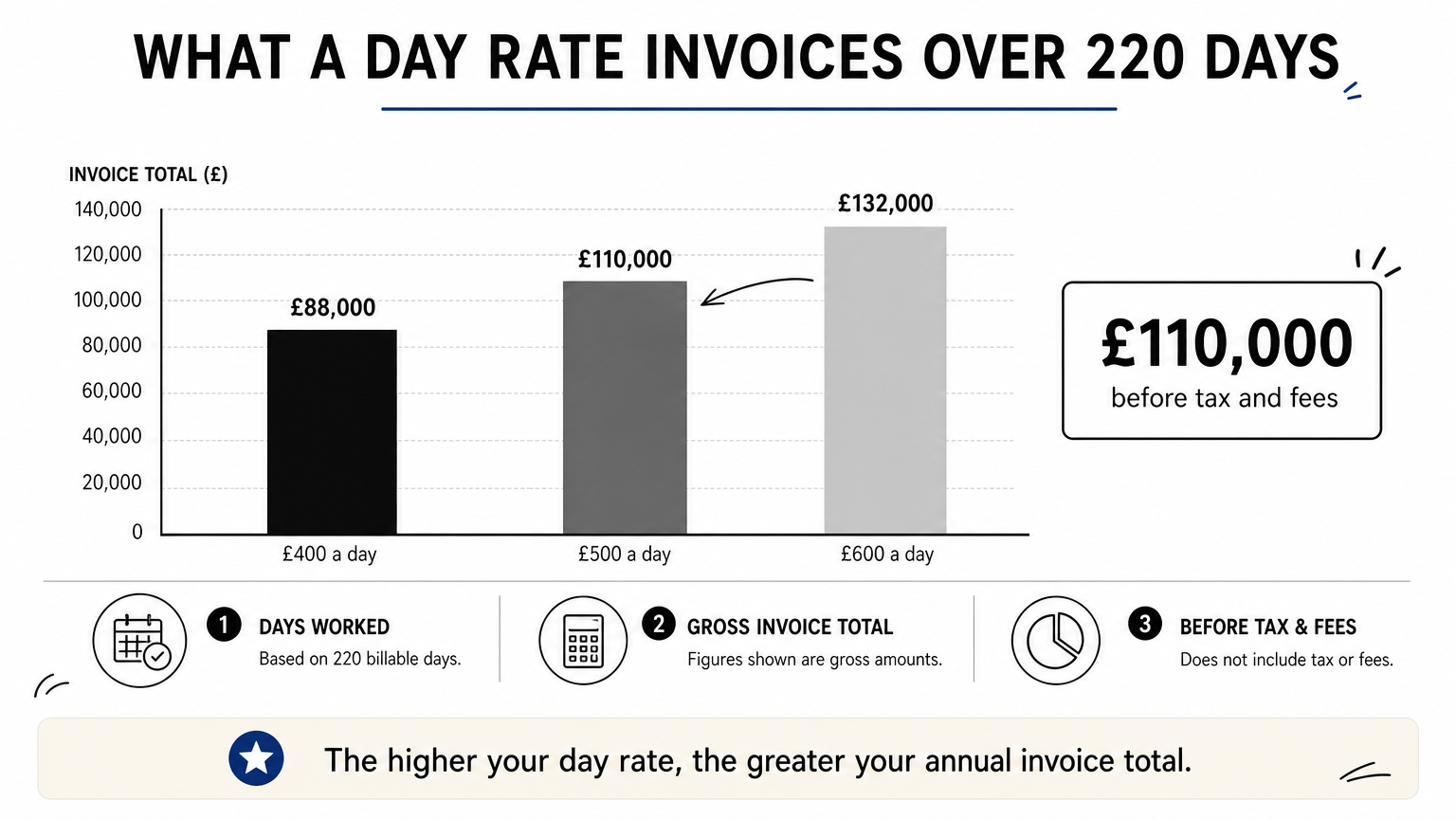
| Day rate | Billable days | Gross turnover |
|---|---|---|
| £400 | 220 | £88,000 |
| £500 | 220 | £110,000 |
| £600 | 220 | £132,000 |
At £500 a day you would invoice £110,000 over 220 days, about double the average salary. That figure is before tax, accountancy or umbrella fees, and before any weeks without work.
A day rate is turnover, not take-home pay.
What IR35 status means for your pay
Outside IR35 means you can invoice through your own limited company and pay yourself as a business owner. Inside IR35 means you are taxed much like an employee. Tax and National Insurance come off before you are paid, usually through an umbrella company, which is why some adverts say "umbrella only". An inside rate of £500 therefore leaves you noticeably less than an outside rate of £500.
Since April 2021, medium and large private-sector clients, and public bodies since April 2017, must decide your status and give you a written status determination. Small private companies leave that decision to you. HMRC publishes a check employment status for tax tool that helps you test a role.
Where to find current openings
Reed, Indeed, LinkedIn, CWJobs, CityJobs and ContractorUK all carry contract listings, and specialist recruiters such as Robert Walters advertise roles directly. London and the South East account for most adverts, with regular demand in Manchester, Birmingham, Leeds, Edinburgh, Bristol and Cheltenham. Hybrid with one to three office days is the usual pattern, and fully remote roles exist but are fewer. Before you apply, check these details in each advert:
- The rate label, because some adverts show a day rate as "per annum" by mistake
- IR35 status, stated as inside or outside
- Security clearance, such as BPSS, SC or eDV
- Initial contract length and the chance of extension
- Office days per week and the office location
1. Financial services and regulatory change
What the role involves
Banks, insurers, pension providers and asset managers hire contract analysts for change work they cannot staff permanently. That means regulatory programmes, know-your-customer (KYC) and financial crime upgrades, product launches and policy administration projects. You write requirements, run workshops and keep traceability from the regulation or business need through to testing.
This is one of the busiest areas for business analyst contracting jobs, with demand in London, Milton Keynes, Birmingham and Leeds. Contracts usually run between three and twelve months, and two or three office days a week is common.
Rates, IR35 and who it suits
Advertised rates run from about £450 to £575 a day. Banking roles are often inside IR35, while some pensions and regulatory work is outside. It suits analysts with domain knowledge of a regulated sector, because clients want someone productive in week one. Recent adverts have included:
- Hybrid financial services roles in Milton Keynes at £500 to £575 a day, inside IR35
- Pensions and regulatory change in Wolverhampton at £450 to £500 a day, outside IR35, for nine months
- A general insurance programme at £550 to £600 a day, inside IR35, for six months
In financial services, domain knowledge is the skill clients pay the premium for.
2. Government and public sector
What the role involves
Central government departments, local authorities and public bodies run digital, case-management and service-redesign programmes. Typical work covers Dynamics 365 case management, Workday HR and finance rollouts and local authority service modernisation. Adverts often ask for active SC clearance and five or more years of business analysis experience.
Hybrid working is standard, with offices in London, Bristol, Warrington and other regional hubs. Some programmes, including a nuclear new-build resilience role, are mostly remote with occasional site attendance.
Rates, IR35 and who it suits
Most advertised rates sit at £450 to £500 a day. Public bodies have applied the off-payroll rules since April 2017, so inside IR35 is common, although outside roles do appear. Cleared analysts have the widest choice. If you are not cleared, look for roles that ask only for BPSS checks. Examples include:
- Central government Dynamics 365 case management, London hybrid, £450 to £500 a day, outside IR35, SC required
- Workday HR or finance for central government, £450 to £500 a day, outside IR35, six months initially
- A public sector programme at £470 a day, inside IR35, for five months
- A London local authority service redesign at up to £500 a day, inside IR35
- A Bristol SC-cleared role leading a small analyst team at £300 to £350 a day, which shows how far rates can vary
Public sector rates are steadier than private sector ones, but clearance decides whether you can apply at all.
3. Defence and aerospace with clearance
What the role involves

Defence primes and technology consultancies need analysts for systems engineering requirements, testing and IT service management and digital engineering programmes. Work clusters around Cheltenham, Corsham, Reading and Manchester, with hybrid patterns that range from one or two days a week on site to a few days a month.
Adverts ask for active SC or eDV clearance as a hard requirement. Clearance is normally sponsored by an employer or contract, so you generally cannot apply for it yourself. That keeps the candidate pool small and rates firm.
Rates, IR35 and who it suits
Rates run from about £480 to £600 a day. Outside IR35 is common on the longer contracts, and twelve-month initial terms are not unusual. The niche suits analysts who already hold clearance and have a systems, testing or service management background. Examples:
- eDV-cleared business analyst roles in Cheltenham, Manchester and London at up to £550 or £600 a day, outside IR35, for 12 months initially
- SC-cleared testing and ITSM analysis in Corsham at £480 to £500 a day, outside IR35
- SC-cleared digital engineering analysis in Reading at up to £67 an hour, inside IR35
In defence, your clearance is the qualification that matters most.
4. ERP and finance platform specialists
What the role involves

These analysts map business processes onto platforms such as SAP, Dynamics 365 Finance, Workday and Charles River, or onto Salesforce and ERP integrations. You run fit-gap workshops, write user stories, define test scenarios and support user acceptance testing. Clients range from retailers and universities to asset managers.
Contracts tend to be short, often two to six months for a defined migration or implementation phase, with twelve-month terms for programme workstream leads. Many roles are hybrid or fully remote, which widens your search beyond London.
Rates, IR35 and who it suits
This niche pays the most. Rates start around £450 and commonly reach £600 to £700, and a Charles River implementation role was advertised up to £850 a day. It suits analysts who have seen at least one platform through go-live, ideally with finance process knowledge. Examples:
- A Dynamics 365 Finance migration at £525 to £550 a day, outside IR35, for two months
- SAP Funds and Grants analysis at up to £600 a day, outside IR35, for five months
- A senior SAP workstream lead at £600 to £700 a day, inside IR35, for 12 months
- A Charles River implementation at £700 to £850 a day, inside IR35, for six months
Platform experience is the biggest single lever on your day rate.
5. Data, digital and process transformation
What the role involves
Here the work centres on data and MI requirements, process mapping and digital products. That includes BPMN future-state process maps, Microsoft Fabric implementations, customer app platforms and AI-enabled transformation programmes. You translate stakeholder needs into data definitions, journeys and backlog items.
These roles are the most remote-friendly in this list. Several are fully remote or predominantly remote, and the rest ask for two or three office days. Contract lengths run from three months to over a year.
Rates, IR35 and who it suits
Rates run from about £450 to £650 a day, with senior analysts at the top. The niche suits analysts coming from data, product or process improvement backgrounds. Examples:
- A Microsoft Fabric implementation in Berkshire at up to £500 a day, outside IR35, for three to six months
- A customer loyalty and mobile app platform in Birmingham at £450 to £500 a day, outside IR35, for six months
- Process mapping in London at £550 to £650 a day, inside IR35, umbrella only, for four months
- A senior analyst on an AI-enabled transformation programme at £600 to £650 a day, inside IR35, predominantly remote
Data and process skills open the most remote contracts, and seniority sets the rate.
Picking your contract niche
Contract business analyst work pays well, but the rate alone decides little. Start with the niche where your experience or clearance is already valuable, check IR35 status before you compare offers, and read the rate label carefully. Then apply with a CV that names the platforms, regulations and programmes you have delivered.
If you are not yet working as an analyst, the sensible route is to build that experience first. Our Business Analysis training with live project experience takes around three months at about five hours a week with no prerequisites. It combines two days of live training, the BCS Business Analysis Foundation certification exam and live business analysis project experience, which gives you something concrete to put on a CV.


