


UK Business Analyst Jobs for Graduates: 5 Places to Look
Need More Help? Book Your FREE Strategy Session With Our Career Coaches Today!
The best business analyst jobs for graduates come through five channels: graduate schemes, job boards, employer career pages, recruitment agencies and adjacent analyst roles. A good pick matches your timing and your background. Schemes suit final-year students who can apply months ahead. Job boards suit anyone who wants volume quickly. Career pages and the public sector suit people who want published pay bands. Agencies suit a fast start, and adjacent roles suit graduates whose degree is unrelated. Advertised starting salaries mostly sit between about £26,000 and £40,000.
The hard part is rarely a shortage of adverts. A search for "graduate business analyst" returns a mix of true entry-level roles, senior jobs that mention the word "business", and "trainee" adverts that turn out to be paid courses. Many entry roles also avoid the exact title and say graduate analyst, systems analyst or data analyst instead.
At Transform Learning Academy we train people for business analysis careers, so we see the same job-hunt questions again and again. Each section below covers how the channel works, what it pays and who it suits, so you can decide where to spend your application time.
1. Graduate schemes at large employers
Graduate schemes are fixed-intake programmes run by banks, consultancies, insurers and professional services firms, and they are the most structured way into business analysis. You apply in a set window, join in a cohort and get training on the job.
How it works
Applications usually open in the autumn for a start the following September, so a final-year student should apply months before graduating. Some schemes place you directly in a business analysis or data transformation stream. Others rotate you through teams, with business analysis as one placement.
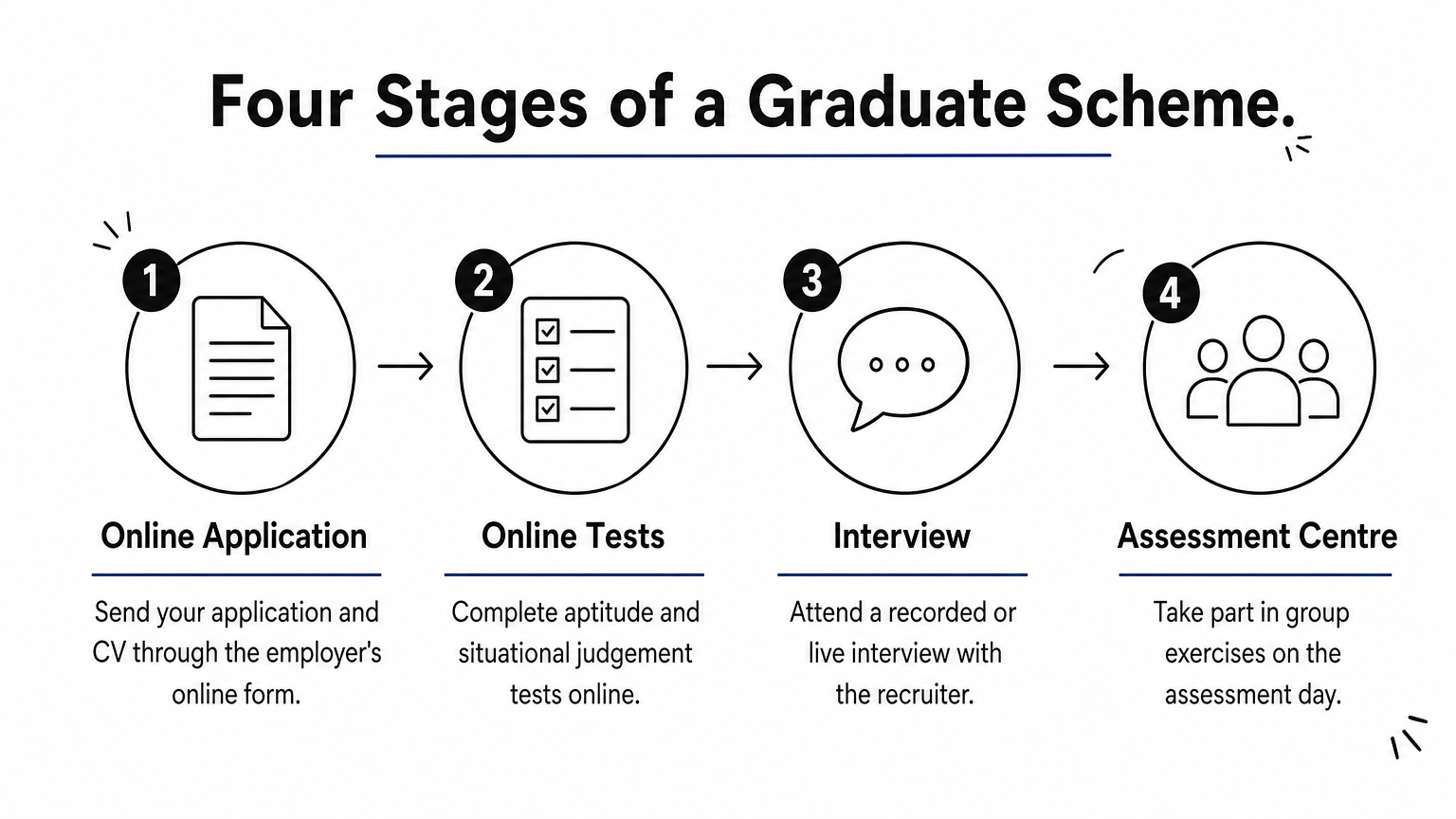
Expect a staged process:
- An online application and CV
- Online aptitude and situational judgement tests
- A recorded or live interview
- An assessment centre with group exercises
Many employers fill places on a rolling basis, so apply early in the window rather than at the deadline.
Pay and who it suits
Many schemes advertise pay as "competitive" rather than a figure. Where a number is shown, it often starts in the high £20,000s and rises with the employer and the specialism. Many ask for a 2:1, though requirements vary, so read each advert.
Schemes suit final-year students and recent graduates who can plan ahead and want a defined career path. They suit you less if you have already missed the autumn window, because most cohorts will be full.
Apply to graduate schemes in the autumn before you finish, because the best ones fill early.
2. Job boards with graduate filters
Job boards give you the widest view of openings at any time. Indeed, Reed, Totaljobs, Milkround and Glassdoor all carry entry-level analyst roles, and each lets you filter by area, salary and posting date.

How it works
Search several job titles, because employers label entry roles differently:
- graduate business analyst
- junior business analyst
- graduate business systems analyst
- graduate analyst
- graduate data analyst
Then set a daily alert for each search and filter to roles posted in the last seven days. Fresh adverts get the most attention from recruiters, so a quick application beats a perfect one sent two weeks late.
Be careful with adverts titled "Trainee Analyst, no experience needed" that quote £30,000 to £65,000. Many are self-funded training programmes where you pay course fees, not salaried jobs. If the advert says fees apply, treat it as a course and judge it on price and outcomes.
Pay and who it suits
Genuine graduate and junior analyst adverts usually fall between about £26,000 and £35,000, with higher figures for technical or finance-heavy roles. Boards suit anyone who wants volume and flexibility, including graduates from past years. They suit you less if you need guidance, because the quality of adverts varies widely.
Search by several job titles and set alerts, because the right role is rarely labelled "business analyst".
3. Employer career pages and public sector sites
Going straight to employers finds roles that never reach a board, or that appear there days later. Banks, insurers, utilities, retailers, manufacturers, the NHS, local councils and the Civil Service all hire analysts directly.

How it works
Build a target list of 15 to 20 employers in one or two sectors and check their careers pages on a regular schedule. Pick sectors where you can say something informed in an interview, such as the one you studied or worked part-time in.
Public sector adverts are the most transparent. Civil Service roles state the grade, the salary band and the pension contribution up front. Analytical roles at Higher Executive Officer grade have been advertised at around £36,000 to £40,000 in some recent adverts.
Pay and who it suits
Private employers often write "competitive" and negotiate. Public bodies publish fixed bands, which makes comparing offers simple. This channel suits graduates who want a specific industry, value pay transparency or like structured progression. It takes more effort than a board, because you do the searching yourself.
A target list of employers beats scrolling job boards, because you hear about roles before the crowd does.
4. Recruitment agencies and consultancy academies
Agencies and consultancy academies both place graduates quickly, but in different ways and at different costs to you.
How it works
Recruitment agencies are paid by the employer, so registering costs you nothing. Register with three or four that specialise in technology, finance or change roles, and send a short CV that names the business analysis tasks you have done. They fill junior analyst roles and short interim graduate contracts, sometimes within days.
Consultancy academies work differently. They hire you, train you for a few weeks, then place you with client companies. Starting pay is often lower, with some adverts around £25,000, in return for guaranteed placement.
Pay and who it suits
Agencies often quote £30,000 to £35,000 for junior analyst roles. With an academy, read the contract for any clause that requires you to stay for a set period or repay training costs if you leave early.
Agencies suit graduates who want speed and are happy to take interim work. Academies suit those who want a guaranteed start and accept the trade-off in pay and flexibility.
Take a placement-based job only after you have read the minimum-service and repayment terms in the contract.
5. Adjacent analyst roles and apprenticeships
Many people become business analysts by starting in a neighbouring role and moving across after a year or two. This channel widens your search, because the entry-level BA title is scarce while the skills transfer easily.
How it works
Search for business systems analyst, data analyst, business intelligence analyst, finance analyst and operations analyst roles. All involve gathering requirements, mapping processes and reporting to stakeholders. After 12 to 24 months you can apply for BA roles with proof of the same work.
Degree apprenticeships are another route. Some consulting firms run three-year programmes that combine university study with client work. Apprenticeship pay can start well below graduate-scheme pay, but you finish with a degree and work history.
Pay and who it suits
Pay follows the adjacent role, so junior data and finance analyst roles often sit in the low to mid £30,000s. This channel suits graduates whose degree is unrelated or who cannot find a BA title. If you lack project history, a qualification can close the gap. Our Certified AI Business Analysis Training Course takes three months at about five hours a week and covers live training, the BCS business analysis foundation exam and live project experience.
If the BA title is scarce, apply for the neighbouring analyst role and move across later.
Pick two channels and start applying
Business analyst jobs for graduates sit in five places. Graduate schemes reward early planning, job boards give volume, employer career pages give transparency, agencies give speed, and adjacent roles give a way in when the title is scarce. Most graduates do best by combining two channels, for example a board with alerts plus a target list of employers.
Whichever you choose, search several job titles, check whether an advert is a job or a fee-paying course, and tailor your CV to the tasks the advert lists. If you want a recognised qualification and live project experience on your CV first, look at our business analysis certification and live project course.


