


Business Analyst Jobs Pay: What UK Analysts Earn and Need
Need More Help? Book Your FREE Strategy Session With Our Career Coaches Today!
Business analyst jobs pay about £24,000 to £33,000 at junior level, £35,000 to £65,000 with a few years' experience, and £80,000 or more for senior specialists in finance, consulting and technology. The median across advertised UK vacancies sits near £55,000. London pays more, and experienced contractors can charge £400 to £550 a day.
A business analyst studies how an organisation works, finds where its processes, systems or data fall short, and recommends changes that save money or improve service. You sit between the business and the technical teams. That bridging role is why employers pay well for it.
This guide covers pay at each career stage, how location, sector and contract work shift it, what the job involves day to day, and what employers ask for. It finishes with a practical route in from another career. Transform Learning Academy trains career changers into analysis roles, so the focus stays on routes that do not need a tech background.
Why business analyst jobs pay well in the UK
Business analysts earn well because they link business problems to technical fixes, and a wrong recommendation costs an employer real money. Pay also climbs steeply with experience. Published UK figures put a graduate at £24,000 to £33,000 and a senior analyst at £55,000 to £80,000.
Salary by experience level
The table sets the typical UK ranges side by side. They are guides, not promises, because employer, sector and location all move them.

| Level | Typical annual salary |
|---|---|
| Junior or graduate | £24,000 to £33,000 |
| Mid-level (a few years' experience) | £35,000 to £65,000 |
| Senior analyst | £55,000 to £80,000 |
| Director or top specialist | £60,000+, over £100,000 in finance and consultancy |
Different datasets give different spans. Averages across UK job listings run from roughly £30,000 to £71,000. Government careers guidance puts the range lower, at £23,000 to £55,000. Treat the upper figures as what strong performers in well-paying sectors reach.
Here is an illustrative path. You start at £28,000 as a junior, reach £42,000 after three or four years, and move to £60,000 as a senior. That is more than double your starting salary.
Expect to start in the high £20,000s and to double that over a career, faster in finance or consulting.
What pushes the pay up
Specialism matters. Systems, data and product-focused analysts tend to earn more than generalists, because their technical knowledge is harder to find.
Responsibility matters too. Senior analysts present to executives, own the biggest projects and sometimes manage junior staff. Employers pay for that accountability, not for years served.
How location, sector and contract work change your pay
Location and sector can move the same job title by many thousands of pounds. London, finance, technology and consulting pay the most, while public sector bodies, charities and smaller firms tend to sit lower.
London versus the rest of the UK
Salary guides for London put typical business analyst pay between about £49,250 and £82,250. User-reported data shows a wider spread of £28,828 to £93,966 once junior and senior roles are included.
Outside London, expect figures closer to the national ranges in the table above. Some employers offer hybrid or flexible arrangements, so check whether a role really needs a London office before you assume you must move.
Sector and contract rates
Finance, technology and consultancy offer the highest ceilings, with senior pay above £100,000 in some cases. Healthcare, retail, government and education all hire analysts, usually at more modest levels.

Contracting is the other big lever. With solid experience, you can charge £400 to £550 a day depending on sector, location and expertise. Billing 220 days at those rates comes to £88,000 to £121,000 before tax. Contractors get no paid holiday, sick pay or employer pension, and they often have gaps between assignments. Compare any day rate with a salary only after allowing for those costs.
A contract rate is not a salary: subtract holidays, gaps and pension before you compare.
What a business analyst does day to day
The business analyst job description comes down to one loop: find out what the business needs, analyse it, recommend a change and help it happen. You work with colleagues and outside stakeholders, and you spend as much time talking and writing as analysing.
Core responsibilities
Most roles include these tasks:
- Interviewing managers and staff to understand what each department needs
- Documenting how current processes and systems work
- Analysing data and findings to suggest improvements
- Explaining the costs, benefits and risks of each option
- Winning agreement from senior management on the preferred approach
- Organising testing and quality checks
- Supporting staff through the change and measuring whether it worked
You also keep up with technology and industry trends, and you work alongside project managers and developers.
The job is less about spreadsheets than about turning messy business needs into a clear, agreed plan.
Job titles, hours and working pattern
Employers use many titles for similar work: business systems analyst, process analyst, digital business analyst, product owner and requirements engineer, among others. Read the duties rather than the title.
Standard hours are 37 to 39 a week, Monday to Friday, in an office, at a client's site or hybrid. Evening or overtime work appears when project deadlines or organisational change demand it.
Business analyst job requirements
Business analyst job requirements are flexible: employers want analytical ability, communication and some proof of work experience, and a degree helps but is not the only way in. You can arrive through a degree, an apprenticeship or a direct move from a related role.
Qualifications and routes in
Degree route. Any degree that builds analytical skills can work. Business management, computing, information systems, economics, finance, mathematics and data analytics are the common ones. Competition is high, so internships and placement years help.
Apprenticeship route. A Level 4 Business Analyst Higher Apprenticeship lets you earn while you learn. Some large employers also run Level 6 degree apprenticeships.
Direct entry. Several years in project management, consulting or IT can be enough to apply straight for analyst roles. Professional credentials such as the BCS Foundation Certificate in Business Analysis show knowledge, and the IIBA's CBAP suits more senior analysts. Check what employers ask for before paying for any certificate.
Skills employers look for
Employers screen for these skills:
- Communication: explaining technical points to non-technical people
- Analytical thinking: an evidence-based approach and good pattern recognition
- Stakeholder skills: collaboration and the ability to influence people
- Organisation: juggling several projects and deadlines
- Technical understanding: how systems and data work, with tools such as Excel and SQL helping
- Adaptability: a positive attitude to change
Soft skills decide who gets hired. Technical skills decide how fast you can move up.
How to move into a business analyst role
You can move into business analysis by building proof of three things: that you can analyse, that you can communicate, and that you have worked on a real project. Your previous career is an asset, not a barrier, because analysts need domain knowledge from teaching, health, policing or finance.
A practical route from another career
- List your transferable evidence. Note times you gathered requirements, analysed data or improved a process.
- Learn the framework. Study the core business analysis techniques and agile ways of working.
- Get a recognised qualification. The BCS Foundation Certificate gives employers a standard to recognise.
- Gain project experience. Volunteer for a charity or small firm, or take a live project through training.
- Rewrite your CV around outcomes. Show what changed because of your analysis.
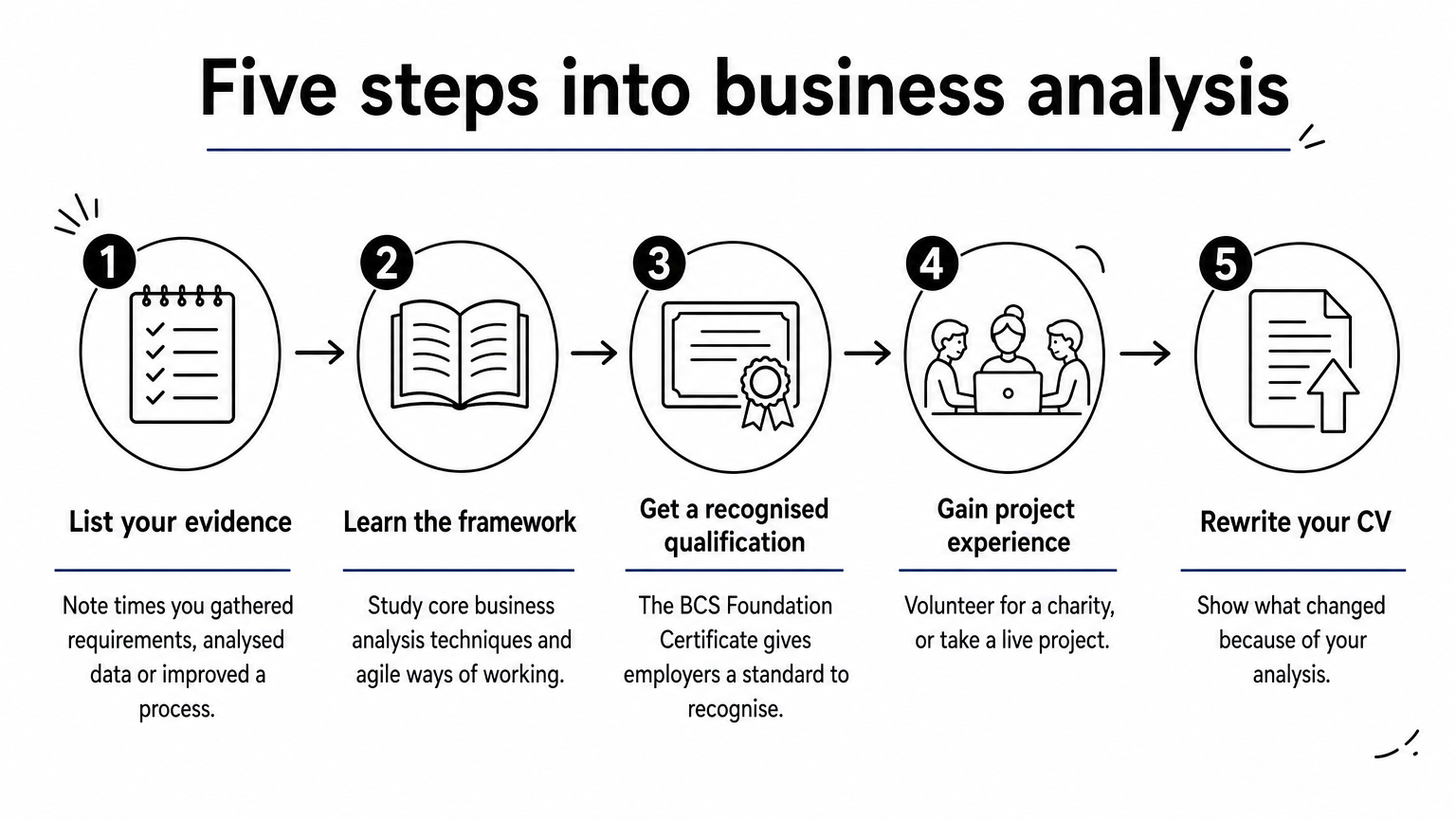
Our Certified AI Business Analysis Training Course follows this path. It runs for 3 months at an average of 5 hours a week, with no prerequisites. It includes 2 days of live training, the BCS Business Analysis Foundation exam and live project experience.
How to climb the pay bands
Once you are in, pay grows fastest when you change something deliberately. Move into a higher-paying sector such as finance. Specialise in data, systems or digital change. Take on a larger project or a junior team to qualify for senior titles. After a few years, consider contracting.
Your first salary matters less than the speed at which you add skills, projects and responsibility.
Where to go from here
Business analyst pay starts in the high £20,000s, rises to £35,000 to £65,000 within a few years, and can pass £80,000 in senior or contract roles. London, finance and technology pay the most, and a degree is helpful but not essential. What counts is evidence that you can analyse, communicate and deliver.
If you want a structured way in, the Business Analysis Programme at Transform Learning Academy combines certification, hands-on project experience and career support for people changing careers.


