


7 Business Analyst Jobs in London and the UK, with Salaries
Need More Help? Book Your FREE Strategy Session With Our Career Coaches Today!
If you are searching for business analyst jobs in London and across the UK, you probably want two things: where the roles actually are, and what they pay. Many listings are vague about both. Others demand years of experience that a career changer simply does not have.
Here is the short answer. London pays the most, with mid-level salaries typically sitting between £45,000 and £65,000, and senior roles climbing well past that. Outside the capital, cities like Manchester, Birmingham and Edinburgh offer strong pay and a growing number of remote and hybrid positions. Entry-level routes exist too, and you do not need a degree in IT to reach them.
Below, you will find seven business analyst job types, from junior BA to product and data-focused roles. For each one, we cover what the work involves, the typical UK salary range, and who tends to get hired. At Transform Learning Academy, we have helped former teachers, care workers pharmacists, customer service representatives and police officers move into these roles, so we write from what we see in real hiring.
1. Entry-level and junior business analyst
This is the door most career changers walk through. Junior and associate business analyst jobs sit inside banks, insurers, retailers, councils and consultancies, and London advertises the largest share of them.

What the role involves
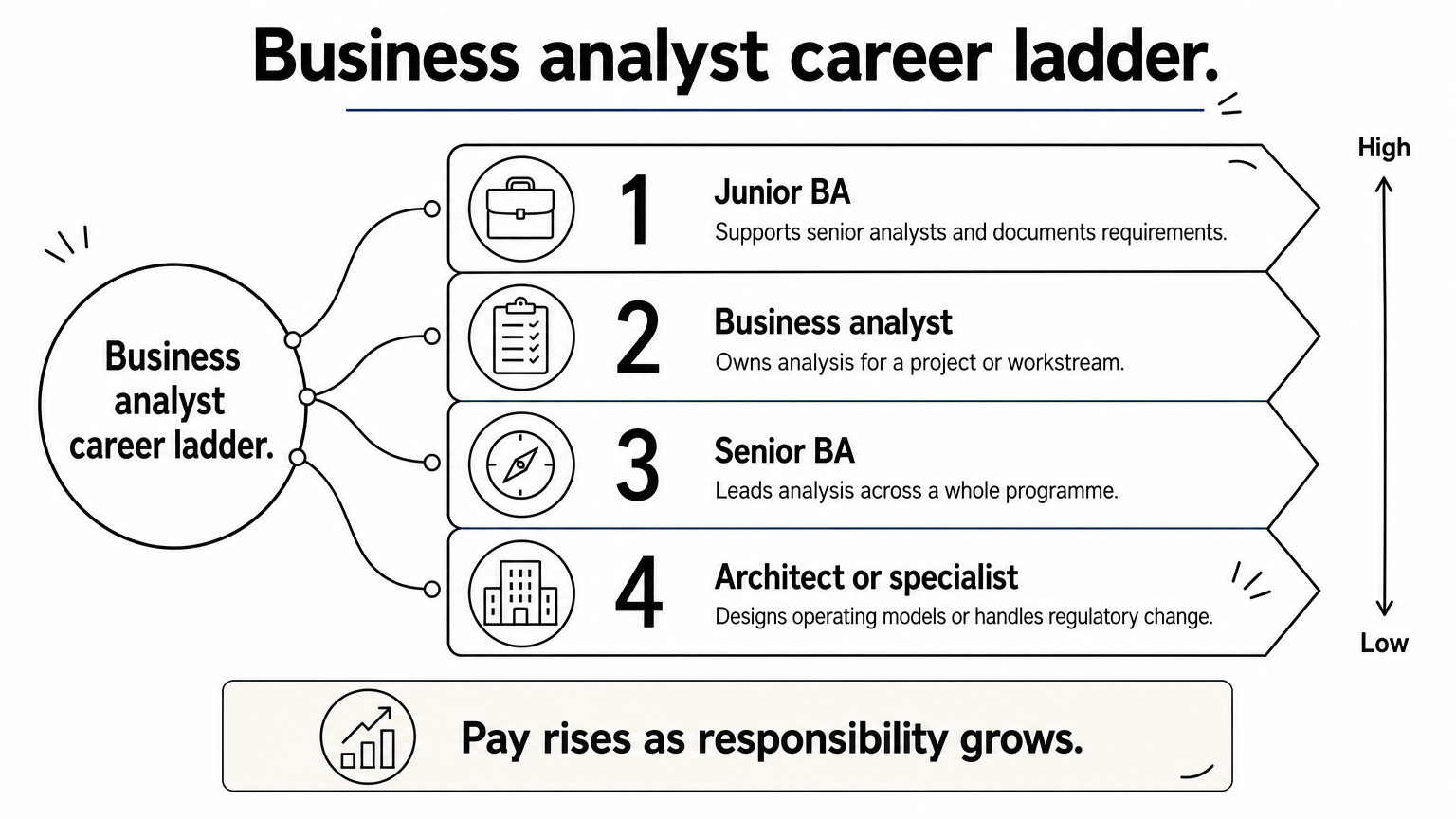
A junior BA supports a senior analyst rather than running a project alone. You gather and document requirements from stakeholders, and you help the team understand how a process works today and what should change. Typical tasks include:
- Taking notes in workshops and writing them up clearly
- Drafting user stories and acceptance criteria
- Mapping processes in Visio or Lucidchart
- Tracking work in Jira or Azure DevOps
- Supporting user acceptance testing before release
Typical salary in London and the UK
Expect £32,000 to £42,000 for entry-level business analyst jobs in London, with the upper end at financial firms. Outside the capital, pay is lower but so is the cost of living, and hybrid working or fully remote working is common.
| Location | Typical junior BA salary |
|---|---|
| London | £32,000 to £42,000 |
| Manchester, Birmingham, Leeds | £28,000 to £36,000 |
| Edinburgh, Bristol | £28,000 to £37,000 |
Treat these as ranges, not promises. Job titles such as associate analyst, graduate BA and trainee BA all land in roughly the same band.
Who it suits and how to get hired
This role suits career changers with no tech background, especially if your old job involved dealing with people, rules or processes. Teachers, care workers pharmacists, customer service representatives and police officers have all made the move, because they already know how to listen, question and write things down.
Employers rarely expect a computing degree. They want proof that you can do the work, so build a small portfolio: a process map, a set of user stories, a requirements document for a realistic project. Then rewrite your CV around transferable achievements instead of job duties. A recognised qualification from BCS or IIBA helps you pass the first screen.
Your first BA job is won with evidence of the work, not with a degree or a perfect CV.
2. Business analyst
The plain "business analyst" title covers the largest pool of vacancies, including most business analyst jobs in London. It usually asks for two to five years of experience.
What the role involves
A mid-level BA owns the analysis for a project or workstream. You act as the link between the business and the delivery team, with little supervision. Typical work includes:
- Running requirements workshops and stakeholder interviews
- Writing business requirements and functional specifications
- Analysing gaps between current and target processes
- Managing scope changes and sign-off
- Working with developers and testers through delivery
Typical salary in London and the UK
Most business analyst jobs in the UK pay £45,000 to £65,000 in London, with banks and insurers at the top of each range.
| Location | Typical BA salary |
|---|---|
| London | £45,000 to £65,000 |
| Manchester, Birmingham, Leeds | £38,000 to £52,000 |
| Edinburgh, Bristol | £40,000 to £55,000 |
Who it suits and how to get hired
This level suits junior BAs with a year or two of experience, plus people from project coordination, operations or customer-facing roles. Career changers can get here faster than they expect.
Hiring managers test whether you have handled real stakeholders and messy requirements. Prepare for business analysis interview questions with two or three examples in the situation, task, action, result format. Course projects count if they mirror genuine delivery work.
Mid-level BA interviews reward concrete stories about problems you solved, not lists of tools you know.
Check that your CV shows outcomes, such as a process cut from five days to two.
3. Senior business analyst
Senior roles are where business analyst jobs in the UK start paying seriously, and London has the deepest supply. Most employers ask for five to eight years of relevant experience.
What the role involves
A senior BA leads the analysis across a whole programme instead of a single workstream. You shape the problem before anyone writes a requirement, and you mentor junior analysts as you go. Typical work includes:
- Advising directors on options, costs and risks
- Building business cases for funding
- Coordinating several analysts and suppliers
- Setting standards for requirements and documentation
- Pushing back when scope drifts
Typical salary in London and the UK
London senior roles typically pay £65,000 to £85,000, and contractors often earn £450 to £650 a day, depending on sector and IR35 status.
| Location | Typical senior BA salary |
|---|---|
| London | £65,000 to £85,000 |
| Manchester, Birmingham, Leeds | £52,000 to £68,000 |
| Edinburgh, Bristol | £55,000 to £70,000 |
Who it suits and how to get hired
This step suits mid-level BAs who have delivered several projects and want more influence over what gets built. It also suits project managers or consultants with strong analysis skills.
Interviewers look for leadership and judgement, not just technique. Be ready to explain a decision you made under pressure, a stakeholder you won over, and a project you would have run differently. Senior roles are often filled through recruiters and networks, so keep your LinkedIn profile current.
At senior level, you are hired for the decisions you help others make, not the documents you produce.
4. Business systems analyst
Business systems analysts sit closer to the technology than a general BA. You will find them in business analyst jobs in London at banks, insurers and software firms, usually tied to a specific platform such as Salesforce, SAP or ServiceNow.
What the role involves
A BSA turns business needs into system requirements and configuration decisions. You work with developers, vendors and testers so the platform does what the business asked for. Typical work includes:
- Writing functional specifications and process flows
- Mapping data and system integrations
- Running basic SQL queries to check data
- Configuring and testing platform changes
- Supporting go-live and fixing post-release issues
Typical salary in London and the UK
Expect £50,000 to £70,000 in London, while platform specialists such as SAP analysts often earn more.
| Location | Typical BSA salary |
|---|---|
| London | £50,000 to £70,000 |
| Manchester, Birmingham, Leeds | £40,000 to £55,000 |
| Edinburgh, Bristol | £42,000 to £58,000 |
Who it suits and how to get hired
This role suits BAs who enjoy the technical side, plus testers, developers or support analysts moving closer to the business. Career changers can reach it, though usually after a first BA role.
Learn basic SQL and how APIs work, then show you can read a technical design. Interviewers probe how you handle integration problems and poor data quality.
A business systems analyst gets hired by speaking both business and technical languages.
5. Data and business intelligence analyst
Data-focused roles are a growing slice of business analyst jobs in the UK, because employers now want decisions backed by evidence.
What the role involves
Rather than writing requirements, you answer business questions with data. You turn raw figures into dashboards and reports that managers use every week. Typical work includes:
- Building Power BI or Tableau dashboards
- Writing SQL queries to pull and join data
- Cleaning and validating messy datasets
- Presenting findings to non-technical stakeholders
Typical salary in London and the UK
Expect £40,000 to £60,000 in London at mid-level, with senior BI specialists earning more. Many of these roles are hybrid or fully remote, which widens your options outside the capital.
| Location | Typical data or BI analyst salary |
|---|---|
| London | £40,000 to £60,000 |
| Manchester, Birmingham, Leeds | £34,000 to £48,000 |
| Edinburgh, Bristol | £35,000 to £50,000 |
Who it suits and how to get hired
This path suits people who enjoy spotting patterns in numbers, including BAs, and analysts from finance, operations or research. Career changers can start as a junior data analyst, and our Data Analysis Program is built for that route.
Start with SQL, then publish a dashboard built on public data. Employers want to see how you reached a conclusion, not only the chart.
A data analyst role is won by showing the question, the method and the decision your analysis changed.
6. AI and digital transformation business analyst
Companies are spending heavily on automation and new platforms, and they need analysts who can connect the technology to a business case. These business analyst jobs in the United Kingdom cluster in London banks, consultancies and public sector programmes.
What the role involves
You help decide where AI or automation will actually pay off, then define what the build team must deliver. Typical work includes:
- Mapping processes to find automation candidates
- Writing requirements for AI tools and their data inputs
- Assessing risks such as bias, privacy and data quality
- Tracking benefits after launch
Typical salary in London and the UK
Expect £55,000 to £80,000 in London, with consultancies paying a premium. Hybrid working is common across these roles.
| Location | Typical AI or transformation BA salary |
|---|---|
| London | £55,000 to £80,000 |
| Manchester, Birmingham, Leeds | £45,000 to £62,000 |
| Edinburgh, Bristol | £47,000 to £65,000 |
Who it suits and how to get hired
This path suits experienced BAs who are curious about new tools, plus change and process improvement specialists. It is rarely a first job, so aim for it from a mid-level role.
Build your case with one worked example. Take a repetitive process, map it, and explain what you would automate and why.
AI roles reward analysts who can prove a process is worth automating, not those who simply know the tools.
7. Business architect and regulatory change analyst
Specialist roles sit at the top of the market, and most cluster in London's financial sector. Business architects map how an organisation fits together, while regulatory change analysts turn new rules into specific delivery work. Both count among the best-paid business analyst jobs in the UK.
What the role involves
Architects design the target operating model, covering capabilities, processes, data and systems. Regulatory analysts read rules from the FCA or PRA and define what the firm must change. Typical work includes:
- Mapping business capabilities to strategy
- Interpreting regulation such as Consumer Duty
- Writing requirements that prove compliance
- Advising boards on the cost of change
Typical salary in London and the UK
London pays £55,000 to £80,000 for regulatory change analysts and £70,000 to £100,000 for business architects. Contractors often earn £550 to £750 a day.
| Location | Regulatory change analyst | Business architect |
|---|---|---|
| London | £55,000 to £80,000 | £70,000 to £100,000 |
| Manchester, Birmingham, Leeds | £45,000 to £62,000 | £58,000 to £80,000 |
| Edinburgh, Bristol | £48,000 to £65,000 | £60,000 to £82,000 |
Who it suits and how to get hired
Both are senior moves, so aim for them after five years or more. Experienced BAs fit well, as do compliance, risk and audit professionals who want delivery work.
Learn the basics of financial services regulation, and consider TOGAF if you target architecture. Prepare one example of turning a regulation into requirements.
Specialist analysts get paid for knowing one complex domain better than most generalists do.
Where to find and apply for these roles
Knowing the roles is half the job. The other half is finding them. Most business analyst jobs in London and across the UK sit in a few places, and some never reach the big boards at all.
Where to search
Set up alerts on the major boards for "business analyst jobs UK" plus your target city. Then add specialist recruiters, because banks and insurers fill many senior and contract roles through them privately.

| Source | Best for |
|---|---|
| Recruiter contact and referrals | |
| Indeed, Reed, Totaljobs | Widest volume of junior and mid-level listings |
| Specialist recruiters | Senior, contract and regulatory roles |
| Employer careers pages | Trainee and graduate schemes at banks, insurers and councils |
How to apply
Speed matters, so apply within the first few days of a listing going live. Tailor your CV to each advert and mirror its wording, such as "stakeholder management" or "user stories". Lead every bullet with an outcome, not a duty.
Ten tailored applications will beat fifty copied ones.
Next, message the recruiter or hiring manager on LinkedIn with two lines on why you fit. It takes five minutes and often gets your CV read by a person.
Finally, filter for "hybrid" and "remote" to look beyond London. Be wary of any listing that asks you to pay a fee before you start, as genuine employers and recruiters never do.
Choosing your next step
Seven roles, one pattern. Pay rises as responsibility grows, and London leads on salary, though Manchester, Birmingham and Edinburgh offer strong pay and plenty of hybrid options. The best business analyst jobs are rarely the first ones you land. You reach them by starting at the right level and building evidence as you go.
Pick the role that matches your experience today, not the one with the biggest salary. If you are changing careers, aim for a junior or entry-level post, build a small portfolio, and send tailored applications every week. Each rung above that becomes reachable once you have delivered real work.
If you want structured help, explore business analysis training at Transform Learning Academy and book an enquiry call. You will get accredited training, practical projects and CV and job search support from working analysts. Your first BA role is closer than it looks.


