


7 Best Business Analyst Certifications in the UK for 2026
Need More Help? Book Your FREE Strategy Session With Our Career Coaches Today!
Pick the wrong certification business analyst employers barely recognise, and you lose months and hundreds of pounds. Pick the right one, and your CV gets past the first filter. The trouble is that the options overlap. IIBA, BCS, PMI and Agile bodies all offer credentials, and each suits a different stage of your career.
Here is the short answer. For most UK career changers, the BCS Foundation Certificate in Business Analysis or the IIBA ECBA is the best place to start, because neither demands prior BA experience. CCBA and CBAP only make sense once you can log documented hours of BA work. PMI-PBA suits those working close to project delivery.
Below, you will find seven business analyst certifications that carry weight in the UK for 2026-2027. For each one, we cover who it is for, the entry requirements, the cost and what it does for your job prospects. At Transform Learning Academy, we train teachers, pharmacists, accountants, social care workers, customer service representatives and police officers into BA roles, so we know which credentials hiring managers ask about and which they ignore.
1. Transform Learning Academy Business Analysis Program
Our own programme comes first because it solves a problem the exam bodies do not: getting hired with no BA experience. It works as a business analyst certification program that pairs accredited learning with practical, work-style projects, which is what UK employers want to see.
What it covers
The Business Analysis Program teaches the real-world BA workflow, from talking to stakeholders to documenting requirements for delivery teams. Working analysts from top UK tech and financial companies teach alongside you, so the examples come from live projects, not textbooks.
- Hands-on projects and interactive discussions
- A curriculum updated for current trends and tools
- CV reviews, networking and job placement assistance
- Ongoing support from trainers and a support team
Who it is for
You are the target student if you are a teacher, pharmacist, accountants, social care workers, customer service representatives, police officer or similar role with no IT degree and no tech certifications. Many of our graduates started exactly there and moved into remote BA roles paying 50k+ GBP.
Skip it if you already have years of documented BA work and only want an exam sitting. In that case, go straight to the IIBA route in section 5.
Cost and time commitment
Learning is online and flexible, so you can study around a full-time job. Fees depend on the package, so book an enquiry call for current pricing and the study schedule before you commit. Ask these questions on the call:
- Which accredited exam, if any, is included in your package?
- How many hours a week should you plan for?
- What payment options are available?
- Which career support comes with the course?
Recognition by UK employers
Hiring managers want two things, proof you can do the work and a name they recognise. Our programmes reference BCS, IIBA, SCRUMSTUDY, PRINCE2 and CPD accreditations, and about 1,400+ Google reviews rate us Excellent.
A certificate gets your CV noticed, but project experience wins the interview.
Confirm exactly which credential sits on your certificate before you enrol. Then use the CV review and the Six Figure CV Template to turn the course projects into the experience section most career changers lack.
2. BCS Foundation Certificate in Business Analysis
What it covers

The Foundation tests the core BA toolkit: the analyst's role, stakeholder analysis, requirements elicitation, process modelling and building a business case. It is the entry point to the BCS business analyst certification route. The exam is a 40-question multiple-choice paper lasting 60 minutes.
Who it is for
Anyone starting out can sit it, because there are no entry requirements. That makes it a sensible first BA certification if you are changing careers and want a recognised UK credential before applying for junior roles. If you already have several years of analysis work, aim higher, for example at the diploma in section 6.
Cost and time commitment
You usually book through an accredited training provider. Expect to budget roughly £800 to £1,500 for a course with the exam included, though prices vary, so confirm the current fee with the provider before paying.
| Item | Typical detail |
|---|---|
| Prerequisites | None |
| Exam | 40 multiple-choice questions, 60 minutes |
| Pass mark | 65% (26 out of 40) |
| Study time | 2 to 5 days of training, plus revision |
Recognition by UK employers
BCS is the Chartered Institute for IT, so banks, government departments and consultancies know the name. For a business analyst certification UK hiring managers trust, it is one of the safest entry-level choices.
The BCS Foundation proves you know the language of business analysis, not that you can do the job.
Pair it with project work. Employers still want evidence of practical skill, and a Foundation certificate alone rarely closes that gap.
3. IIBA Entry Certificate in Business Analysis
What it covers
The ECBA comes from the International Institute of Business Analysis and tests the BABOK Guide knowledge areas. These include strategy analysis, elicitation and requirements lifecycle management. The exam is 50 multiple-choice questions in one hour, and it checks that you understand the concepts, not that you have applied them on live projects.
Who it is for
Newcomers with no BA experience can sit it. The only prerequisite is 21 hours of professional development within the past four years, and most training courses count towards that. If you want the best certification for business analyst beginners who plan to progress, this is a strong pick, because CCBA and CBAP build on the same BABOK framework.
The ECBA is the cheapest route to a globally recognised BA credential, but it proves knowledge, not experience.
Cost and time commitment
Budget for the exam fee plus a prep course. IIBA prices in US dollars, so the sterling cost shifts with the exchange rate. Check the current fee on the IIBA website, as members pay less than non-members.
| Item | Typical detail |
|---|---|
| Prerequisites | 21 hours of professional development |
| Exam | 50 multiple-choice questions, 1 hour |
| Exam fee | Roughly $250 to $325, depending on membership |
| Study time | 2 to 6 weeks part-time |
Recognition by UK employers
In the UK, IIBA is best known among consultancies, multinationals and financial firms. Entry-level job adverts mention BCS more often, so a certification business analyst recruiters scan for may be the Foundation. Still, the ECBA signals you know the international standard. Choose it if you plan to work towards CCBA or CBAP later, or want a credential that travels abroad.
4. IIBA Certification of Capability in Business Analysis
What it covers
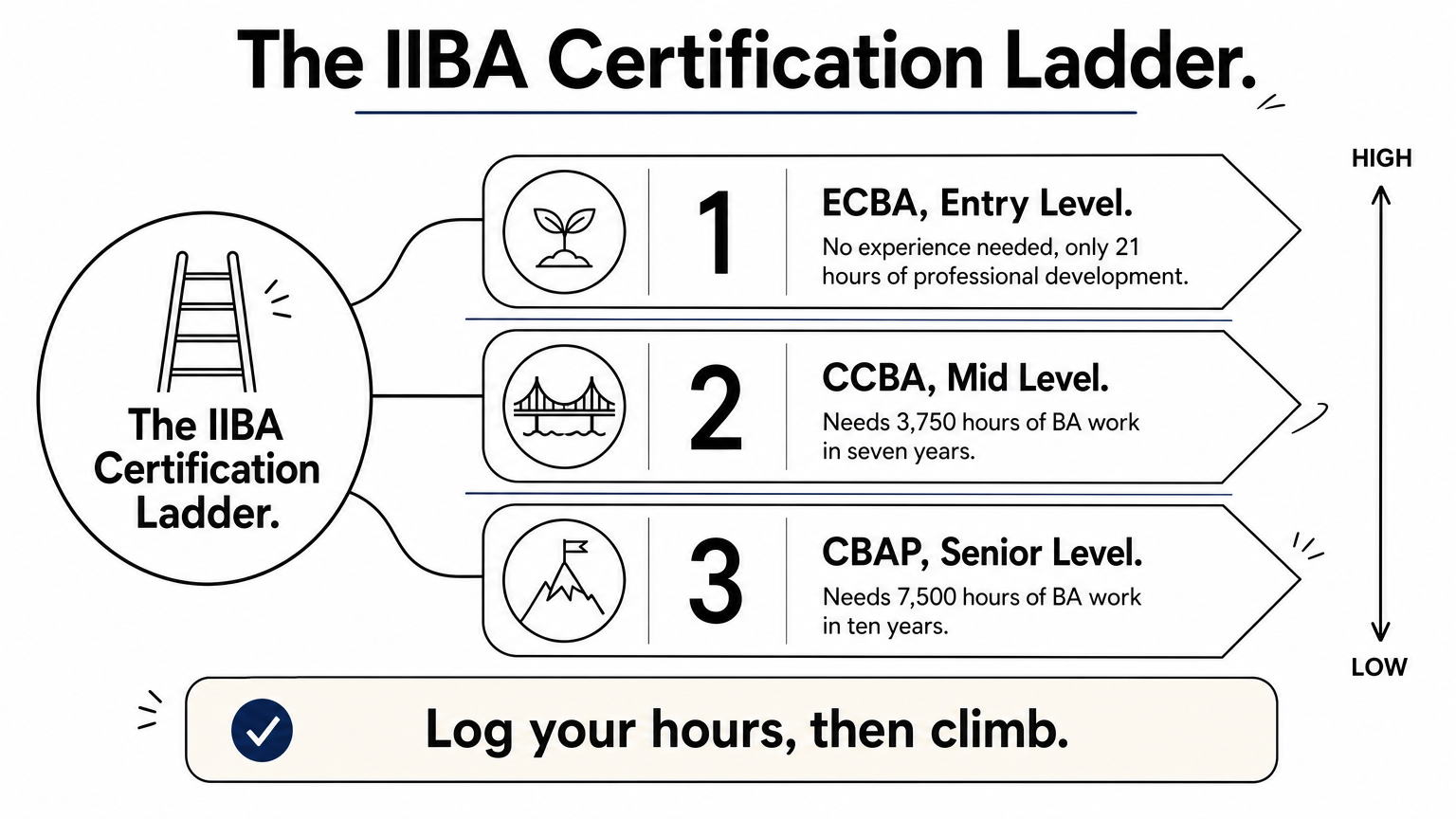
The CCBA sits in the middle of the IIBA ladder. It tests whether you can apply the BABOK Guide, not just recite it. The exam has 130 multiple-choice questions over three hours, mostly scenarios. A typical question describes a stakeholder conflict and asks what you would do next.
Who it is for
This business analyst professional certification suits analysts with a few years behind them. You need roughly 3,750 hours of BA work in the last seven years, spread across BABOK knowledge areas. You also need 21 hours of professional development and two references.
The CCBA certifies work you have already done, so you cannot use it to get your first BA job.
Career changers rarely qualify yet. Start with the BCS Foundation or the ECBA, log your hours in your first role, and return to the CCBA later.
Cost and time commitment
| Item | Typical detail |
|---|---|
| Prerequisites | 3,750 hours of BA work, 21 hours of professional development, two references |
| Exam | 130 multiple-choice questions, 3 hours |
| Fees | Application plus exam, roughly $470 to $600 depending on membership |
| Study time | 4 to 8 weeks part-time |
Fees are in US dollars, so check IIBA's current price list before budgeting. IIBA reviews your application first, so allow time for approval before you can book the exam.
Recognition by UK employers
Recognition is decent but uneven. Multinationals, consultancies and financial firms know IIBA, yet UK job adverts name the CBAP or BCS more often than the CCBA. Treat it as a stepping stone that shows mid-level competence, and take it if your employer pays or you want a clear route to the CBAP.
5. IIBA Certified Business Analysis Professional
What it covers
The CBAP sits at the top of the IIBA ladder. It tests whether you can apply the BABOK Guide to complex, scenario-based problems, such as enterprise change, governance and solution evaluation.
Expect 120 multiple-choice questions over 3.5 hours, built around long case studies rather than definitions. You need real project experience to answer them well.
Who it is for
Senior analysts, lead BAs and consultants fit here. You need 7,500 hours of BA work in the last 10 years, with at least 900 hours in each of four BABOK knowledge areas. You also need 35 hours of professional development and two references.
The CBAP marks seniority, so treat it as a goal for year five, not year one.
Career changers should start with the BCS Foundation or the ECBA, then return once the hours add up.
Cost and time commitment
Budget for the application fee, the exam fee and a prep course. IIBA charges in US dollars, so confirm the current fees on its website before you plan.
| Item | Typical detail |
|---|---|
| Prerequisites | 7,500 hours of BA work, 35 hours of professional development, two references |
| Exam | 120 multiple-choice questions, 3.5 hours |
| Fees | Application plus exam, roughly $550 to $800 depending on membership |
| Study time | 8 to 12 weeks part-time |
Recognition by UK employers
Of the IIBA credentials, this is the one UK recruiters name most often for senior and lead roles. It is a strong business analyst professional certification for contractors and consultants, because it shows you can work to a recognised global standard.
Renewal comes every three years through continuing development units, so it also shows you keep learning. If you plan a long career in BA, it is arguably the best business analyst certification to aim for once you have the experience.
6. BCS International Diploma in Business Analysis
What it covers
The diploma is the practitioner-level step above the Foundation. You combine the Foundation Certificate, the Business Analysis Practice module and optional modules such as requirements engineering or process modelling. Together they test whether you can apply BA techniques to realistic scenarios, not just define them. Module choices change, so check the current structure on the BCS website.
Who it is for
This suits analysts who hold the Foundation and have some real project experience. It is a professional business analyst certification for people who want to move beyond entry level without logging thousands of hours first, as the IIBA route requires. Career changers should start with the Foundation, which counts towards the diploma anyway.
Cost and time commitment
Expect the highest cost of the BCS route, because you pay per module. Budget several thousand pounds through an accredited provider and allow several months of part-time study. Confirm current prices before you book.
| Item | Typical detail |
|---|---|
| Prerequisites | Foundation Certificate (counts as a module) |
| Format | Several modules, each with its own exam |
| Cost | Charged per module, varies by provider |
| Study time | Several months part-time |
Recognition by UK employers
BCS is the Chartered Institute for IT, so a business analyst certification in UK job adverts often mentions this one by name. Banks, government bodies and consultancies know it, and the diploma signals practitioner-level skill rather than exam knowledge alone.
The diploma shows you can practise business analysis, not only describe it.
It carries less weight abroad than the CBAP. If you plan to work mainly in the UK, though, it is a strong middle step.
7. PMI Professional in Business Analysis
What it covers
The PMI-PBA comes from the Project Management Institute and tests business analysis inside a project context. It covers five domains: needs assessment, planning, analysis, traceability and monitoring, and evaluation. Expect 200 multiple-choice questions over four hours, and 25 of those are unscored pretest items.
Who it is for
Choose this if you work as a BA close to project delivery, for example in a PMO or beside project managers. Prerequisites depend on your education. With a degree you need about 36 months of BA experience in the last eight years. With a secondary diploma you need about 60 months. Both routes also require 35 hours of BA training.
The PMI-PBA suits analysts who already live inside projects, not people still chasing a first BA job.
Career changers cannot sit it yet, so start with the BCS Foundation or the ECBA.
Cost and time commitment
PMI prices in US dollars, so the sterling cost moves with the exchange rate. Check the current fee on the PMI website, as members pay less than non-members.
| Item | Typical detail |
|---|---|
| Prerequisites | 36 to 60 months of BA experience, 35 hours of BA training |
| Exam | 200 multiple-choice questions, 4 hours |
| Exam fee | Roughly $405 to $555, depending on membership |
| Study time | 8 to 12 weeks part-time |
Recognition by UK employers
In the UK, PMI is far better known for the PMP than for this credential. Job adverts name BCS or the CBAP more often when they ask for a business analyst professional certification. The PMI-PBA earns its place in project-heavy environments such as programme delivery and consultancies. Renewal needs 60 professional development units every three years, which keeps your skills current.
How to choose the right certification for you
Prestige matters less than fit. The best business analyst certification UK employers respect is the one you can sit now and use within months, so match it to your logged BA hours before you compare anything else.
Match it to your experience
Count your hours first. Most IIBA and PMI credentials check your work history, so your experience decides your options more than your ambition does. Use this table as a quick filter.
| Your situation | Best fit |
|---|---|
| No BA experience | BCS Foundation or IIBA ECBA |
| Some project experience, UK-focused career | BCS International Diploma |
| About 3,750 hours of BA work | IIBA CCBA |
| 7,500 hours, senior or lead role | IIBA CBAP |
| 36 to 60 months of BA work in project delivery | PMI-PBA |
Choose the certification you can sit this year, not the one that sounds most impressive.
Test it against real job adverts
Open 20 adverts for the roles you want and tally which credentials appear. In UK listings, BCS and CBAP come up most often, while ECBA, CCBA and PMI-PBA appear less. Your own sector may differ, so let the adverts break any tie.

Finally, weigh cost and proof. IIBA and PMI charge in dollars, so budget for exchange rate swings and check current fees. A certificate alone rarely lands a first job either. If you are changing careers, pair a recognised entry credential with practical project work, which is what our Business Analysis Program is built to give you.
Are business analyst certifications worth it?
Yes, for most people, but only when you pick the right one at the right time. A certification business analyst employers recognise is worth the money when it removes a specific barrier. It is a waste when you buy it just to feel ready.
When they pay off
Certifications help most at the start of your career. Recruiters screening dozens of applications for junior roles use credentials as a quick filter, and a career changer has no BA job titles to show. A BCS Foundation or ECBA tells them you know the vocabulary and the standard process. Some employers also fund later exams once you are in post, so the senior credentials may cost you nothing.
A certification is worth it when it removes one specific barrier, not when it promises a job.
When they fall short
No exam replaces practice. Hiring managers still ask what you have actually analysed, documented and delivered, and a certificate alone rarely answers that. The higher IIBA and PMI credentials also verify work you have already done, so they reward experience rather than create it. If you chase them too early, you pay for a badge you cannot yet use.
Before you pay for any exam, ask yourself:
- Does it appear in adverts for the roles I want?
- Can I sit it now, given my logged hours?
- Will I get project practice or CV support alongside it?
If you answer yes to all three, the fee is a sound investment. If you answer no to the last one, add practical project work before you spend more.
Choosing your next step
The right certification business analyst route depends on where you stand today, not on which badge sounds grandest. If you have no BA experience, start with the BCS Foundation or the IIBA ECBA. Save the CCBA, CBAP and PMI-PBA for when your logged hours qualify you, and look at the BCS Diploma once you have some project work behind you. Check the adverts for your target roles, then commit to one exam and book it.
Whichever credential you choose, employers hire people who can do the job. Practical project experience is what turns a certificate into an offer, and it is where most career changers get stuck. If you want accredited business analysis certification and training online, CV support and work-style projects in one place, book an enquiry call with Transform Learning Academy and map out your path into a BA role.


