


How to Change Careers in the UK Without Losing Money
Need More Help? Book Your FREE Strategy Session With Our Career Coaches Today!
To change careers without wasting years or savings, work through four steps. Map the skills you already have onto one target role, test that field before you quit, fund the move with a cash runway, and rewrite your CV around the new role. First decide whether the problem is your career or just your current job. You can do all of it while still earning.
The hard part is rarely ambition. It is knowing where to start. You may feel too old, too far from the field, or too short of money to risk a pay cut. Job boards make it worse, because they ask for experience in a job you have never done. So people stay put, or jump to another employer in the same field and feel the same frustration a year later.
This guide covers the decision and four practical steps, with a worked budget, a skills table and a CV template you can copy. At Transform Learning Academy, we help UK career changers with no degree or tech background move into business analysis, project management and data roles, so many examples lean that way. The method works for any move.
Why change careers, and how to know you should
Change careers when the work itself no longer fits you, not when one employer or one bad month is the problem.
Reasons that justify a move
Good reasons are structural. Your pay has hit a ceiling that no promotion in your field will lift, your sector is shrinking, or the daily tasks bore you even in a good team. Some people need to change careers for outside reasons, such as redundancy, health, or a wish for remote or flexible work. Those are valid too, but they call for a faster plan.
Reasons that only need a fix
Run one check first. If a better manager, a different employer or a four-day week would remove your frustration, you want a new job, not a new career. A career change costs time and money, so pay that price only when the problem would follow you to any employer in your field.
A three-question test
Answer these honestly before you go further:
- Do you dislike the type of work you do, not just where you do it?
- Could you describe the new role's daily tasks after speaking to people in it?
- Can you cover your outgoings while you retrain?
If the answers are yes, yes and yes, you are ready for Step 1.
A career change is justified when the problem would follow you to any employer in your field.
Step 1. Map your skills to one target role
Turn your past jobs into a list of transferable skills, then match that list to a single target role.
Turn your experience into skills
Write down ten tasks from your last three years. Rename each as a skill an employer in the new field would recognise. "Explained treatment plans to anxious patients" becomes stakeholder communication. "Wrote incident reports" becomes documenting facts accurately. The table shows how common backgrounds translate.
| Current background | Transferable skills | Likely target roles |
|---|---|---|
| Teacher | Explaining complex ideas, managing many stakeholders, planning | Business analyst, project manager |
| Pharmacist | Accuracy, regulatory compliance, process checking | Business analyst, data analyst |
| Police officer | Evidence gathering, risk assessment, report writing | Business analyst, project manager |
Choose one target, not five
Shortlist two or three roles. Read 20 live job adverts for each and note the skills that repeat. The role where your list matches the most repeated skills is your target role. The National Careers Service offers free careers advice and a skills assessment tool if you want an outside view.

Pick one target role, because a CV aimed at five jobs convinces no one.
Step 2. Test the field before you quit
Test the new field with real conversations and a small piece of real work before you hand in your notice.
Speak to three people in the role
Find people on LinkedIn who made a similar switch and ask for 15 minutes. People who changed careers themselves give the most useful answers. Ask three things:
- What does a normal Tuesday look like?
- What do you wish you had known before starting?
- If you started again today, how would you get in?
Do one small piece of the job
Spend two weeks on a mini-project. A future business analyst could map a process from their current workplace, and a future project manager could plan a house move with tasks, owners and dates. Free training sessions and live webinars also help, and we run these for career changers. If you dread the work, you have saved yourself months. If you want to carry on, you have your answer.

Two weeks of trial work tells you more than two months of reading about a career.
Step 3. Fund the move and pick a training route
Build a cash runway first, then choose the shortest route that gives you a recognised qualification and real project experience.
Build a runway
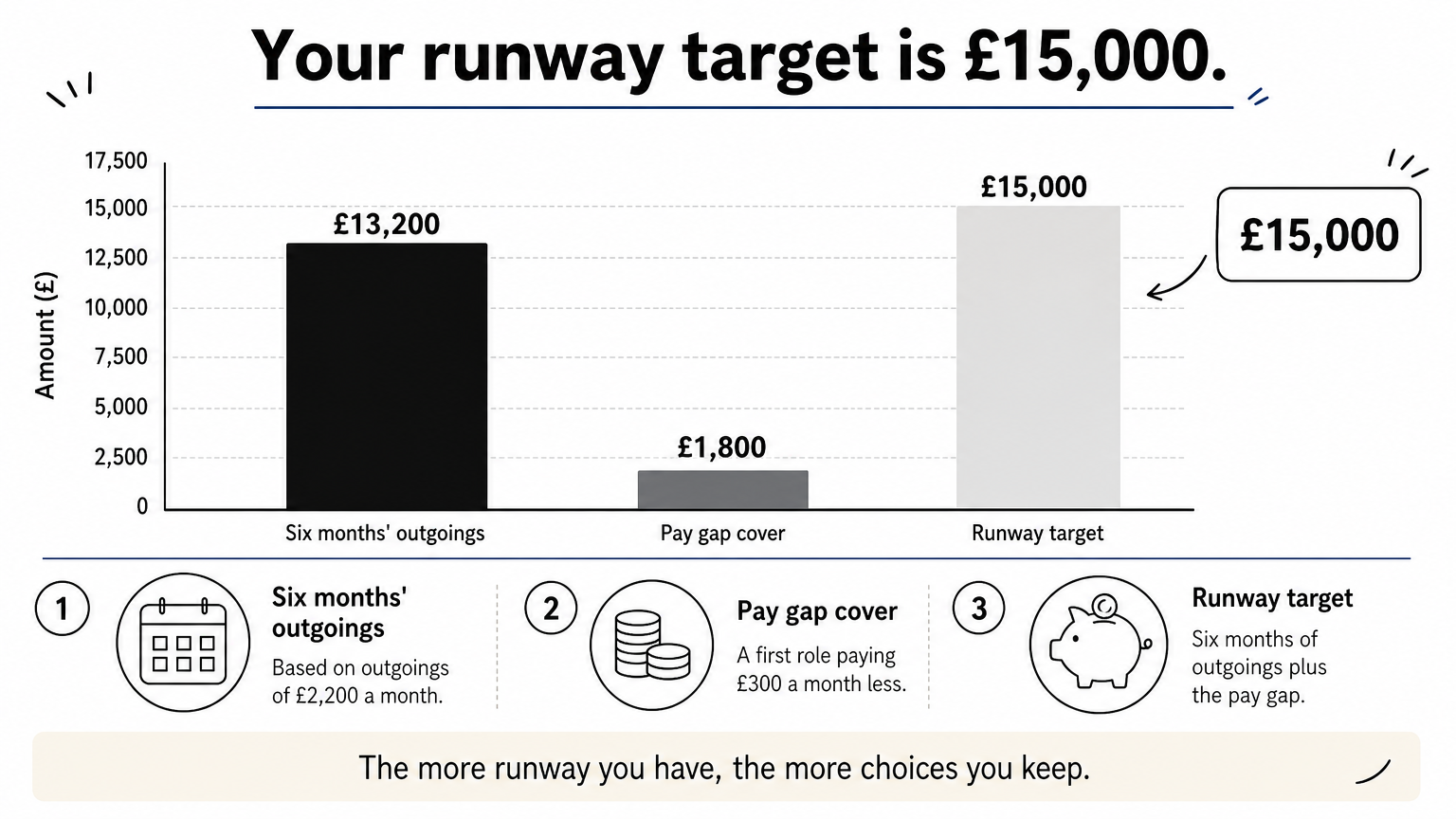
Aim for six months of outgoings plus any expected pay gap. Say your outgoings are £2,200 a month. That is £13,200 for six months. If your first role pays £300 a month less than you earn now, add £1,800 for that gap. Your target is £15,000. The safest way to change careers without losing money is to keep your salary while you train.
Compare your routes
| Route | Typical time | Income while learning | Suits you if |
|---|---|---|---|
| Internal move | Weeks to months | Full salary | Your employer has the target role |
| Self-study | Open-ended | Full salary | You are disciplined and the role needs no credential |
| Accredited online course | Often 3 to 6 months part-time | Full salary | You need a qualification and project experience fast |
| Part-time degree or conversion master's | Around 2 to 3 years | Full salary, plus fees | The role requires a degree |
| Apprenticeship | Often 1 to 4 years | Apprentice wage | You can accept a lower wage |
In England, government-funded Skills Bootcamps can cover some training for eligible adults, so check eligibility before you pay for anything.
How our programmes fit
Our Business Analysis programme takes three months at about 5 hours a week, with no prerequisites. It ends with the BCS business analysis foundation exam and live project experience. Project Management also runs three months and prepares you for the PRINCE2 exam. Business Intelligence runs six months. You can split payments over 3, 6 or 12 months interest free, and a 14-day money-back guarantee backs the courses.
Keep your salary until the new role is paying you.
Step 4. Rewrite your CV and start applying
Rewrite your CV so its first half shows the target role's skills, then apply in steady batches and tell a short career-change story.
Lead with the target role
Put a summary at the top that names the role you want. Move old job titles lower and quantify achievements, such as the number of people you trained or the hours a process saved. Copy and adapt this template:
Former [current job title] moving into [target role]. [X] years' experience in [skill 1], [skill 2] and [skill 3]. [Certification you hold or are studying for]. Completed [project name], where I [action] and achieved [result].
Apply and tell your story
Send five to ten tailored applications a week rather than one perfect one a month. In interviews, tell your story in three beats: why you left, what you did to prove the move, and what you now offer. Look for programmes that include CV reviews, networking and job placement help, as ours do.
Hiring managers hire evidence, so show a finished project before you ask for a first chance.
Your first move this week
You should change careers when the problem would follow you to any employer. Then the route is clear. Map your skills to one target role, test the field with real people and a small project, build a runway of about six months, and rewrite your CV around the new role. Each step lowers the risk before you commit more time or money.
Start with the ten-task skills list from Step 1. It takes an evening and tells you whether your target role is realistic. If business analysis looks like the right fit, see how the Business Analysis Programme works and book an enquiry call to ask questions before you decide.


