


Change of Career at 40 in the UK: How to Plan the Switch
Need More Help? Book Your FREE Strategy Session With Our Career Coaches Today!
To make a change of career at 40, pick a target role you can reach within 6 to 18 months, retrain part-time while you keep your salary, test the move with a small piece of real work, then rewrite your CV around the skills you already have. You do not need to quit first, and several routes do not need a degree. The order of the steps matters more than the speed.
The problem is that most advice stops at "it's never too late". At 40 you probably have a mortgage or rent, perhaps children or caring duties, and a salary you cannot drop to zero. You also carry the doubt that nobody will hire a beginner who is older than the hiring manager. Those worries are reasonable, and a plan solves them better than a pep talk.
This guide gives you that plan for the UK, in five steps, from working out what you want to landing the first role. It covers career ideas, retraining and funding routes, and how to present yourself. At Transform Learning Academy we train career changers into business analysis and related tech roles, so some examples lean towards jobs that need no coding or IT degree. The method works for any field.
Why a change of career at 40 is a sound move
A change of career at 40 is realistic because you still have 25 years or more of working life ahead and two decades of skills that employers already pay for. The real question is not whether it is too late. It is whether you can plan the switch so it does not damage your finances.
You have more runway than you think
Under current legislation, anyone born after April 1978 has a State Pension age of 68. That puts a 40-year-old roughly 28 working years from retirement, so a retraining period of 6 to 18 months is a small share of what remains. A role you start at 42 can run for two decades.
Funding is also adapting to longer working lives. The Lifelong Learning Entitlement is England's new flexible student finance, being introduced from 2026, and it is designed to give adults funding equivalent to four years of post-18 study to use across their lives. Check on GOV.UK which courses qualify before you count on it.
What you bring that a 25-year-old does not
Employers who hire career changers are rarely buying technical skill alone. They are buying judgement, reliability and the ability to work with people. By 40 you have handled difficult customers, missed deadlines, tight budgets and office politics. A graduate cannot show that on a CV.
Make a list of the specific things you do that would transfer. Typical examples are managing stakeholders, explaining complex topics to non-experts, working within regulation, delivering to a deadline and handling money. You will turn this list into CV wording in Step 4.
Your experience is not baggage to hide. It is the main thing you are selling.
The honest costs, and how to handle them
Every worry about a switch at this age has a practical answer. Here are the four that come up most often.
| Worry | What is true | Your answer |
|---|---|---|
| A pay cut | Possible in year one, especially in teaching, healthcare or entry-level roles | Build a financial runway in Step 1 and agree a pay review at 12 months |
| Ageism | It exists, although the Equality Act 2010 makes age discrimination in hiring unlawful | Lead with recent learning and results, and target employers who hire career changers |
| No tech background | Roles such as business analysis, project management and business intelligence need no coding | Choose a role by the skills it uses, not by the job title |
| Time with family | Retraining takes evenings and weekends | Study part-time and agree a weekly schedule at home before you start |
Step 1. Define what you want and what you can afford
Start by writing down what drains you, what energises you and what you will not compromise on, then calculate how many months of essential spending you can cover. Doing this before you browse courses prevents the most expensive mistake when you change career at 40, which is retraining for a job you would leave within a year.
Audit your current job in 30 minutes
Set a timer and work through this list on paper.
- List the last 20 tasks you did at work, from long meetings to one-off problems.
- Mark each one as energising, neutral or draining.
- Circle the problems colleagues bring to you. These point to your strongest skills.
- Write your non-negotiables: minimum salary, days of remote work, hours and maximum commute.
- Write what you refuse to do again, such as sales targets or night shifts.
The pattern matters more than any single answer. If your energising tasks involve untangling messy processes and explaining them to others, you are describing business analysis. If they involve spotting patterns in numbers, look at data roles. If they are hands-on and practical, skilled trades deserve a look.
Work out your financial runway
Your runway is the number of months you can cover essential costs if your income drops. Aim for three to six months of essentials, and keep your current job while you retrain so the runway only has to cover the gap between roles.
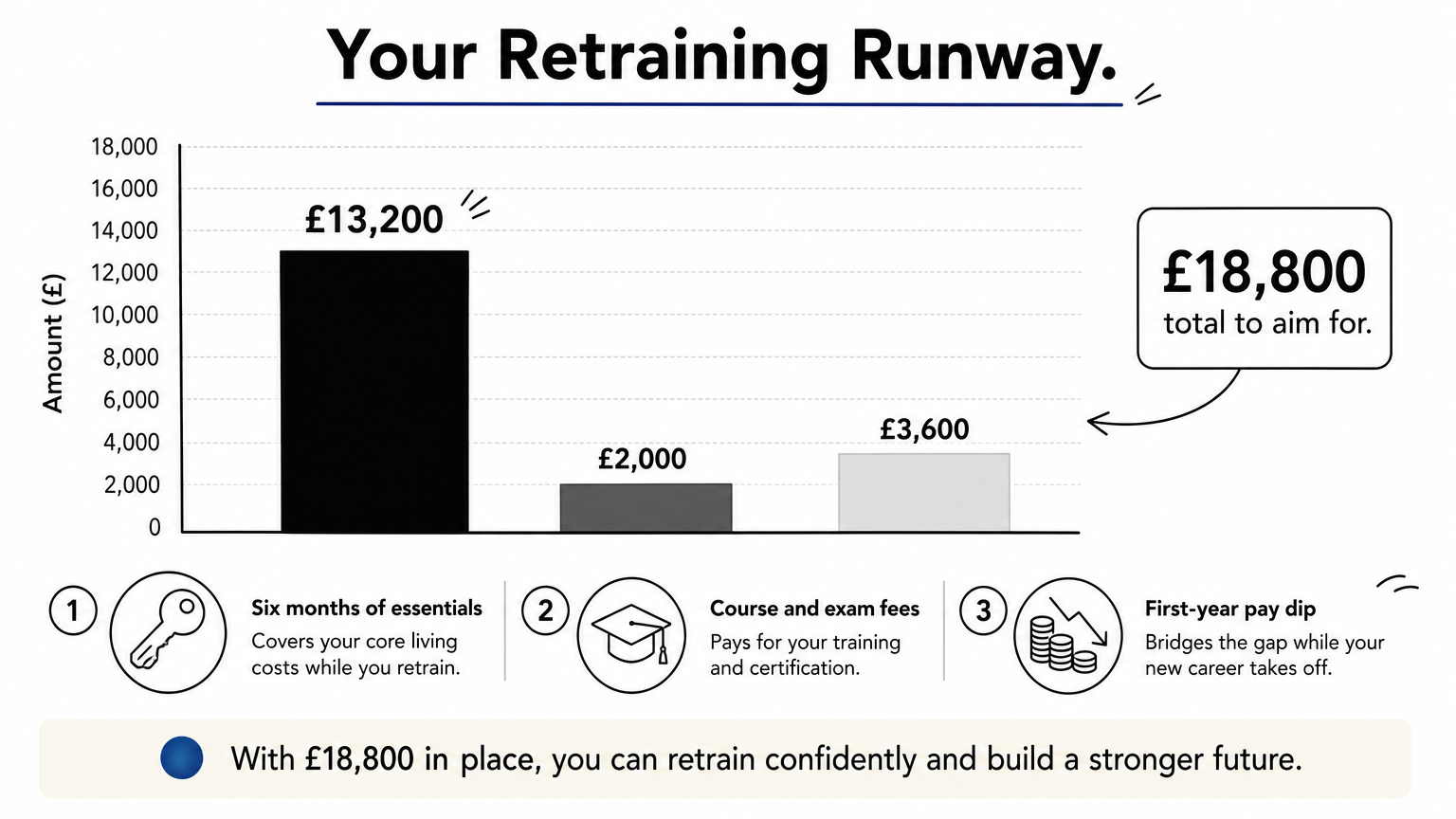
Here is a worked example with made-up figures. Replace them with your own.
- Monthly essentials (rent or mortgage, bills, food, transport, debt payments): £2,200
- Six-month runway: £2,200 × 6 = £13,200
- Course fees and exam costs: £2,000
- Allowance for a first-year pay dip of £300 a month: £3,600
- Total to aim for: £18,800
If the total looks out of reach, shorten the runway to three months, choose a cheaper or funded route in Step 3, or extend your timeline. Then have one honest conversation at home about evenings, money and the next 12 months. Agreed expectations protect a career change better than willpower does.
Keep your salary while you retrain, and let your savings cover only the gap between jobs.
Step 2. Choose a career idea you can test
There is no single best career change at 40, only the best fit between your skills, the retraining time you can give and the pay you need. Shortlist two or three options, not ten, and test each against real job adverts before you spend any money.
Career change ideas that suit people in their 40s
This table sets out common routes, based on how much each one rewards existing experience.
| Career | Typical retraining | Why it suits a 40-year-old | Watch for |
|---|---|---|---|
| Business analyst | Part-time certification plus practical project work | Uses industry knowledge and communication, no coding | Entry roles are competitive without project experience |
| Project manager | PRINCE2, APM or Agile qualification | Rewards leading people and delivering to deadlines | You must evidence delivery, not just a certificate |
| Data or BI analyst | Excel, SQL, Power BI or similar, plus a portfolio | Logical, remote-friendly work | Employers expect examples of your analysis |
| Teaching or training | Teacher training route, usually about a year | Purpose and use of life experience | Check starting pay and placement demands |
| Healthcare and social care | Hundreds of NHS roles, from support work to clinical posts | Steady demand | Shift work, and some roles need a degree |
| Skilled trades | College courses plus assessed experience | Clear pathways and self-employment | Physically demanding, and upfront costs for tools and exams |
For gas work, Gas Safe registration is a legal requirement, so check the full route before you commit.
An IT career change at 40 without coding
You can make an IT career change at 40 without learning to program. Business analysis, project management and business intelligence sit between the business and the technology teams, and they hire people who can talk to stakeholders, write clearly and think in processes.
Junior business analyst roles are commonly advertised at roughly £30,000 to £40,000, and experienced analysts often earn £50,000 or more. Pay varies by employer, sector and location, so read adverts for your own area. Many of these roles also offer hybrid or remote working, which suits anyone fitting a career around family life.
Pick the role by the skills it uses, not by how techy the title sounds.
Test your shortlist with three questions
Before you commit to a path, put each option through this check.
- Can I realistically reach an entry-level role within 12 months?
- Does the typical starting pay clear the salary floor from Step 1?
- Do the requirements in adverts ask for things I can learn, or for years I cannot fake?
Open 20 current job adverts for each option and count how often the same requirements appear. Repeated requirements become your study list. Rare ones you can ignore.
Step 3. Retrain around your current job
Retrain part-time, online and alongside your job, using the funding route that matches your target role. A change of career at 40 works best when the training is short, practical and recognised by employers, not a three-year detour you cannot afford.
Compare your retraining routes
Funding and availability differ across England, Scotland, Wales and Northern Ireland, so check the rules where you live.
| Route | Typical length | Cost | Best for |
|---|---|---|---|
| Part-time online certification | Weeks to a few months | Self-funded, sometimes employer-funded | Fast moves into business analysis, project management and data |
| Skills Bootcamp (England) | Up to 16 weeks | Government-funded, free to many eligible adults | Digital and technical skills with a job-focused finish |
| Apprenticeship | One to four years | Funded by employer and government, with an apprentice wage | Trades, or retraining inside your current employer |
| Part-time degree or diploma | Three years or more | Tuition fees, possibly Lifelong Learning Entitlement funding | Roles that legally require a degree |
Apprenticeships have no upper age limit in England, though the pay is usually lower than a full salary. Ask a provider for a written breakdown of every cost, including exam fees, before you enrol.
Check accreditation before you pay
A certificate only helps if hiring managers recognise it. Look for awarding bodies such as BCS or IIBA for business analysis, PRINCE2 or APM for project management and CIPD for HR. CPD accreditation shows that a course meets continuing professional development standards, but it carries less weight than a professional body qualification.
Ask any provider three questions. Is the qualification recognised by employers? Does the course include practical project work, not just theory? What help do you get with your CV and job search afterwards? If business analysis is on your shortlist, Transform Learning Academy's business analysis training is built around exactly those three things: certification, hands-on projects and career support.
Build a weekly study plan
A realistic target is six to eight hours a week. For example, two weeknight evenings of 90 minutes each, plus a three-hour block on Saturday or Sunday morning. Put the sessions in your calendar as fixed appointments and tell your family when they are.
If you can, ask your employer about flexible working or study time, since you can request flexible working from your first day in a new job in the UK. Finish the course within your planned window and do not collect extra certificates while you wait to feel ready.
A course you finish at six hours a week beats one you abandon at fifteen.
Step 4. Test the move and rewrite your story
Prove the move with a small piece of real work, then rewrite your CV so your past reads as preparation for the new role. Employers hiring for a career change at 40 want evidence that you can do the job, and a short project does more than another course.
Run a low-risk test
Pick one of these tests and finish it within eight weeks.

- Business analysis: map a process at your current employer or a charity, list the pain points and write up recommended improvements.
- Data analysis: analyse a public dataset, build a short dashboard and explain what it shows in plain English.
- Project management: run a real project, such as a charity event or an internal workplace change, with a plan, risks and a close-out review.
- Any field: shadow someone for a day or have three 20-minute conversations with people in the role, found through LinkedIn.
Ask each person what a typical week looks like and what they would learn first if they started again. Their answers often change your plan, and that is the point of testing before you commit.
Translate your past into the new role
The career changers we train come from backgrounds such as pharmacy, teaching and policing, and in each case the move works because the old job already built the skills. The trick is to phrase them in the language of the new job.
| Former role | Skill that transfers | CV phrasing pattern |
|---|---|---|
| Pharmacist | Accuracy, regulation, explaining to non-experts | "Applied regulatory requirements to daily decisions and explained complex information to patients and clinicians" |
| Teacher | Planning, using data, managing many stakeholders | "Analysed progress data to adjust plans and reported outcomes to parents and senior leaders" |
| Police officer | Gathering evidence, writing reports, working under pressure | "Gathered and structured evidence to tight deadlines and wrote reports used in formal proceedings" |
Put a short profile at the top of your CV that names the target role, and move your most relevant achievements above your job history. Use numbers and outcomes wherever you honestly can.
Prepare your answer to "why change now?"
Every interviewer will ask it, so prepare a calm, positive answer. Use this template and fill in the brackets.
I spent [X years] in [current field], where I [specific result].
That work taught me [skill 1] and [skill 2], which are what [target role] needs.
Over the last [months] I completed [course or certification] and [practical project].
I'm moving now because [positive reason], and I want to bring [strength] to [employer's problem].
Say what you are moving towards, not what you are running from.
Step 5. Apply, interview and manage the pay dip
Target entry-level and junior job titles, apply in small tailored batches, and plan for a first-year salary that may sit below your current one. Treat the job search as a project with weekly targets, because a change of career at 40 usually succeeds through steady applications, not one perfect application.
Target the right job titles
Search for titles that match your retraining, and include the adjacent titles that employers use for the same work.
- Junior business analyst or business analyst
- Data analyst or reporting analyst
- Business intelligence analyst
- Project coordinator or PMO analyst
- Process improvement analyst
Also look inside your current employer. An internal move into an analyst or project role, perhaps through a secondment, often carries less risk and less pay dip than starting with a new company. Tell your manager early if you are retraining, as some will support it.
Apply and interview with a system
Aim for five tailored applications a week. Tailor means mirroring the key phrases of each advert in your profile and highlighting the two or three achievements most relevant to it. Use the STAR method (situation, task, action, result) for interview answers, and prepare six stories from your past work.

When you get an offer, negotiate. Ask what the progression path looks like, and request a salary review at 12 months if the starting pay is below your target. A modest pay cut with a clear review date and a path to promotion is often a sound trade for a career that pays more by year three.
Review your progress every four weeks
Set a monthly check so the switch does not drift. Look at your applications sent, interviews secured, offers received and the feedback you got. If you are sending applications but not getting interviews, rewrite your CV. If you are getting interviews but no offers, practise your answers with someone who works in the field.
Revisit your runway from Step 1 at the same time. If savings drop below your three-month floor, extend your timeline or take interim work, but keep studying. Progress at this age is built from small, steady moves.
Measure the search weekly, adjust monthly, and keep going until the offer arrives.
Your next move
A change of career at 40 works when you plan it in order: know what you want and can afford, choose a role that rewards your experience, retrain around your job, test the move with real work, and apply with a CV that tells a clear story. You do not need to be fearless. You need a shortlist, a runway and a weekly schedule.
If business analysis is one of your options, you can see what a structured route looks like. Explore the Business Analysis Programme for career changers to find out how certification, hands-on project experience and career support fit around a full-time job.


