


Cost of Business Analyst Certification: 7 Options Priced
Need More Help? Book Your FREE Strategy Session With Our Career Coaches Today!
The cost of business analyst certification runs from about $165 for Microsoft's Power BI exam to $555 for PMI-PBA at the non-member rate. IIBA's ECBA, CCBA and CBAP sit in between. Once you add training, membership and renewal, your real total is usually well above the headline exam fee. For most UK career changers, the best pick is an entry-level exam bundled with training, such as the BCS Foundation. If you already work as an analyst, IIBA's CCBA or CBAP suits you. If your work is Power BI or project delivery, PL-300 or PMI-PBA fits better.
The trouble is that nobody lists these costs in one place. IIBA and PMI charge in US dollars, BCS exams usually come bundled with a course, and membership, application and renewal fees sit on separate pages. A cheap exam can turn out to be an expensive route once you count eligibility rules and study hours.
This guide prices seven options, from a bundled BCS route to subscription certificates. For each one you get the fee, the extras to budget for, what you receive and who it suits. A comparison table, a worked example and a short decision guide follow. Transform Learning Academy trains business analysts in the UK, so its programme comes first. Every other option is independent. Treat dollar figures as a guide and confirm them on the provider's page before you pay.
1. Transform Learning Academy BA programme
What it costs
Transform Learning Academy sells its Business Analysis programme as one bundle. The figure to ask for is the all-in programme price, which you can get on an enquiry call, rather than a separate exam fee. Here is what the bundle covers and how you can pay:
- Included: the BCS Business Analysis Foundation certification exam, a 2-day live training and live business analysis project experience
- Time: about 3 months, at an average of 5 hours a week
- Payment: split over 3, 6 or 12 months, interest free
- Safety net: a 14-day money-back guarantee
- Not included: resits, which are charged extra
Ask any bundled course for the exam fee, the training fee and the resit fee as three separate lines.
What you get for the money
The programme prepares you for the BCS Business Analysis Foundation certificate, the entry level of the BCS route, and includes the exam. There are no prerequisites, so you can start without a degree or prior tech experience. After the live training you work on live business analysis project experience. A bare exam never gives you that.
Classes are online, mostly live at weekends, and intakes run monthly, so the programme fits around a job. Transform Learning Academy reports that 98% of its delegates pass their exams first time. That figure matters for your real cost, because a resit is charged separately.
Who it suits
It suits career changers who want a recognised qualification, project experience and one price, instead of buying exam, training and practice separately. It is poor value if you already have years of BA work behind you and only need an exam.
- Worth it if: you have no tech background and want guided practice
- Skip it if: you only need a single exam and can self-study
2. IIBA Entry Certificate in Business Analysis (ECBA)
What it costs
The ECBA is IIBA's entry credential, and its exam fee sits at the bottom of IIBA's range. Published figures vary from about $175 to $350, depending on whether you are an IIBA member and when the fee was listed. Membership is an annual fee on top, so check IIBA's current fee page before you decide whether joining pays off.
- Exam: roughly $175 to $350
- Membership: optional, annual, extra
- Prerequisite: 21 hours of professional development in business analysis
- Renewal: none, as the certificate does not expire
The ECBA exam is cheap, but the 21 hours of training you need first are usually the bigger bill.
What you get for the money
The ECBA tests the basics of the BABOK Guide, IIBA's body of knowledge, through 50 multiple-choice questions. You can sit it online from home. Because it never expires, you pay once and avoid the renewal costs that hit the higher IIBA levels.
Its weakness is weight. It helps your CV pass automated screening, but employers still ask what you have delivered. Pair it with a project or volunteer work if you want it to count.
Who it suits
It suits career changers who want an internationally known credential at a low exam cost. Before you pay, check whether the adverts you are targeting mention IIBA, BCS or neither.
- Worth it if: you want a low-risk first credential and will do the 21 training hours anyway
- Skip it if: your target employers ask for BCS qualifications
3. IIBA Certification of Capability in Business Analysis (CCBA)
What it costs

The CCBA exam costs about $325 for members and $450 for non-members. You also pay an application fee, which IIBA charges to check your experience, so confirm that figure on its fee page. The business analyst certification cost here is higher than the ECBA, and the recertification you owe every three years adds more.
- Exam: about $325 to $450
- Application fee: extra, check current figure
- Experience required: 3,750 hours of BA work in the last 7 years
- Training required: 21 hours of professional development
- Renewal: every 3 years, through continuing development units
The CCBA's real price is two years of documented work, not the exam fee.
What you get for the money
The CCBA is IIBA's mid-level credential. The exam has 130 scenario-based questions, so you must apply techniques to situations, not recall definitions. The 3,750 hours are roughly two years of full-time BA work, spread across at least two BABOK knowledge areas.
It marks you out for senior analyst or team lead roles. Be ready to log your hours and reference your work at application, which takes time.
Who it suits
It suits analysts with two to three years in the role who want a formal step up. If you have under two years, you cannot apply, so the ECBA or a BCS route comes first.
- Worth it if: you want a promotion lever and can document your hours
- Skip it if: your employer promotes on delivery, not credentials
4. IIBA Certified Business Analysis Professional (CBAP)
What it costs
The CBAP exam is priced like the CCBA, at about $325 for members and $450 for non-members, plus an application fee. Its cost to you lies in the eligibility bar. You need 7,500 hours of BA work in the last 10 years, which is close to four years of full-time work, and 35 hours of professional development.
- Exam: about $325 to $450
- Application fee: extra, check current figure
- Renewal: every 3 years, with 60 continuing development units
- Study: typically 150 to 200 hours
At this level, certification costs you the least; the experience behind it costs the most.
What you get for the money
The CBAP is IIBA's senior credential. Its exam has 120 scenario-based questions covering all the BABOK knowledge areas. It carries the most recognition of the IIBA levels, particularly for consulting work and BA management posts.
The renewal burden is real, because 60 development units every three years means ongoing time and, often, course fees. Count that into your budget over a decade, not a single year.
Who it suits
It suits established analysts with four or more years behind them who are moving into leadership, consulting or enterprise-level transformation work. It is overkill for anyone earlier in their career.
- Worth it if: you lead BA teams or sell your services as a consultant
- Skip it if: you are under four years in or happy in a delivery role
5. PMI Professional in Business Analysis (PMI-PBA)
What it costs
The PMI-PBA is the priciest exam here, at $405 for PMI members and $555 for non-members. The $150 gap is worth weighing against PMI's membership fee, so compare the two on PMI's site. Eligibility is stricter than it looks, and renewal follows every three years.
- Exam: $405 (member) or $555 (non-member)
- Experience: 4,500 hours with a bachelor's degree, or 7,500 hours with a secondary degree
- Education: 35 hours of business analysis training
- Renewal: every 3 years, with 60 professional development units
If PMI membership costs less than the $150 saving, join before you book the exam.
What you get for the money
The exam has 200 questions over four hours, which makes it the longest of the options here. It is set inside project environments, so it tests how you align requirements with project constraints and work with project managers.
If you already hold PMP or another PMI credential, some development activities can count towards more than one renewal. That lowers the long-run cost for people already in the PMI system.
Who it suits
It suits analysts embedded in PMO or project-led organisations, where PMI's framework is the house standard. Outside those settings, an IIBA or BCS route usually gives better value.
- Worth it if: your colleagues hold PMI credentials
- Skip it if: you work in product or agile teams without a PMO
6. Microsoft Power BI Data Analyst (PL-300)
What it costs
The PL-300 exam is the cheapest of the formal exams at $165 in US pricing. Microsoft sets local prices by country, so look up the figure for the United Kingdom when you book. There is no membership, and the annual renewal is a free online assessment.
- Exam: $165 (US pricing)
- Prerequisite: none formally, though 6 months of Power BI use is recommended
- Study: typically 4 to 8 weeks
- Renewal: annual, free
PL-300 is the lowest business analyst certification cost, but only if Power BI is your daily tool.
What you get for the money
This is a tool credential, not a BA framework one. It tests data connections, modelling, DAX calculations and report building, with hands-on tasks inside Power BI. You need real proficiency to pass.
Recruiters in Microsoft-heavy firms often filter CVs for it. It does not prove you can run a requirements workshop. For that you still need a BA framework credential or project evidence.
Who it suits
It suits analysts moving towards reporting, BI or data-heavy BA roles in Microsoft environments. Budget the exam fee plus preparation time, since practice with real data matters more than reading.
- Worth it if: job adverts in your area name Power BI
- Skip it if: you never touch Power BI in your work
7. Coursera business analyst professional certificates
What it costs
Coursera certificates are billed by subscription, typically $49 a month in US pricing. The IBM Business Analyst Professional Certificate runs about 3 to 4 months, so $147 to $196, and the Microsoft Power BI Data Analyst Professional Certificate about 3 to 5 months, so $147 to $245. UK prices may differ, so check at checkout.
- IBM Business Analyst: about 3 to 4 months, $147 to $196
- Microsoft Power BI Data Analyst: about 3 to 5 months, $147 to $245
- Exam fees: not included, as IIBA or Microsoft exams are bought separately
- Expiry: none
These certificates cost less than exams, but they teach rather than certify.
What you get for the money
The IBM programme aligns with the BABOK framework and prepares you for the ECBA. The Microsoft one covers the same ground as PL-300 and advertises a discount voucher on that exam. Check the current terms before counting on it.
Both end with portfolio projects you can discuss in interviews. Neither is a proctored professional exam, so employers value them as proof of learning, not as official certification.
Who it suits
They suit self-starters who want structured learning for a few hundred dollars before committing to an exam fee. They are less suitable if you need live support, deadlines or project experience with real stakeholders.
- Worth it if: you are testing whether BA work appeals to you
- Skip it if: you need guided practice and a recognised UK qualification in one package
Business analyst certification cost side by side
Fees at a glance
This table sets the options next to each other. Dollar figures come from IIBA, PMI, Microsoft and Coursera pricing, and exam fees change, so confirm them before you pay.
| Option | Headline cost | Extras to check | Typical time |
|---|---|---|---|
| Transform Learning Academy BA programme | One bundled price, ask on an enquiry call | Resits charged extra | About 3 months |
| IIBA ECBA | $175 to $350 | Membership, 21 hours of training | 50 to 100 hours |
| IIBA CCBA | $325 to $450 | Application fee, 3-year renewal | 100 to 150 hours |
| IIBA CBAP | $325 to $450 | Application fee, 3-year renewal | 150 to 200 hours |
| PMI-PBA | $405 to $555 | PMI membership, 35 hours of training, renewal | 100 to 150 hours |
| Microsoft PL-300 | $165 | Free annual renewal | 4 to 8 weeks |
| Coursera certificates | $147 to $245 | Exam bought separately | 3 to 5 months |
Costs outside the exam fee
A BA certification cost is rarely the exam fee alone. Before you commit, check each of these:
- Membership, which lowers some exam fees but is an annual charge
- Application fees for experience-based levels
- Training to meet required professional development hours
- Practice exams and study materials
- Resits, which most providers charge for
- Renewal fees and development units every one to three years
- Card charges, exchange rates and whether VAT applies
A worked example
Take a teacher moving into business analysis. These totals use the top of each range and leave out membership, application and training fees:
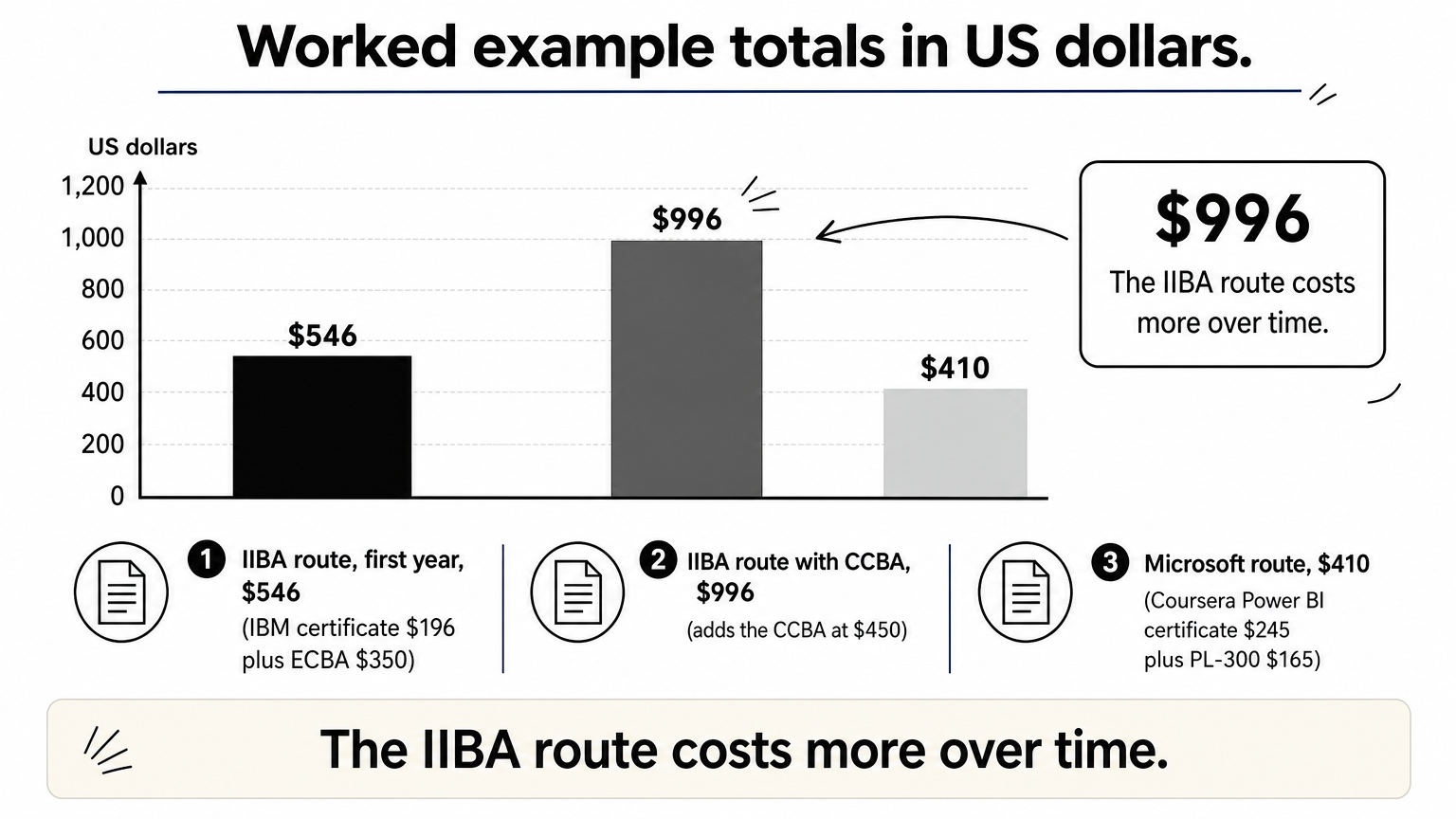
- IIBA route: IBM certificate for 4 months at $196, plus the ECBA at the non-member rate of $350, makes $546. Later, the CCBA at $450 brings it to $996 over a few years.
- Microsoft route: the Coursera Power BI certificate for 5 months at $245, plus PL-300 at $165, makes $410.
- Bundled BCS route: one price from Transform Learning Academy covering the exam, live training and project experience.
Which business analyst certification is worth the cost
A simple decision order
Start from where you are, not from the cheapest fee. Work through these steps:
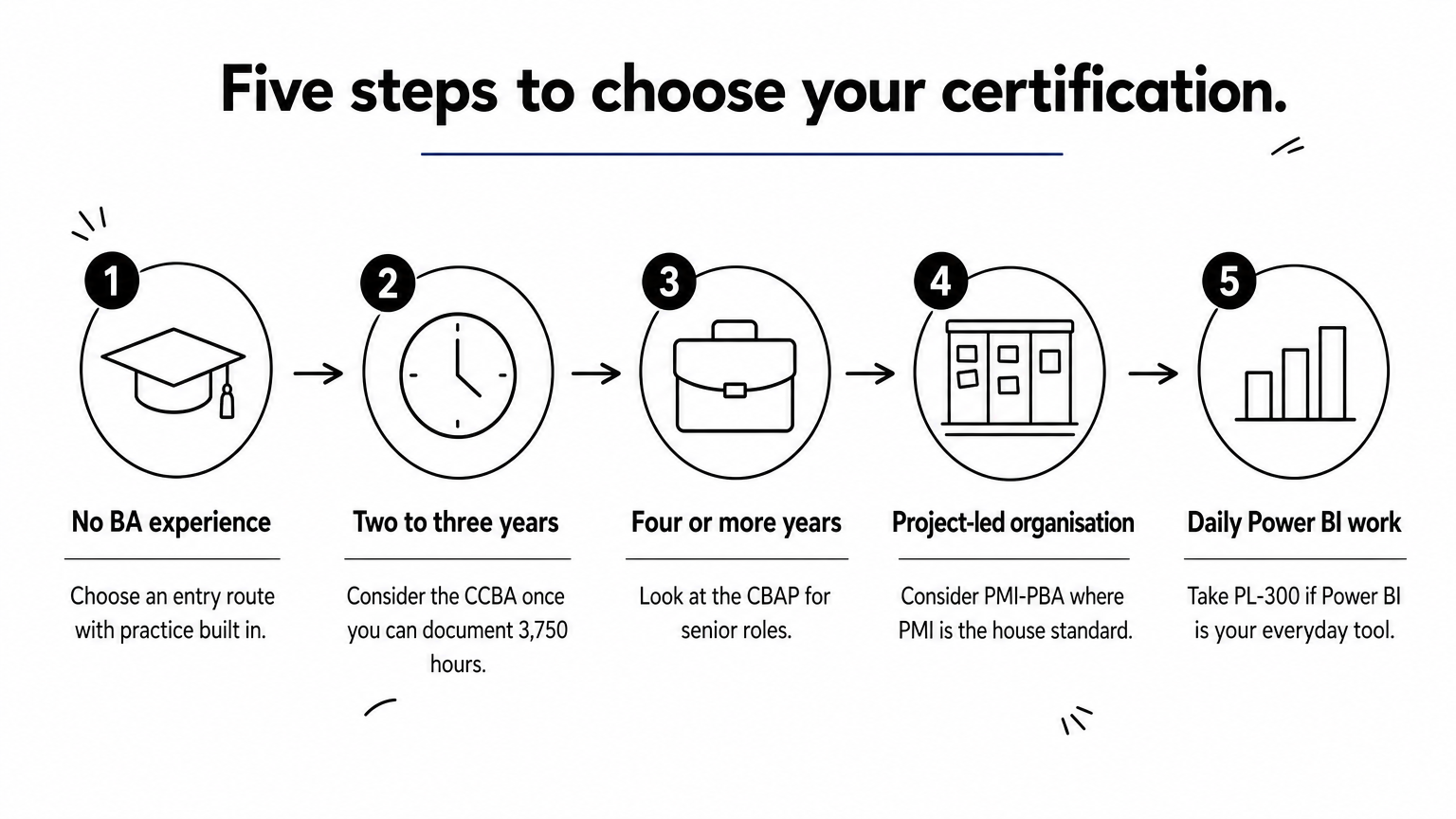
- No BA experience: choose an entry route with practice built in, such as a bundled BCS Foundation programme, or the ECBA with project work.
- Two to three years of BA work: consider the CCBA once you can document 3,750 hours.
- Four or more years in senior roles: look at the CBAP.
- Project-led organisation: consider PMI-PBA.
- Daily Power BI work: take PL-300.
Pick the certification your target employers name in adverts, then pay the least to get it.
When a certification is not worth paying for
If you already have strong delivery experience, a portfolio of requirements documents and process maps may do more for you than a $450 exam. Employers often weigh what you have done over what you hold, so spend on credentials only when they unlock something specific.
Be wary of paying for a higher level you cannot yet apply for, or for a tool certificate in software you do not use. A cheaper credential you finish beats an expensive one you abandon.
Choosing your route and next step
Business analyst certification cost ranges from about $165 for PL-300 to $555 for PMI-PBA, and the experience hours, training and renewal behind each one matter more than the headline fee. Match the credential to your career stage and to what employers in your target roles ask for.
If you are changing career and want exam, live training and project experience in one package, look at Transform Learning Academy's business analysis training with exam and live project experience. Ask for the full price, the resit terms and the payment plan before you enrol, and compare them with the independent routes above.


