


5 Agile Project Management Courses: AgilePM, PRINCE2, Scrum
Need More Help? Book Your FREE Strategy Session With Our Career Coaches Today!
The best agile project management course depends on where you start. If you run projects in an organisation with budgets and sign-off, AgilePM or PRINCE2 Agile fits best. If you work in a software or product team, a Scrum certification gets you working faster. If you have never managed a project, build a structured foundation first and add agile on top. An online self-paced course suits you if you only want to test the subject.
The difficulty is that agile training is crowded with acronyms and near-identical course names. Some courses end in an accredited exam that employers list in job adverts. Others end in a certificate of completion that proves you watched the lessons. Format matters too, because a classroom course, a live online class and a self-paced module ask very different things of your week.
Below are five routes, each judged on what you learn, the format and cost, and who it suits. The first is our own project management programme at Transform Learning Academy. It is not agile-specific, and the section explains why it still belongs at the start of this list.
1. PRINCE2 project management with Transform Learning Academy
Our Certified Project Management Course With Job Placement is the best starting point if you have no project background. It builds the structure that agile methods adapt, and it is the base that PRINCE2 Agile builds on.

What you learn
The programme teaches you to work as a qualified project manager, then places you on a live project management project. It prepares you for the PRINCE2 certification exam. That is a structured method rather than an agile one, and we say so plainly.
Agile courses assume you already understand scope, risk, stakeholders and governance. This programme gives you that vocabulary, so a later agile course feels like an extension rather than a new language.
Agile is easier to apply once you understand the structure it adapts.
Format and cost
The course runs for three months at an average of 5 hours a week, so plan on roughly 65 hours in total (13 weeks at 5 hours). Classes are online, either live via webinar or as self-study.
- Prerequisites: none.
- Payment: split over 3, 6 or 12 months, interest free.
- Safety net: a 14-day money-back guarantee.
- Resits: not included, and any resit costs extra.
Ask for the current fee on an enquiry call, because it is not worth guessing at a figure you will pay.
Who it suits
You are the target reader if you are a teacher, pharmacist, police officer or other career changer with no tech background. The live project gives you something concrete to put on your CV.
Skip this route if you already hold PRINCE2 or manage projects daily. You will get more from routes 2 to 4.
2. AgilePM Foundation and Practitioner
AgilePM is the fullest agile project management method on this list, because it treats agile as a way to run a whole project, not just a team routine. It is owned by the Agile Business Consortium and examined through APMG International.
What you learn
The course covers the principles and lifecycle of an agile project, plus roles, responsibilities and management styles. It is a complete method with governance built in.
- Foundation tests that you understand the method.
- Practitioner tests that you can apply it to a realistic scenario.
AgilePM treats agile as a project method with governance, not just a team habit.
Format and cost
Most accredited providers teach each level over a few days, in a classroom or live online, and some offer self-paced versions. Check that the course teaches the current Version 3 framework.
Prices vary widely by provider. Ask whether the exam fee and any retake are bundled, and whether Foundation and Practitioner are sold together.
Who it suits
It suits project managers, team leaders and business analysts who work where scope, budget and approvals matter. The method has UK roots, so UK employers tend to recognise it. If you work in a small product team with no formal governance, it may be more than you need.
3. PRINCE2 Agile
PRINCE2 Agile is the right choice if your organisation already runs projects with PRINCE2 and wants teams to deliver in iterations. It keeps PRINCE2's control while letting delivery teams work in short cycles.

What you learn
The course shows how to tailor PRINCE2 with agile ways of working such as Scrum and Kanban. You learn how to fix and flex project constraints, so that delivery adapts without losing oversight.
It has two levels, Foundation and Practitioner, like AgilePM.
PRINCE2 Agile does not replace PRINCE2. It teaches you to flex it.
Format and cost
Providers usually run short instructor-led courses, in person or live online. Confirm the prerequisites before booking, because the exam body expects prior PRINCE2 knowledge for some levels.
Ask whether both levels and the exams are bundled. A bundled price is often easier to compare than separate fees.
Who it suits
It fits project managers in large organisations and the public sector, where PRINCE2 is widely used. If you hold PRINCE2 Foundation or Practitioner, this is the quickest agile upgrade. If you have no PRINCE2 background, start with route 1 or choose AgilePM instead.
4. Scrum certification
Scrum is the quickest agile course to complete, but it is a team framework, not a full project management method. It does not cover budgets, procurement or governance, so employers often expect you to pair it with a wider project method.
What you learn
You learn sprints, the backlog and the three roles: Scrum Master, Product Owner and Developers. You also learn the regular events that keep a team inspecting and adapting its work.
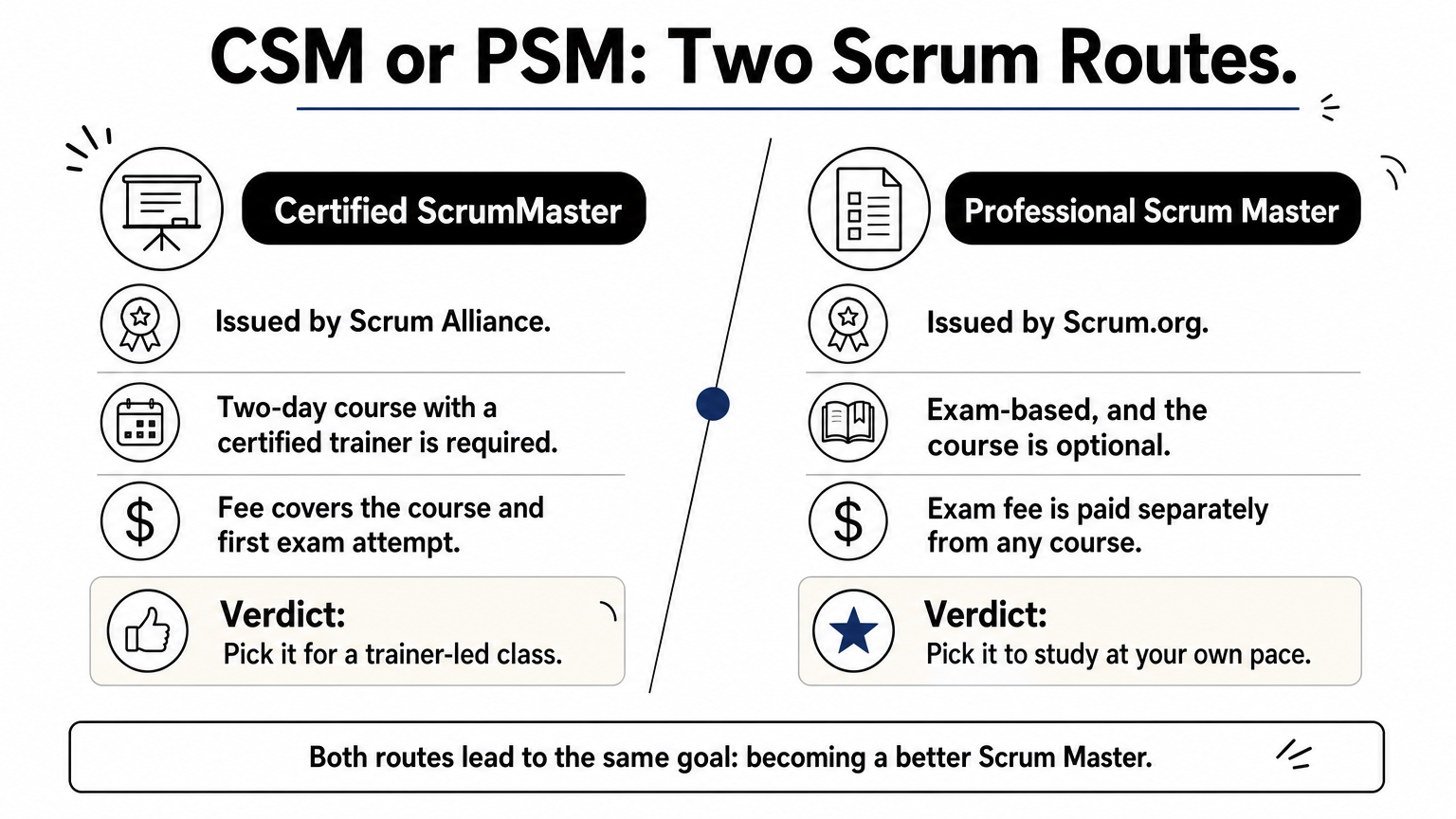
Two main certification routes exist. The Certified ScrumMaster from Scrum Alliance requires a two-day course with a certified trainer. The Professional Scrum Master from Scrum.org is exam-based, and the course is optional.
Scrum teaches a team how to work, not how to govern a project.
Format and cost
The CSM fee covers the course and the first exam attempt. For the PSM, the exam fee is paid to Scrum.org separately from any course you choose. Live online classes are now common, so you rarely need to travel.
Who it suits
Scrum suits people aiming for Scrum Master or delivery roles in software and product teams. It also suits beginners who want a quick, recognised entry point to agile project manager training. If your target job advert asks for AgilePM or PRINCE2 Agile, choose those instead.
5. Online self-paced agile courses
Self-paced online courses are the cheapest and most flexible way to learn agile, and the right choice if you want to test the subject before committing to an accredited exam. They teach the ideas well but rarely carry the credentials employers screen for.
What you learn
Platform courses cover the history and philosophy of agile, the Scrum framework, and tools such as Kanban boards. Coursera's Agile Project Management course, for example, explores the approach and philosophy including Scrum. LinkedIn Learning offers shorter topic courses on principles, Scrum and Kanban.
An online course teaches you the ideas, but only an exam gives you the credential.
Format and cost
You study at your own pace, usually through a subscription or a per-course fee. Check the price on the platform before you start. The result is normally a certificate of completion, not an accredited exam pass.
Who it suits
It suits managers short on time, people unsure whether agile is for them, and anyone preparing for AgilePM or Scrum. Before you pay, search your target job adverts. If they name an accredited qualification, treat the online course as a warm-up.
Choosing your first agile course
Match the course to your starting point. A career changer needs a structured foundation first, a PRINCE2 user should look at PRINCE2 Agile, a team member in software should look at Scrum, and a project manager in a governed organisation should look at AgilePM. Online courses are a sensible warm-up for any of them.
If you are still deciding between project management and business analysis as your way into tech, look at our Business Analysis Programme. It combines professional certification, hands-on project experience and career support, and an enquiry call will help you choose the route that fits your background.


