


Business Analyst Courses: 6 Best Online Options in the UK
Need More Help? Book Your FREE Strategy Session With Our Career Coaches Today!
Picking a course business analyst roles actually value is harder than it looks. Search the UK market and you will find dozens of options, from free taster videos to university diplomas costing thousands. Many promise a job but teach only theory. If you are switching careers with no tech background, that gap matters.
The short answer: the best business analyst course for you combines recognised accreditation (BCS or IIBA), hands-on project work, and help with your CV and job search. Price and length matter less than those three things. For most beginners, an online business analyst course taught by working analysts is the fastest, most flexible route, and you can study around your current job.
Below, we compare 6 online options in the UK. For each one, you will see who it suits, what you learn, which qualification you get, and what support comes with it. We run business analyst training at Transform Learning Academy, so we know what employers ask for, and we have judged every course against that standard. By the end, you can shortlist two or three and decide with confidence.
1. Transform Learning Academy Business Analysis Program
What the course covers
This business analyst training course is built around real-world BA work, not exam theory. You learn alongside seasoned analysts from top UK tech and financial companies, so the examples come from live projects. Expect hands-on tasks and interactive discussions rather than hours of passive video. Typical skills include:
- Gathering requirements and interviewing stakeholders
- Mapping processes and writing user stories
- Producing documents a hiring manager recognises
- Completing projects you can talk through at interview
A good business analyst course makes you do the job before you apply for it.
Accreditation and qualification
Transform Learning Academy references BCS, IIBA, SCRUMSTUDY, PRINCE2 and CPD accreditations across its programmes. These are the names UK recruiters know. Ask on your enquiry call which certificate comes with the Business Analysis route, then match it to the job adverts you are targeting.
Beyond the business analyst qualification itself, support carries on into your job search. You get CV reviews, networking help and job placement assistance, plus a Six Figure CV Template. The curriculum is also updated to reflect current tools and trends.
Who it is best for
This is a business analyst beginner course in the truest sense. It suits career changers with no degree, no IT certifications and no tech experience. Former pharmacists, teachers and police officers have made the move to Business Analyst through the programme.
It is a weaker fit if you only want a cheap, one-evening taster. It also suits you less if you already hold a BA role and just need a single exam. In those cases, a short course or a standalone certificate (see options 2 to 4) costs less.
Format, duration and cost
The course runs fully online, so you can study around a current job. About 1,350 Google reviews rate the academy Excellent, and many single out the responsive trainers and support team.
| Detail | What to expect |
|---|---|
| Format | Online, flexible, with interactive discussions |
| Taught by | Working analysts from UK tech and finance firms |
| Support | Trainers, support team, CV and job search help |
| Price | Shared on an enquiry call |
This is a paid programme, and it costs more than a self-paced video course. You are paying for live practitioners, projects and career support. To check the schedule and price, book an enquiry call with Transform Learning Academy before you commit.
2. BCS Business Analysis certificates and Diploma
What the course covers
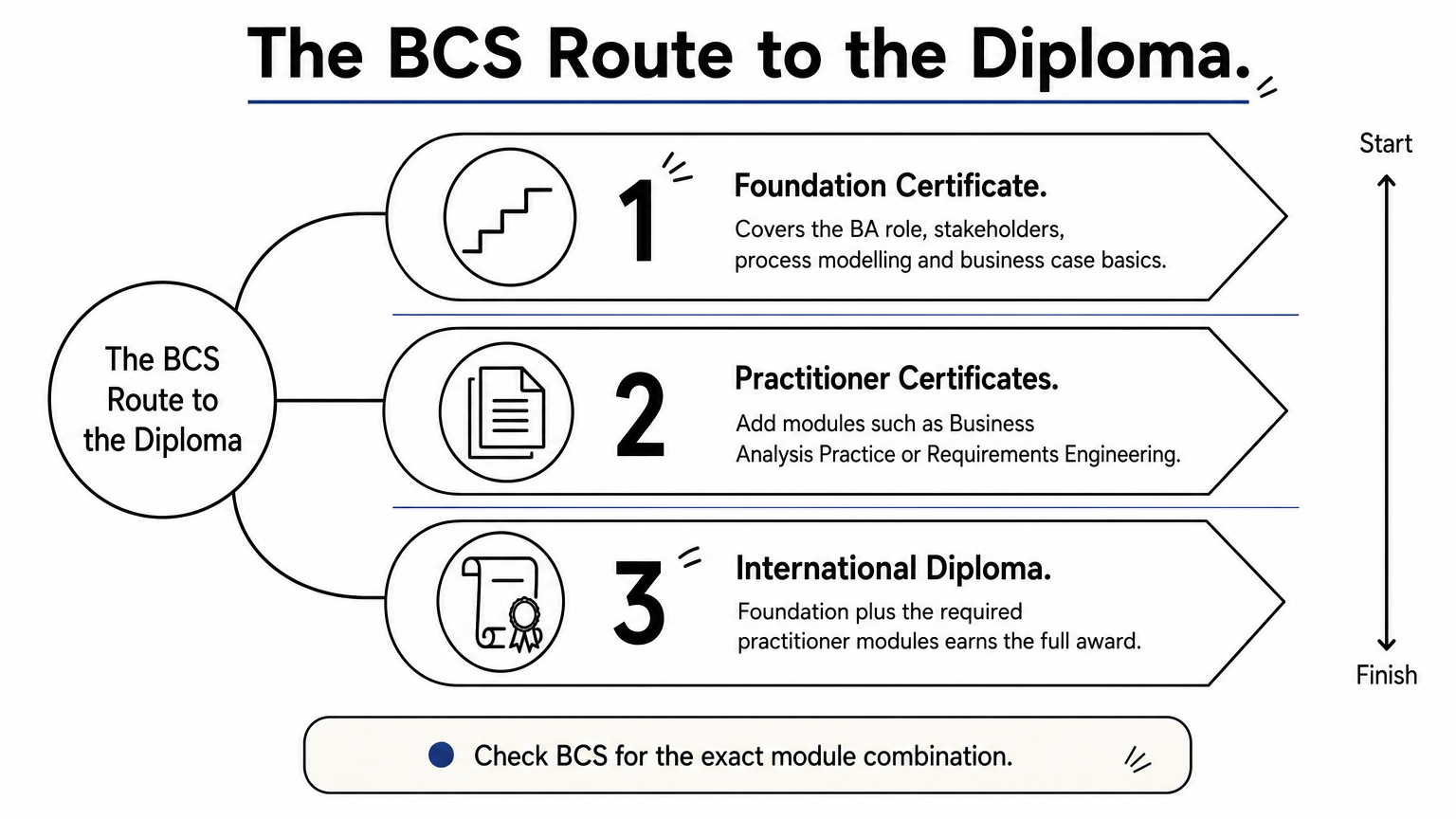
The BCS route is a ladder of exams rather than one single course. You start with the Foundation Certificate in Business Analysis, which covers the BA role, stakeholder analysis, process modelling and business case basics. You then add practitioner certificates, such as Business Analysis Practice or Requirements Engineering, through an accredited training provider.
Accreditation and qualification
BCS, The Chartered Institute for IT, is the body UK employers know best. Pass the Foundation and the required practitioner modules, and you can work towards the International Diploma in Business Analysis. Check BCS for the exact module combination before you book anything.
BCS proves you know the method, but it does not prove you can do the job.
Who it is best for
This path suits people who already work near BA, such as project coordinators, testers and operations staff, and want a recognised business analyst certificate course on their CV. It also helps if an employer will fund your exams.
If you are starting from zero, it is a weaker choice on its own. Exams test knowledge, and most providers include no projects or job search help. Many beginners pair a BCS exam with a practical programme like option 1.
Format, duration and cost
Training providers across the UK offer these as live online classes or self-paced study, so you can take them from home. Exams are usually sat online or at a test centre.
| Stage | Typical study time |
|---|---|
| Foundation Certificate | A few days of training or several weeks of self-study |
| Each practitioner module | Several further days of study |
| International Diploma | Foundation plus the required modules |
Prices vary widely by provider. Expect several hundred pounds per module, and more for the full Diploma route. Always ask whether the exam fee is included in the quoted price.
3. Microsoft Business Analyst Professional Certificate
What the course covers

This business analyst online course comes from Microsoft and runs on Coursera. It leans towards the data side of the job. You work with Excel, Power BI and data-driven decision making, and you practise framing business problems and presenting findings. Microsoft updates the content, so check the course page for the current module list before you enrol.
Accreditation and qualification
You finish with a Coursera certificate issued under Microsoft's name. It is a vendor credential, not a BCS or IIBA qualification, so UK recruiters read it as proof of tool skills rather than BA method. If you want an official exam, Microsoft's separate PL-300 Power BI Data Analyst certification is the one to look at.
A Microsoft certificate shows you can use the tools, not that you can run a BA project.
Who it is best for
Beginners who like numbers will get the most from it, especially if you want to move towards data-heavy BA or reporting roles. It also works as a low-risk way to test whether analysis suits you. Expect a gap if you want stakeholder workshops, requirements documents or live project practice, because a self-paced online course for business analyst skills rarely covers those well.
Format, duration and cost
Study is fully online and self-paced, so it fits around work. Most of the cost depends on how fast you move.
| Detail | What to expect |
|---|---|
| Format | Online, self-paced video and exercises |
| Duration | Several months at a few hours a week |
| Cost | Coursera subscription, billed monthly |
| Support | Discussion forums, no live career help |
Because you pay monthly, faster learners pay less. Check the current Coursera price, as it changes.
4. AgileBA Foundation and Practitioner
What the course covers
AgileBA teaches business analysis inside agile delivery, which is how most UK tech teams now work. You learn to shape a business case, work with stakeholders and prioritise requirements using MoSCoW and timeboxing. Foundation covers the principles and vocabulary. Practitioner asks you to apply them to a scenario.
Accreditation and qualification
APMG International awards the certificates, working with the Agile Business Consortium. You pass Foundation first, then sit Practitioner. This agile-specific business analyst qualification sits alongside BCS rather than replacing it, and employers running Scrum or DSDM-style projects often list it in job adverts.
AgileBA proves you can analyse inside an agile team, not that you can learn the BA basics from scratch.
Who it is best for
Choose it if you already understand the BA role and want to add an agile credential, for example as a tester, product owner or project coordinator. Complete beginners will struggle with Practitioner, because the exam assumes you know what requirements and stakeholders look like in practice. If that is you, start with a business analyst beginner course that includes projects, then add AgileBA later.
Format, duration and cost
Training providers run this business analyst certificate course as live online classes or in a classroom, so you can find a business analyst course UK option near you or from home. Exams are multiple-choice for Foundation and scenario-based for Practitioner.
| Detail | What to expect |
|---|---|
| Format | Live online or classroom, plus exams |
| Duration | Typically a few days per level |
| Cost | Several hundred pounds or more per level |
| Support | Trainer during class, no job search help |
Always check whether exam fees and the course manual are included in the price.
5. Level 4 business analyst apprenticeship
What the course covers

This route is a job with training attached, not a course business analyst candidates buy. A provider teaches the Level 4 standard while you work, and about 20% of your paid time goes on off-the-job learning. Topics include:
- Eliciting and documenting requirements
- Process modelling and stakeholder management
- Data analysis and agile delivery on live projects
Accreditation and qualification
Every apprenticeship ends with an end-point assessment, usually a project report, presentation and professional discussion. Pass it and you earn a nationally recognised Level 4 business analyst qualification.
Many providers also include BCS exams, so ask which ones are in the price.
Who it is best for
You must be employed in a UK role that involves analysis. It suits school leavers, graduates and existing staff an employer wants to retrain.
Career changers face a catch. You must win an apprenticeship post first, which is competitive, so your best route may be sponsorship from your current employer.
Format, duration and cost
Your employer pays the fees through the apprenticeship levy or government co-funding, so you pay no tuition. You earn a wage throughout, though entry salaries sit below a qualified BA's.
An apprenticeship pays you to learn, but you have to land the job first.
| Detail | What to expect |
|---|---|
| Format | Paid work plus day-release or online study |
| Duration | Typically 18 to 24 months |
| Cost to you | Usually nothing |
6. Udemy and LinkedIn Learning short courses
What the course covers
Each platform hosts hundreds of short videos on single topics, such as requirements gathering, user stories, BPMN process mapping and SQL basics. Quality varies by instructor, so check recent ratings and the last update date before you pay.
Accreditation and qualification
Expect a certificate of completion, not a recognised business analyst qualification. Neither platform awards BCS or IIBA credentials, so recruiters treat these certificates as evidence of effort and little more.
A certificate of completion shows you finished a video course, not that an employer should trust your skills.
Who it is best for
Use them as a low-cost taster or to fill one skills gap, such as SQL or Jira, once you work in or near BA. They are a poor main route into a first role, because you get no projects, no feedback and no job search help.
Format, duration and cost
Everything is self-paced, so a business analyst course online from these platforms fits around any schedule. Most courses run from one to ten hours.
| Detail | Udemy | LinkedIn Learning |
|---|---|---|
| Pricing | Pay per course, often discounted | Monthly or annual subscription |
| Access | Lifetime for each course | While you subscribe |
| Extras | Downloadable templates | Free trial, sometimes free via employers or libraries |
Treat these as supplements, not a complete plan. Check current prices before you buy.
Choosing the right course for you
Start with your situation, not the price tag. If you have no tech background, pick a programme with projects and job search support, because exams alone rarely win a first interview. If you already work near BA, a BCS or AgileBA certificate adds a recognised line to your CV for a few hundred pounds.
Apprenticeships suit you only if an employer will take you on or sponsor you. Microsoft, Udemy and LinkedIn Learning courses work best as cheap supplements once you know where your gaps are.
Our view is simple. The best course business analyst career changers can take is one that teaches you to do the job and helps you get hired. If that sounds like you, explore the Transform Learning Academy business analysis training programme and see how it fits around your current work.


