


5 Best Courses for Project Management, Free and Paid
Need More Help? Book Your FREE Strategy Session With Our Career Coaches Today!
The best course for project management is the one that matches your goal. If you need a credential that UK employers recognise, choose a PRINCE2 course or an APM qualification. If you are testing whether the work suits you, start with a free course from PMI or the Open University. If you already manage tasks at work and want practical tools, LinkedIn Learning fills the gaps. Career changers who want certification and live project experience in one programme should look at our own PRINCE2 course first.
Searching for a project management course returns a confusing mix. Free tasters sit beside awarding bodies, training companies and university short courses, and acronyms such as PRINCE2, PMP, PFQ and PMQ rarely get explained. You can easily pay for a qualification you did not need, or settle for a free module that no recruiter will notice.
This guide ranks five options, free and paid, in the order most career changers should consider them. Each gets the same two checks: what it covers, and who it suits, including cost and time. We run the first option, so weigh our view with that in mind.
1. Transform Learning Academy PRINCE2 course
What it covers

Our Certified Project Management Course With Job Placement takes you from no experience to a PRINCE2 certification exam, then onto live project work. There are no prerequisites. You study online, either live by webinar or on our self-study platform, and a new intake starts every month. Live classes are mostly at weekends.
- Length: 3 months
- Time commitment: an average of 5 hours a week, so roughly 60 to 65 hours in total
- Certification: PRINCE2 certification exam
- Experience: live project management project experience
- Accreditation: our courses are accredited by bodies including BCS, Axelos and CPD
Most project management training stops at the exam. Ours adds the live project, which gives you something concrete to put on a CV. So far, 98% of our delegates have passed their exams first time.
A PRINCE2 pass gets your CV noticed, and live project experience gives you something to say at interview.
Who it suits and what it costs
This course suits career changers with no tech or project background who want to be job-ready in about 90 days and can study around a current job. Students from teaching, pharmacy and policing have moved into business roles with us, so you do not need to come from an office career.
Ask the team for the current price and next intake date at customercare@transformlearningacademy.com. You can split payments over 3, 6 or 12 months interest free, and a 14-day money-back guarantee applies. We do not offer free re-sits, and a resit costs extra, so book your exam when you feel ready.
2. APM PFQ and PMQ qualifications
What it covers
The Association for Project Management (APM) offers two entry routes. The Project Fundamentals Qualification (PFQ) introduces the vocabulary and life cycle of a project. The Project Management Qualification (PMQ) goes deeper into planning, risk, scope and delivery, and suits people who have already seen projects up close.
You study with an accredited training provider and then sit an exam, so format, length and price vary by provider. Both qualifications draw on the APM Body of Knowledge, which describes good practice across the whole profession rather than one fixed method.
PRINCE2 teaches one structured method, while APM qualifications test your wider project knowledge.
Who it suits and what it costs
Choose APM if you want a UK-based professional body behind your certificate, or if your employer already recognises it. Start with the PFQ if you are new to the subject. Move to the PMQ once you have a year or two of project exposure to draw on.
Fees are set by each provider. Compare two or three quotes and ask whether the exam fee is included, how long you have access to the materials, and what a resit costs.
3. PMI Kickoff and the PMI certification route
What it covers
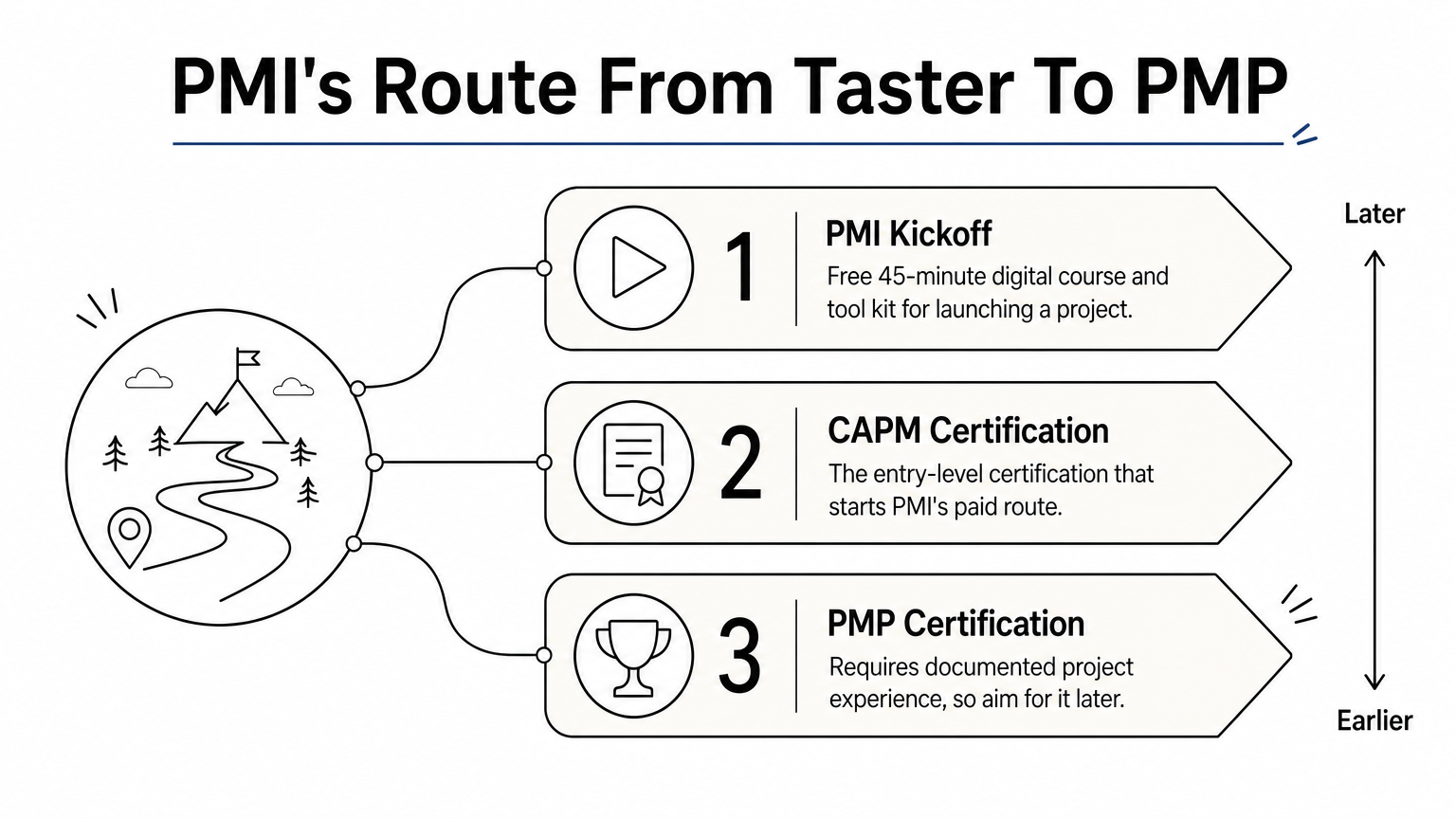
PMI Kickoff is a free, 45-minute digital course and tool kit that walks you through the basics of launching a project. It is a taster, not a qualification. PMI's paid route starts with the CAPM, an entry-level certification, and runs up to the PMP, which requires documented project experience.
That experience requirement matters. The PMP is aimed at people already leading projects, so a beginner should treat it as a later goal and not a first purchase.
Kickoff costs you 45 minutes and tells you whether project work is worth a larger investment.
Who it suits and what it costs
Kickoff suits anyone unsure about the field, because the only cost is the time. The CAPM and PMP suit people aiming at international employers, where PMI credentials are widely known. Exam fees apply and change over time, so check PMI's current pricing before you budget.
4. OpenLearn free project management course
What it covers
The Open University's OpenLearn platform hosts a free course on project management called "Project management: the start of the project journey". It explains what projects are, how they come about and how teams respond to problems. It is self-paced, written in plain language, and a sensible read before you spend money anywhere.
It is not an accredited qualification, so it will not replace a PRINCE2 or APM certificate on your CV.
A free course proves you can learn the subject, not that you can manage a project, so use it to decide, then invest.
Who it suits and what it costs
This option suits complete beginners, students and anyone comparing careers who wants a free project management course with no commitment. It costs nothing.
If you want a recognised qualification without paying full price, look at funding. Some providers in England offer funded places for adults who meet eligibility rules, so check your eligibility before you pay for any course.
5. LinkedIn Learning project management courses
What it covers

LinkedIn Learning offers a library of project management courses covering agile, scrum, waterfall and PRINCE2 concepts, plus how to use project management software. Lessons are short videos you can take in any order. You finish with certificates of completion, which show effort but are not accredited qualifications.
LinkedIn Learning is best for filling specific skill gaps, not for earning a credential.
Who it suits and what it costs
It suits working professionals who already manage tasks and want practical tools, or learners comparing methods before they commit to a certification. Access runs on a subscription, and trial terms change, so check the current price and trial offer on the platform before you start.
Choosing your first step
Match the course to your goal. If you want a recognised qualification and a route into work, take a PRINCE2 or APM course. If you are still deciding, spend an hour on PMI Kickoff or the OpenLearn course first. If you need tool skills, LinkedIn Learning is the cheapest top-up.
Whichever you pick, a certificate alone rarely lands the job. Look for a course that gives you hands-on project work as well. If the neighbouring career of analysing business problems also appeals, see how professional certification, project experience and career support come together in our Business Analysis Programme.


