


Data Analyst Jobs Entry Level: 10 UK Job Titles to Target
Need More Help? Book Your FREE Strategy Session With Our Career Coaches Today!
The best data analyst jobs entry level are the ones that put SQL, Excel and a dashboard tool such as Power BI in your hands from week one, whatever the job title says. Junior and graduate data analyst roles suit people with a degree or a few months of focused training. Apprenticeships suit school leavers and career changers who need a wage while they learn. Reporting, marketing, finance and operations analyst roles suit people who already know an industry and want to add data skills to it.
Searching for these jobs is frustrating because no single title covers them. The same role appears as junior analyst, trainee, graduate, insight analyst or MI analyst, and job boards bury it among data entry clerks, service desk posts and software roles. This article sets out ten job titles that count as entry-level data analyst work in the UK. For each one you get what the job involves, realistic pay and who it suits. Then you get a pay comparison and a method for searching by city and applying.
We train career changers with no tech background at Transform Learning Academy, so we see which routes turn into interviews and which waste applications. The pay figures below come from advertised ranges, not promises, and they move with the market.
1. Junior data analyst
A junior data analyst pulls, cleans and reports on data under the guidance of a senior colleague, and it is the most common label for data analyst jobs entry level in the UK. Employers use it when they want someone productive within weeks, not months.
A junior data analyst role is where most analytics careers start, so it deserves the largest share of your applications.
What the job involves
Most of your week goes on writing SQL queries, tidying the results in Excel or Google Sheets, and turning them into a weekly report or dashboard. You rarely design analysis from scratch. A manager brings a question, such as why sales dipped in one region, and you check the numbers before anyone else sees them.
Tools that adverts name most often:
- SQL and Excel, almost always
- Power BI or Tableau for dashboards
- Google Analytics or Adobe Analytics in digital teams
- Basic Python or R, usually listed as a bonus
Pay and where it is advertised
Advertised salaries for junior data analyst roles mostly fall between £24,000 and £32,500, and one large graduate job board puts the average at about £29,000. London adverts often start higher. Short contracts are quoted by the hour instead, for example £17 to £19.50 for a three-month London placement.
Watch the experience line. Some "junior" adverts ask for one to two years in a data role, which makes them junior in name only. Apply anyway if you meet most of the list, but expect stiffer competition.
Who it suits
This route suits anyone who can prove SQL and Excel skills with a small portfolio, whether the skills come from a degree or a few months of data analyst training. Many adverts ask for "exposure" rather than experience, so a project built on public data counts as evidence.
It is also the safest first target if you are changing careers. The title is widely understood, so recruiters know how to place you.
2. Graduate data analyst
A graduate data analyst role is a structured entry-level post, often a scheme, that recruits people with a degree and trains them over one to two years. It is the closest thing to a guaranteed learning path among entry level jobs for data analyst candidates.
Graduate schemes pay slightly more than most junior roles, but they close early and recruit a year ahead.
What the job involves
You do the same core work as a junior analyst, with more formal training around it. Expect rotations through teams, mentoring from a named analyst and sometimes professional exams. Some employers use fixed-term contracts that become permanent once you complete the programme.
Tasks and conditions vary by sector. A packaging firm might have you validating customer data for regulatory returns. A defence employer will have you modelling and managing data, and may ask for a long record of UK residency so that you can pass security vetting.
Pay and where it is advertised
Pay usually sits between £27,500 and £34,000. Examples include £31,000 plus a 3% bonus on a 24-month programme that turns permanent, and £34,000 for a graduate post in Bristol. Large employers publish schemes on their own careers pages, and many also appear on graduate job boards.
Many schemes recruit a year ahead, so adverts for next year's start appear in the autumn. Set alerts early and prepare your application before the advert goes live.
Who it suits
Final-year students and recent graduates fit best. Most schemes accept any degree if you can show numeracy, though maths, economics, science and computing graduates have an edge.
If you graduated a few years ago, do not rule yourself out. Some graduate-titled adverts accept people who qualified recently and have no relevant experience.
3. Trainee data analyst
A trainee data analyst is hired before you are fully skilled, and the employer builds your skills on the job. It is the friendliest label for entry level data analyst jobs UK career changers can find, because the advert expects gaps.

A trainee title tells you the employer expects to teach you, which makes it the best label for career changers.
What the job involves
Your first months mix supervised reporting work with structured learning. You might assist with monthly reports for regional offices, check data for errors and gradually take over a set of recurring dashboards. The ratio of training to real work depends on the employer.
Some trainee posts run through an academy model where a training provider prepares you and then places you with a client. Read these carefully. Find out who employs you, whether you are paid during training and what happens if you leave.
Pay and where it is advertised
Advertised pay runs from the mid-£20,000s to about £31,000, for example £27,500 for an entry-level data and AI analyst academy post, or £26,000 to £31,000 for a trainee in a financial services firm in Newcastle. Be wary of any advert that asks you to pay for training before a job is confirmed.
Hmm
Search for "trainee data analyst", "data analyst trainee" and "analyst trainee programme". Trainee posts are less common than junior ones, so check smaller firms and regional employers.
Who it suits
Trainee roles suit people with transferable skills but little formal data experience, such as admin staff, customer service leads and teachers. Show you can learn quickly with a completed online course and one project.
A short, honest cover note helps more than a long one. Say what you have already taught yourself, because that tells an employer you will finish their training.
4. Data analyst apprentice
A data analyst apprenticeship combines paid work with study towards a nationally recognised qualification. It is the route to data analyst jobs entry level that needs no degree, and the employer pays you while you learn.

An apprenticeship is the only route where you earn a wage, gain a qualification and avoid student debt at once.
What the job involves
You work in a real analytics or insights team for most of the week and spend the rest on study, usually one day or a block of time. One advert I would point to is an HR data analyst apprenticeship, where the apprentice builds skills in data visualisation, HR metrics, dashboard reporting and trend forecasting.
Apprenticeships span several levels. Business analyst apprenticeships at level 4 also appear, which makes this route worth checking if you lean towards the business side.
Pay and where it is advertised
Pay is lower than for other routes, roughly £18,000 to £26,000 depending on employer and level. A London insights apprenticeship at a wine merchant advertised £18,000 to £21,000, an apprenticeship in Cheltenham £23,000, and a level 4 business analyst apprenticeship in Manchester £26,000.
The government's Find an apprenticeship service lists current vacancies in England. Rules differ in Scotland, Wales and Northern Ireland, so check your own nation's service.
Who it suits
Apprenticeships suit school leavers, college leavers and adults who cannot afford a gap in income. Age is not a barrier, as anyone aged 16 or over who is not in full-time education can apply in England.
Read eligibility carefully. Some employers rule out applicants who already hold a qualification that overlaps significantly with the apprenticeship content, so a recent data degree can count against you here.
5. Junior business intelligence or reporting analyst
A junior business intelligence analyst builds and maintains the dashboards that managers use every day. Reporting analyst and MI analyst are near-identical titles, and all of them are good ways into data analyst jobs entry level if you enjoy visual tools more than statistics.
If dashboards appeal more than statistics, search for reporting and BI titles, not just data analyst.
What the job involves
You connect to databases, model data in a tool such as Power BI or Tableau, and publish reports that refresh automatically. Much of the work is fixing broken reports and answering "why doesn't this number match?" from colleagues.
The strongest candidates know basic data modelling, can write joins in SQL and can explain a chart in plain English. Microsoft publishes a Power BI Data Analyst Associate certification, which gives you a credential that employers recognise.
Pay and where it is advertised
Advertised ranges overlap with junior data analyst pay, so expect somewhere in the high £20,000s to low £30,000s. Treat a "junior BI analyst" advert with a much higher salary as a post that really wants experience, even if the title says junior.
Use several search terms: "reporting analyst", "MI analyst", "BI analyst junior", "dashboard analyst" and "insight analyst". Each pulls different listings from the same job boards.
Who it suits
This role suits people who already live in spreadsheets, such as finance assistants, admin coordinators and operations staff. You are halfway there, because you know what managers want to see.
A portfolio piece helps. Publish one dashboard built on public data, then be ready to explain each design decision in an interview.
6. Junior marketing or digital analyst
A junior marketing analyst measures campaigns, websites and customers using tools such as Google Analytics. It is one of the more approachable data analyst entry level jobs because the data is easy to get hold of and you can practise on a personal site.
Digital analytics is the one area where you can build real practice data for free on your own website.
What the job involves
You track how many visitors arrive, where they come from and which ones buy. Daily work includes building campaign reports, spotting drops in conversion and presenting findings to marketing managers. One junior data analyst advert listed Google Analytics, Adobe Analytics, Google Sheets and Google Apps Script among its key skills.
Automation matters here. Being able to turn a manual weekly report into a scheduled one is a skill employers mention repeatedly.
Pay and where it is advertised
Pay falls in the same broad band as other junior data analyst roles, with the exact figure depending on sector and location. Adverts rarely use the word "analyst" alone, so search for "digital analyst", "web analyst", "marketing data analyst" and "performance analyst".
E-commerce firms, agencies, publishers and in-house marketing teams all hire. Larger retailers usually advertise on their own careers pages first.
Who it suits
Marketing coordinators, social media managers and e-commerce assistants fit best. You already understand the metrics, so your task is to add SQL and a dashboard tool.
Show a short case study with real numbers. Even a small blog analysed in Google Analytics can demonstrate you can find an insight and recommend an action.
7. Junior finance or commercial analyst
A junior finance or commercial analyst uses data to track budgets, margins and sales for a business. These roles often count among the best-paid entry level jobs data analyst applicants can reach, because employers value the mix of numbers and commercial sense.
Finance analyst roles pay slightly more than general data roles because the data directly drives money decisions.
What the job involves
The work is Excel-heavy. You build forecasts, reconcile figures from several systems and explain variances to budget holders. A commercial finance analyst might partner with clients on project budgets and new business proposals, which is how one international research organisation describes its entry-level post in London.
SQL and Power BI increasingly appear alongside Excel. Many employers now want a finance analyst who can pull their own data without waiting for the IT team.
Pay and where it is advertised
Advertised pay often sits between £30,000 and £35,000 outside London, for example a junior commercial finance analyst post in Cheshire. A junior consulting analyst role in London advertised £40,000 plus benefits. Some adverts state no salary at all, so ask early in the process.
Search for "junior commercial analyst", "junior FP&A analyst", "finance analyst graduate" and "credit analyst trainee". Specialist recruitment agencies post many of these, often on short contracts.
Who it suits
Accounts assistants, bookkeepers and anyone with a finance or economics background suit this route. You already read financial statements, so the move is to show data tools on top.
Mention any experience with budgets or month-end reporting. Employers weigh that as heavily as a data course.
8. Junior operations, planning or revenue operations analyst
An operations or planning analyst uses data to keep a business running, whether that means vans, staff or sales pipelines. These posts hide in plain sight among data analyst jobs entry level searches because the title seldom says "data".
Operations analyst roles often do the same work as a data analyst under a different label, with less competition.
What the job involves
A junior resource and demand planning analyst, for example, combines resource planning with data analysis, reporting and practical AI automation to match technician capacity to customer demand. A revenue operations analyst works on sales data and CRM systems such as Salesforce. A workforce analyst tracks staffing and productivity.
All three spend their time in spreadsheets, databases and dashboards. The difference is the business domain you learn alongside them.
Pay and where it is advertised
Advertised pay runs from about £28,000 to £33,000. Examples include a junior planning analyst role up to £33,000, a trainee workforce analyst at £28,000 in Newcastle and a graduate revenue operations analyst role in London at £30,000 with a 5% discretionary bonus.
Search "planning analyst", "workforce analyst", "supply chain analyst", "revenue operations analyst" and "junior Salesforce administrator". The last often involves data quality, duplicates and clean-up, which is good analyst training.
Who it suits
Retail managers, logistics coordinators, call centre team leaders and hospitality supervisors fit best. You know how operations behave on the ground, which analysts without that background lack.
Lead your CV with the operational problem you solved, then name the numbers and tools you used.
9. Research or insight analyst
A research or insight analyst studies data from surveys, customers or markets and turns it into recommendations. It is a quieter corner of entry-level data analyst jobs that suits people who like questions as much as spreadsheets.
Insight roles reward curiosity and clear writing as much as technical skill, which makes them good for career changers.
What the job involves
You gather data, analyse it with Excel or a statistics package and write up what it means. A junior research analyst at a media group, for example, works in a research-focused role with a global remit. Apprentice data and insight posts at publishers ask for an analytical mindset and willingness to learn visualisation tools.
Reports and presentations are a bigger part of this job than in most others. Expect to explain findings to non-specialists.
Pay and where it is advertised
Adverts often leave pay out, so ask recruiters for the range at the first call. Do not guess from similar titles, because pay varies far more between employers here than in finance roles.
Search "research analyst", "insight analyst", "data and insight apprentice" and "performance and insight analyst". Councils, universities and housing associations also advertise data and insight posts, so check their own careers pages.
Who it suits
Social science graduates, market researchers, teachers and policy staff fit well. If you have run surveys or analysed results during a degree or a job, put that first.
A sample write-up helps more than a certificate here. Show that you can reach a finding and say what a manager should do about it.
10. Junior business analyst with a data focus
A junior business analyst works out what a business needs, then uses data to support the case. It sits next to data analysis and is a strong alternative among data analyst entry level jobs if you prefer talking to people over writing code all day.
If you would rather shape what gets built than build the dashboard, business analysis is the closer fit.
What the job involves
You gather requirements from stakeholders, map processes, write user stories and use SQL and Excel to test whether a change worked. The data side is lighter than in a pure analyst role, but employers increasingly expect you to query data yourself.
Typical deliverables are process maps, requirement documents and short reports. You work with developers, product managers and operations leads.
Pay and where it is advertised
Pay varies by sector, and financial services and consultancies tend to pay more than the public sector. Because business analyst adverts mix junior and senior posts, filter for "junior business analyst", "graduate business analyst" and "business analyst apprentice".
If you want a guided route, our Business Analysis Programme combines professional certification, hands-on project experience and career support for people with no tech background.
Who it suits
Career changers from teaching, pharmacy, policing and customer-facing work fit this path well. Your experience of people and processes counts for more than you expect.
Pair it with basic SQL and a recognised qualification. Together they answer the "no experience" objection that stops most applications.
Entry-level data analyst salaries across the UK
Entry-level data analyst pay in the UK mostly runs from the low £20,000s for apprenticeships to the mid-£30,000s for graduate, finance and London roles. A role title tells you less than the sector and city do, so compare like with like before you decide whether an offer is fair.
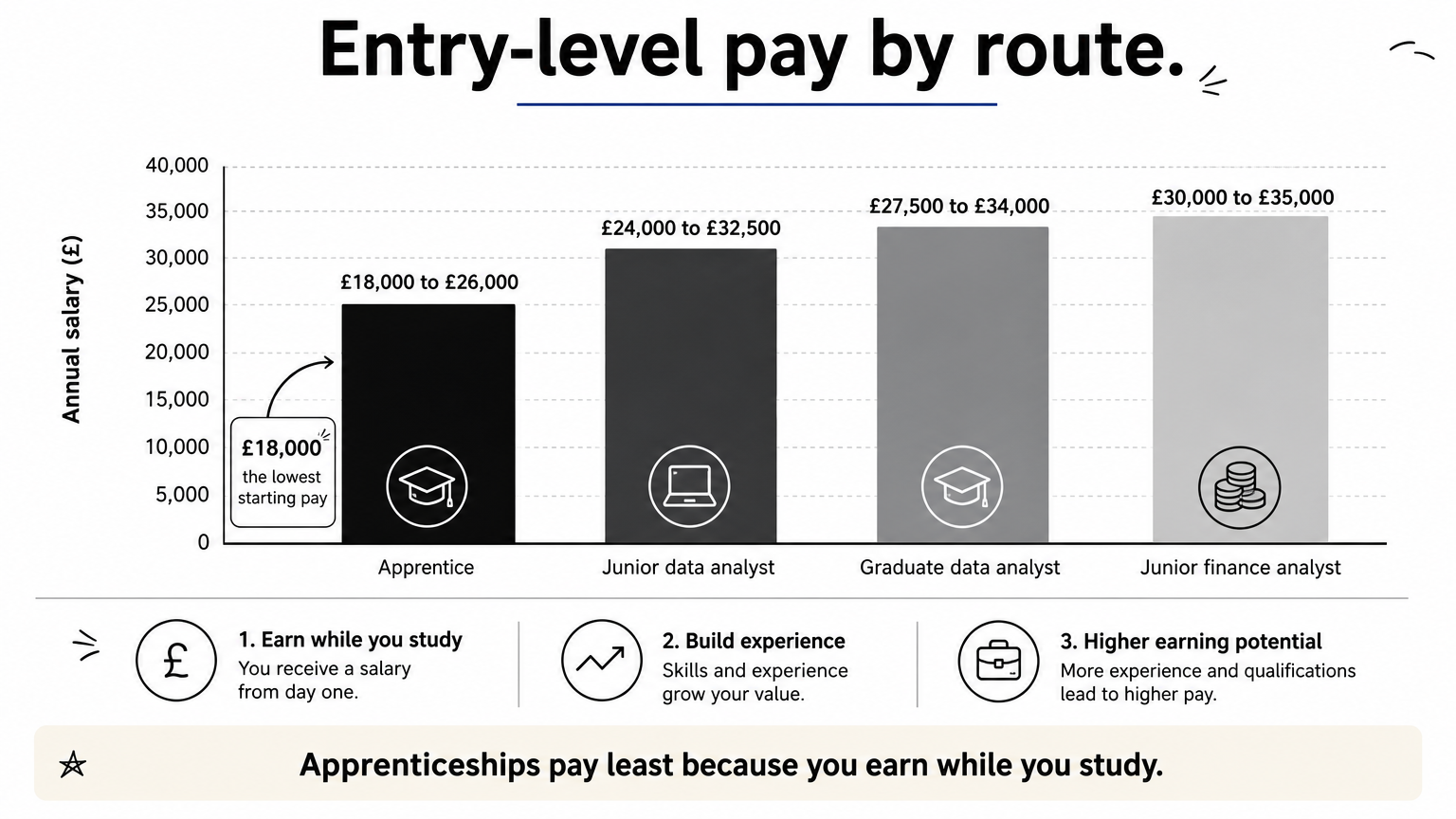
A salary range tells you which kind of employer wrote the advert, so read the whole range, not the top figure.
Pay by role side by side
The table collects the advertised ranges from the ten roles above. Treat each figure as a typical band, not a guarantee, and check current adverts before you negotiate.
| Role | Typical advertised pay | Main tools to know |
|---|---|---|
| Junior data analyst | £24,000 to £32,500 | SQL, Excel, Power BI or Tableau |
| Graduate data analyst | £27,500 to £34,000 | SQL, Excel, a BI tool |
| Trainee data analyst | £26,000 to £31,000 | Excel, SQL basics |
| Data analyst apprentice | £18,000 to £26,000 | Excel, reporting tools |
| Junior BI or reporting analyst | Similar to junior data analyst | Power BI, Tableau, SQL |
| Junior marketing or digital analyst | Similar to junior data analyst | Google Analytics, Adobe Analytics |
| Junior finance or commercial analyst | £30,000 to £35,000 | Excel, forecasting |
| Operations or planning analyst | £28,000 to £33,000 | Excel, Salesforce, planning tools |
| Research or insight analyst | Often not stated | Excel, survey tools |
| Junior business analyst | Varies by sector | SQL, process mapping, Excel |
London compared with the rest of the UK
London has the most listings and the highest starting pay. A junior consulting analyst role in the capital advertised £40,000, against about £28,000 for a trainee workforce analyst in Newcastle and £31,000 for a graduate role in Milton Keynes. Bristol graduate roles in defence and engineering reach about £34,000.
The London premium is real, but so are living costs. Outside London, Birmingham, Leeds and Bristol often show the most listings, and hybrid working means you can sometimes live further out and attend an office one or two days a week.
How to read a salary in an advert
Look at what sits around the number. Employer-provided figures are firm, while estimates that a job board generates itself can be far off. A range with a very high top, such as £27,500 to £65,000, usually covers several seniority levels, and the entry point is the lower end.
Check the contract too. Fixed-term posts, bonuses of 3% to 5% and day rates "inside IR35" tell you whether you are an employee or a contractor. A £160 to £175 day rate is not directly comparable with an annual salary.
How to find and apply to data analyst jobs near you
To find entry-level data analyst jobs near you, search several title variants, filter by town or city with a realistic radius, set daily alerts and apply with a short portfolio. The same method works for London, Manchester, Leeds or a smaller town.
Search by title variants, not just "entry level data analyst", or you will miss half the roles and drown in the wrong ones.
Search terms that surface the right roles
Searching "entry level data analyst" alone returns data entry clerks, service desk analysts and cyber security trainees, because job boards match the words "entry" and "data" separately. Use exact titles instead.
- junior data analyst
- graduate data analyst
- trainee data analyst
- data analyst apprentice
- reporting analyst or MI analyst
- insight analyst
- data coordinator
- junior business analyst
Searching near you and in London
For a near-me search, enter your town and set a radius of 10 to 20 miles, then widen it if results are thin. In London, search "central London" and your own borough separately, since employers use both. Expect hybrid arrangements, with one to three office days a week common in adverts.
Fully remote entry-level data analyst jobs are rarer, because employers prefer to train juniors in person. Do not filter them in exclusively, or you will cut your options sharply. Public sector posts also appear on the Civil Service Jobs site, and many councils and universities advertise on their own pages.
Building an application that gets a reply
Employers screen quickly, so make your evidence easy to see. Use this order for your application:
- Put a two-line summary at the top that names your target role and your main tools.
- List two or three projects with the question, the tool and the finding.
- Add a link to a dashboard or a SQL file that a recruiter can open in a minute.
- Match the advert's key skills in your own words, without copying phrases.
- Prepare for a short SQL test, an Excel task or a small case study at interview.
Set alerts and apply within the first few days of an advert, because fresh listings attract the most applicants. Keep a simple tracker of where you applied and which title brought interviews, then lean towards that title.
Where to start your search
Entry-level data analyst work goes by many names, and the people who get hired search by title, show proof of SQL and Excel skills, and apply early. Start with junior and trainee titles, add apprenticeships or graduate schemes if you qualify, and test adjacent roles in finance, operations, marketing and insight where competition is thinner.
If the business side appeals more than the technical side, a certified business analysis route can open the same doors with a different emphasis. You can see how our certified business analysis programme works, including the project experience and the career support, before you decide.


