


5 Entry Level Data Analyst Jobs You Can Apply for in the UK
Need More Help? Book Your FREE Strategy Session With Our Career Coaches Today!
The best entry level data analyst jobs teach you on the job and rely on tools you can learn in months: Excel, SQL and Power BI or Tableau. Apply for junior data analyst roles if you want the standard route. Aim at junior BI analyst roles if you like building dashboards. Choose an apprenticeship if you need a wage while you train. Look at management information or sector analyst roles if you already know an industry well.
Searching for these jobs is harder than it should be. Titles vary from employer to employer, many "entry level" adverts ask for two years of experience, and remote or part-time openings are scarce. This article sorts the market into five types of role, so you know which titles to search for, what each employer expects and where the adverts appear.
At Transform Learning Academy we train UK career changers with no tech background for data and business analysis work. So the list focuses on roles where a newcomer has a fair chance, with or without a degree.
1. Junior data analyst
What the job involves
A junior data analyst collects, cleans and summarises data so a team can make a decision. In a typical week you write SQL queries, tidy messy spreadsheets, refresh a weekly report and answer questions such as "why did sales dip in March?"

You work beside a senior analyst who checks your output, which is why employers are willing to hire at this level. Expect small, well-defined tasks at first, then more ownership of a reporting area as you prove accurate.
A junior analyst is paid to answer small, specific questions accurately and on time.
What employers ask for
Most adverts ask for the same four skills, and Python is usually a bonus rather than a requirement:
- Excel, including pivot tables and lookups
- SQL for filtering, joining and summarising tables
- Power BI or Tableau for charts and dashboards
- Clear explanations for non-technical colleagues
Degrees are often listed as desirable rather than essential, and a portfolio of projects usually carries more weight than another certificate. Advertised pay for junior roles commonly sits between about £25,000 and £35,000, so check each advert's figure against your region and sector.
Where to look and who it suits
Search Reed, Indeed, CV-Library and LinkedIn for "junior data analyst", "graduate data analyst" and "trainee data analyst", then set a daily alert. Many adverts labelled entry level ask for two years of experience. Apply if you meet most of the skills, but skip any that demand several years of commercial work.
Fully remote junior roles are rare, because employers like to coach newcomers face to face. Filter for hybrid and expect some office days. This role suits you if you already have Excel and SQL basics and a few projects to show.
2. Junior BI or reporting analyst
What the job involves
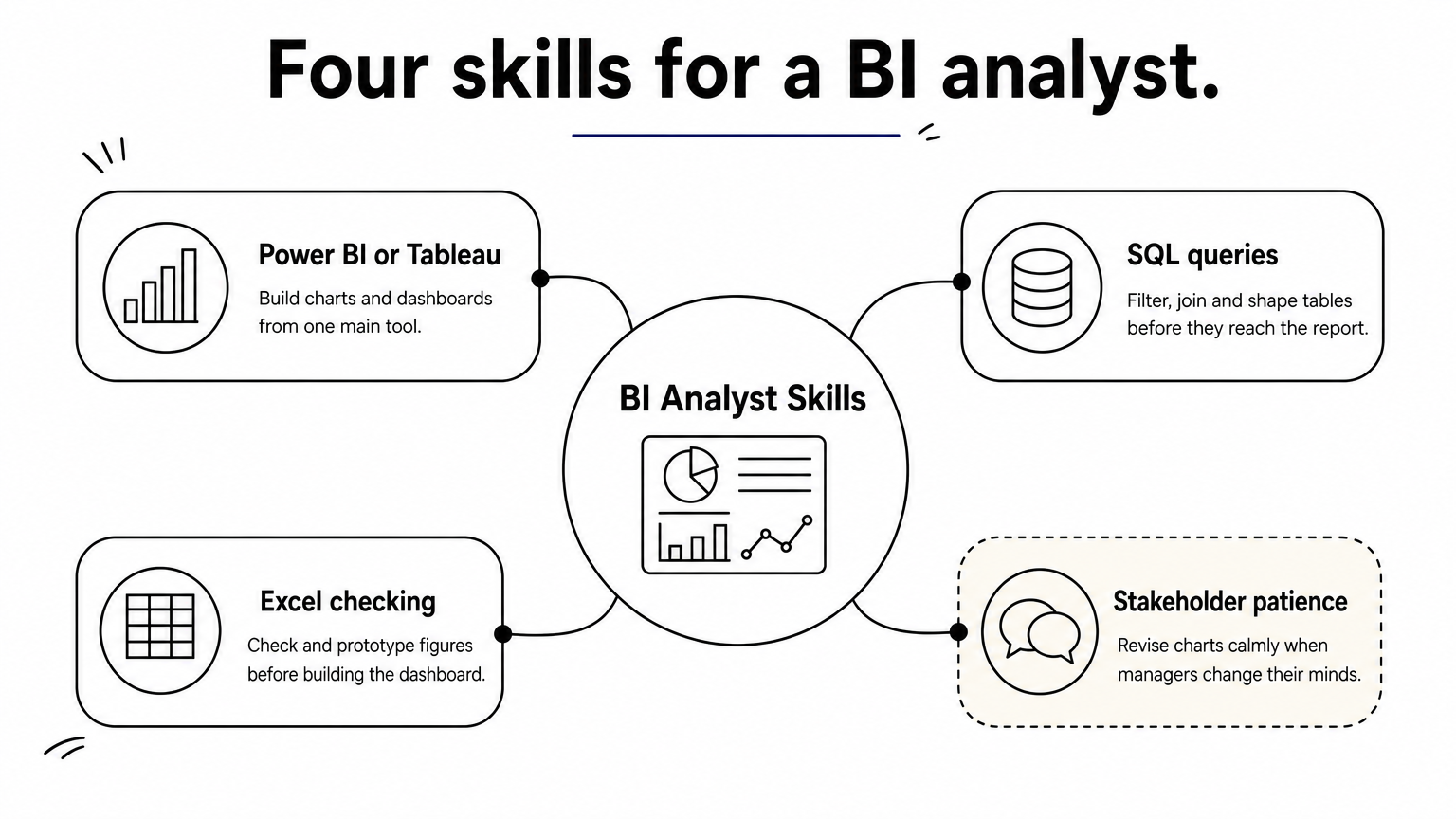
A junior business intelligence (BI) analyst builds and maintains the dashboards that managers open every morning. You connect Power BI or Tableau to a database, write SQL to shape the data, fix reports that fail to refresh and ask stakeholders what each chart should show.
The work is narrower than a general analyst role and more visual. You spend less time on one-off questions and more on reliable, repeatable reporting that other people depend on.
BI roles reward the person who builds a dashboard a busy manager understands in ten seconds.
What employers ask for
Adverts for these roles usually centre on one main tool plus the skills around it:
- Power BI (often with DAX, its formula language) or Tableau
- SQL and a grasp of how tables, keys and relationships fit together
- Excel for checking and prototyping
- Patience with stakeholders who change their minds
Depth in one tool beats shallow knowledge of two. A single polished dashboard built on a public dataset shows more than a list of software names on your CV.
Where to look and who it suits
Search "BI analyst", "reporting analyst", "Power BI analyst" and "dashboard analyst". These jobs are common in retail, logistics, finance and consultancies, where managers live on weekly numbers. They suit you if you enjoy visual problem solving and explaining what a chart means.
If you want structured training for this route, Transform Learning Academy's Business Intelligence Analyst Course with Job Placement runs for six months at an average of five hours a week, roughly 130 hours in total. It has no prerequisites and includes a two-day live training, 12 months of e-learning access to Advanced Excel, SQL, Python, R, Tableau and Power BI, accredited certification and live project experience.
3. Data analyst apprentice or trainee
What the job involves
An apprenticeship is a paid job where part of your week goes on studying for a qualification. A trainee scheme is an employer-run programme with its own internal training. Either way, you are hired expecting to start with little and to learn the craft on the job. With an apprenticeship, the tuition is covered by the employer and government funding, not by you.
In England the data analyst apprenticeship standard sits at level 4, and these schemes typically last well over a year. Scotland, Wales and Northern Ireland run their own apprenticeship systems with different rules.
An apprenticeship trades a lower starting wage for a salaried job, a qualification and no tuition fees.
What employers ask for
These employers hire for attitude and aptitude more than for software skills:
- Visible interest in numbers, such as a small spreadsheet project
- Basic Excel
- GCSE maths and English, or equivalent, which many schemes list
- Good results in numeracy tests and interviews
Apprenticeships are open to adults, not only school leavers, but competition is stiff. Apply to several schemes at once.
Where to look and who it suits
The GOV.UK Find an apprenticeship service lists current vacancies in England. Large employers also post schemes on their own careers pages, often with fixed application windows. Set alerts for "data analyst apprentice" and "data trainee" so you do not miss one.
This route suits you if you can manage a lower starting salary for a while and want a structured path with a recognised qualification at the end. If your outgoings are high, compare the wage carefully against the junior roles above.
4. MI, operations or performance analyst
What the job involves
A management information (MI) analyst produces the recurring numbers a department runs on, such as weekly sales, call volumes, complaints or staffing levels. Titles include MI analyst, performance analyst, operations analyst and insight analyst.

Most of the work happens in Excel, with some SQL as you progress. Your time goes on accuracy: reconciling figures, spotting errors before a manager does and explaining movements in plain English.
The quickest way into analysis is often an analyst job in the industry you already know.
What employers ask for
Employers care about accuracy and sector knowledge as much as tools:
- Advanced Excel: pivot tables, lookups and formulas
- Attention to detail and a habit of checking your own work
- Knowledge of how the sector's processes work
- Ability to explain figures to non-specialists
Domain knowledge is your edge here. A former teacher understands school performance data, and a former pharmacist understands dispensing and stock figures. A graduate with no work history cannot match that, which is why domain knowledge often decides the shortlist.
Where to look and who it suits
Start inside your current employer or sector. Many organisations advertise vacancies internally first, and a manager who already trusts you will back an internal move more readily than an unknown applicant. Outside, search banking, insurance, local government, retail and contact centres for these titles.
Part-time openings exist but are scarce across all five role types. Filter by working pattern on the job boards and raise reduced hours at offer stage. This role suits you if you have years of sector experience and want the lowest-risk switch into analysis.
5. Marketing, finance or healthcare analyst
What the job involves
Sector analyst roles use the same analytical skills as the roles above but tie them to one function. A junior marketing analyst tracks campaigns and website traffic. A junior finance analyst supports budgets and forecasts. A junior healthcare data analyst reports on activity and patient data for an NHS trust or private provider.
The pay-off is narrower competition. You compete on knowledge of the function, not only on tools, and fewer applicants can credibly do both.
A sector label narrows the competition because you compete on knowledge as well as tools.
What employers ask for
Tools overlap heavily between sectors, but each one adds its own knowledge requirements:
| Sector | Typical tools | Extra knowledge |
|---|---|---|
| Marketing | Google Analytics, Excel, campaign dashboards | Channels such as email, search and paid social |
| Finance | Excel modelling, SQL, Power BI | Budgeting, forecasting and basic accounting |
| Healthcare | SQL, Excel, Power BI or Tableau | Patient data confidentiality and UK GDPR |
Treat the right-hand column as your study list. A short course or project in the sector's vocabulary shows you can speak the hiring manager's language.
Where to look and who it suits
NHS trusts advertise on the NHS Jobs site, with pay set by published national bands, which makes salaries easy to compare. For marketing and finance, use the general job boards and search titles such as "marketing analyst", "junior financial analyst" and "healthcare data analyst". Read the requirements carefully, because some finance adverts ask for accountancy study.
This route suits you if you have a background in the function, such as years of clinical, finance or marketing work, and want to add data skills to it rather than start from zero.
Choosing your first role
Pick the role by what you already have. Start with junior data analyst roles if you have Excel, SQL and a portfolio. Go for BI roles if you enjoy dashboards, an apprenticeship if you need a wage while you train, and MI or sector roles if your past career gives you knowledge that graduates lack. Whichever you choose, search several job titles, set daily alerts and apply when you meet most of the requirements, not all of them.
If you would rather start from business analysis, which asks for many of the same reporting and communication skills, take a look at Transform Learning Academy's programme for business analysis certification and project experience, with career support to help you into work.


