


Entry Level Business Analyst Jobs in the UK: 5 Routes In
Need More Help? Book Your FREE Strategy Session With Our Career Coaches Today!
The best entry level jobs business analyst employers fill in the UK come through five routes: certified training with project experience, graduate schemes, internships and placements, junior roles, and apprenticeships. Graduates suit schemes, students suit internships, people with a year of related work suit junior roles, and school leavers suit apprenticeships. Career changers with no degree suit the first route. A good pick is one whose requirements you meet today and whose pay is stated.
Job boards make this harder than it should be. A search for entry level business analyst jobs returns adverts that ask for seven to ten years of experience, internships with no pay figure, and roles that are really sales or admin. Listings also expire within days, so a static list of vacancies would be out of date before you finished reading it.
This guide covers each route in the same way: how it works, what it pays and where to apply. The figures come from UK job adverts and the National Careers Service. It comes from Transform Learning Academy, a UK online training provider whose students include former teachers, pharmacists and police officers who became business analysts. That gives us a close view of what career changers lack on a CV. By the end you will know which route fits you, what to search for and how to read an advert.
1. Certified training with live project experience
If you have no degree, no tech background and no experience, the quickest way into entry level business analyst jobs is to qualify first and build project experience before you apply. Transform Learning Academy's Business Analysis Programme is built for this situation.

A recognised certificate plus real project work gives a recruiter something to assess when your CV has no analyst job on it.
How it works and what it pays
The programme takes about 3 months at an average of 5 hours a week, with no prerequisites. It includes 2 days of live business analysis training, a live business analysis project and preparation for the BCS Business Analysis Foundation certification exam.
Pay depends on the role you land, not the course. The junior pay bands in route 4 show what to expect. If data appeals more, the Data Business Intelligence Analyst course runs for 6 months at the same weekly pace. It gives 6 months of e-learning access to Advanced Excel, SQL, Python, R, Tableau and Power BI, which are the tools entry level BI analyst jobs ask about.
Who it suits and where to start
Career changers fit this route best. Teachers, pharmacists and police officers have strong transferable skills but no analyst title, and a certificate plus project work fills that gap. Classes are online and live sessions are mostly at weekends, so you can keep your current job. Intakes start every month.
Begin by checking the next intake date for your chosen course. Then ask about the CV reviews and job placement assistance that come with it. Certification opens interviews, but you still apply for junior roles through the channels in route 4.
2. Graduate business analyst schemes
Graduate schemes are the most structured entry level business analyst jobs, because they pair a salaried first role with a senior analyst who trains you. A typical advert places you in a change team under a senior business analyst.
If you hold a degree, a graduate scheme gives you pay and mentoring from the first day.
How it works and what it pays
The National Careers Service says any degree that builds analytical skills can work. Some employers prefer business information systems, business management, computing or computer science. You apply, sit assessments and interviews, then start a salaried role.
Advertised London graduate roles have offered £30,000 plus an annual bonus, and £33,500 plus benefits for a technical business analyst post with hybrid working. One remote graduate listing advertised £40,000. Treat these as examples of the range, not a guarantee.
Who it suits and where to apply
Final-year students and recent graduates are the target. Search "graduate business analyst" on Milkround, LinkedIn and Indeed, then check the careers pages of banks, consultancies and large retailers directly.
Widen your business analyst job titles as well. Business analyst work also sits under "technology graduate programme", "associate consultant" and "graduate analyst". Some large retailers describe the work as supporting agile project teams to deliver business outcomes, which is business analysis under another name.
3. Business analyst internships and placements
Internships and placements last from 3 months to a year, and they are the easiest way to put business analysis on a CV while you study. Amazon UK, for example, has advertised business analyst internships of 3, 6 and 12 months.

Large employers recruit a year ahead, so apply in autumn for the following summer.
How it works and what it pays
Programmes such as the London Stock Exchange Group summer business analyst internship start in June 2027 and were already open for applications in autumn 2026. Some employers ask for one application across all their graduate opportunities, so read the instructions before you apply twice.
Pay varies widely. One London internship advertised £2,000 per month, about £24,000 a year if annualised. Several near-identical internship adverts used the same wording and no pay figure, so ask about pay before you invest time in an application.
Who it suits and where to apply
Students and recent graduates benefit most. The National Careers Service notes that internships, work placements and a year in industry give a degree candidate an advantage, and a placement often turns into a graduate offer.
Search "business analyst intern" and "business analyst placement" on LinkedIn, Indeed and Milkround, and check university careers services. Prefer adverts that name the employer, the length and the pay.
4. Junior business analyst and BI analyst roles
Junior roles are direct hires for people with roughly a year of related experience, not a degree-led scheme. One London junior business analyst advert asked for around one year in market research, business support, administration, marketing or sales support, with a degree preferred.
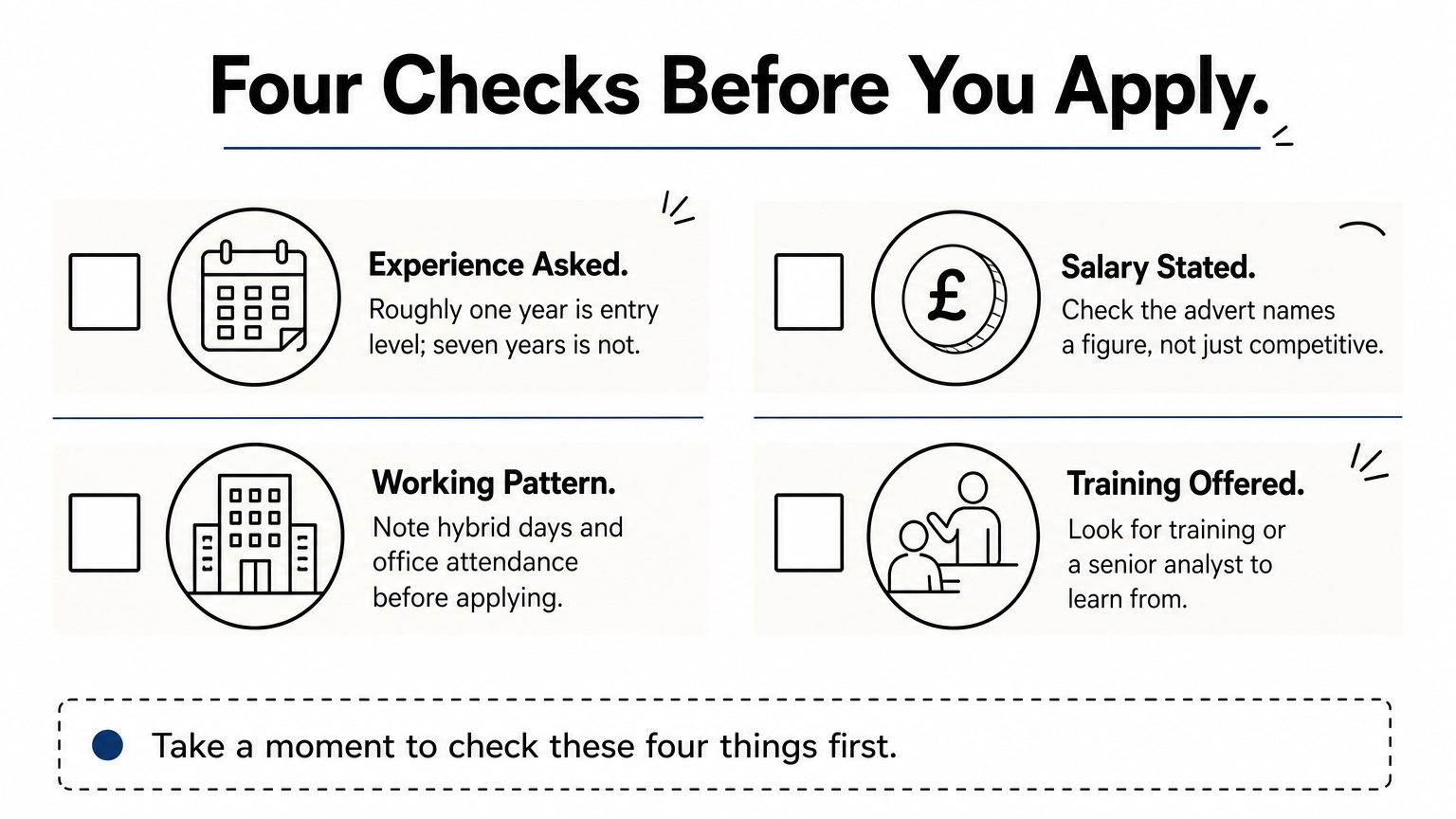
The "entry level" label on a job board is not a promise, so read the requirements list.
How it works and what it pays
Milkround puts the average junior business analyst salary at £32,499, within a range of £24,999 to £37,499. The National Careers Service gives £23,000 as an average starting salary, rising to £55,000 for experienced analysts. Entry level BI analyst jobs usually appear as junior BI analyst, reporting analyst or data analyst roles, and their advertised pay varies, so check each advert.
Check these points before you apply:
- The experience asked for. One year is fine. Seven to ten years is not entry level, even when the search page says so.
- Whether the advert states a salary or only "competitive".
- The working pattern, such as hybrid with four office days a week.
- Whether the employer mentions training or a senior analyst to learn from.
Who it suits and where to apply
This route suits people with admin, research, marketing or support experience who can show analysis in their current work. Search Indeed, LinkedIn, Totaljobs, CWJobs and Glassdoor for "junior business analyst", "graduate business analyst" and "associate business analyst".
London has the most listings, so search there first. Then widen to the whole UK and to hybrid or remote roles, because the same job titles appear in other cities with fewer applicants.
5. Business analyst apprenticeships
An apprenticeship lets you earn a wage while working towards a qualification, and it needs no degree. The National Careers Service lists the Business Analyst Level 4 Higher Apprenticeship as a route into the role.
Apprenticeships are the paid way into business analysis without a degree.
How it works and what it pays
You work for an employer and study alongside the job. For a higher or degree apprenticeship you usually need 4 or 5 GCSEs at grades 9 to 4 and A levels or equivalent. One advertised business analyst apprentice post paid £22,000 a year, which sits just under the £23,000 average starting salary quoted for the job.
Who it suits and where to apply
School leavers and adults without a degree who prefer to learn on the job suit this route. Search the government's Find an apprenticeship service, and read the National Careers Service business analyst profile for entry requirements.
Progression is real. The same profile says experienced analysts can move into business project management, consultancy, other industries or freelance work.
Choosing your route in
Match the route to your starting point. With a degree, aim for graduate schemes and internships. With a year of related work, apply for junior roles. Without a degree, look at apprenticeships. If you are changing careers with no tech background, certified training and project experience gives you the credentials and the work examples that entry level business analyst jobs ask for.
Whatever you choose, read the requirements instead of the label, check that pay is stated, and apply early to the schemes that recruit a year ahead.
If you are a career changer, see how our business analysis certification and project programme works and whether the next intake suits you.


