


Graduate Business Analyst Jobs: 5 UK Routes and Their Pay
Need More Help? Book Your FREE Strategy Session With Our Career Coaches Today!
The best graduate business analyst jobs fall into five routes: consultancy and technology schemes, financial services and fintech roles, data and insight analyst posts, industry schemes in sectors such as infrastructure and defence, and placements, apprenticeships or junior roles. A good pick matches your degree, your pay floor and the place you want to work. Schemes suit you if you want structured training. Direct fintech roles suit you if you want the highest advertised salary. Junior routes suit you if your degree is not an obvious fit.
The difficulty is the noise. Search any job board and you meet hundreds of listings under overlapping titles, and most graduate scheme adverts say "competitive" where a salary should be. It is hard to tell a real business analysis role from a general analyst post.
This article sorts those listings into five routes. For each one you get example programmes advertised for 2027 starts, what the work involves, entry requirements and the pay signals that exist. A final section shows how to search by area, compare pay and strengthen your application. At Transform Learning Academy we train people into business analyst roles, so we know the titles and requirements employers use.
1. Consultancy and technology graduate schemes
Consultancies and technology firms run the most structured business analyst graduate jobs, but they rarely use the plain title. Search for "analyst", "consultant" or "graduate programme" as well.
Programmes and day-to-day work
A typical consultancy scheme puts you on client work early. Capgemini Invent's Accelerate Graduate Programme describes requirements capture and workshops, recommendations, business cases and tracking project progress and risks. That is the core of business analysis. Programmes worth searching for:
- Capgemini graduate programmes, including customer experience analyst and insights and data routes
- Accenture's Technology Analyst Graduate Programme, which opens with core training that includes GenAI
- PwC's graduate advisory and consulting roles
Pay, requirements and who it suits
Advertised pay is usually "competitive", so ask about salary during the application and compare it with the figures in the pay table later in this article. Many listings ask for a 2:1 or 2:2. Some add background checks: one Capgemini listing asks for proof of identity, three continuous years of employment history and an unspent criminal record check.
This route suits you if you want broad exposure and are happy to move between teams as business demand changes. It is less useful if you want to know your exact salary before applying.
Consultancy schemes train you broadly, so search for the programme name and not only "business analyst".
2. Financial services and fintech graduate roles
Banks, insurers and fintech firms hire graduates straight into business analyst roles, and their listings tend to state the clearest salaries.
Examples and advertised pay
Recent listings show a fintech graduate business analyst role with a £35,000 starting salary and a 2:1 requirement. A graduate scheme business analyst listing on a professional accountancy careers board offered £33,500 to £35,000 with hybrid working. A remote graduate product owner role was advertised at £35,000 to £40,000 plus bonus, built as a development role towards a full product owner position. Product ownership draws on the same skills as business analysis, so search both titles.
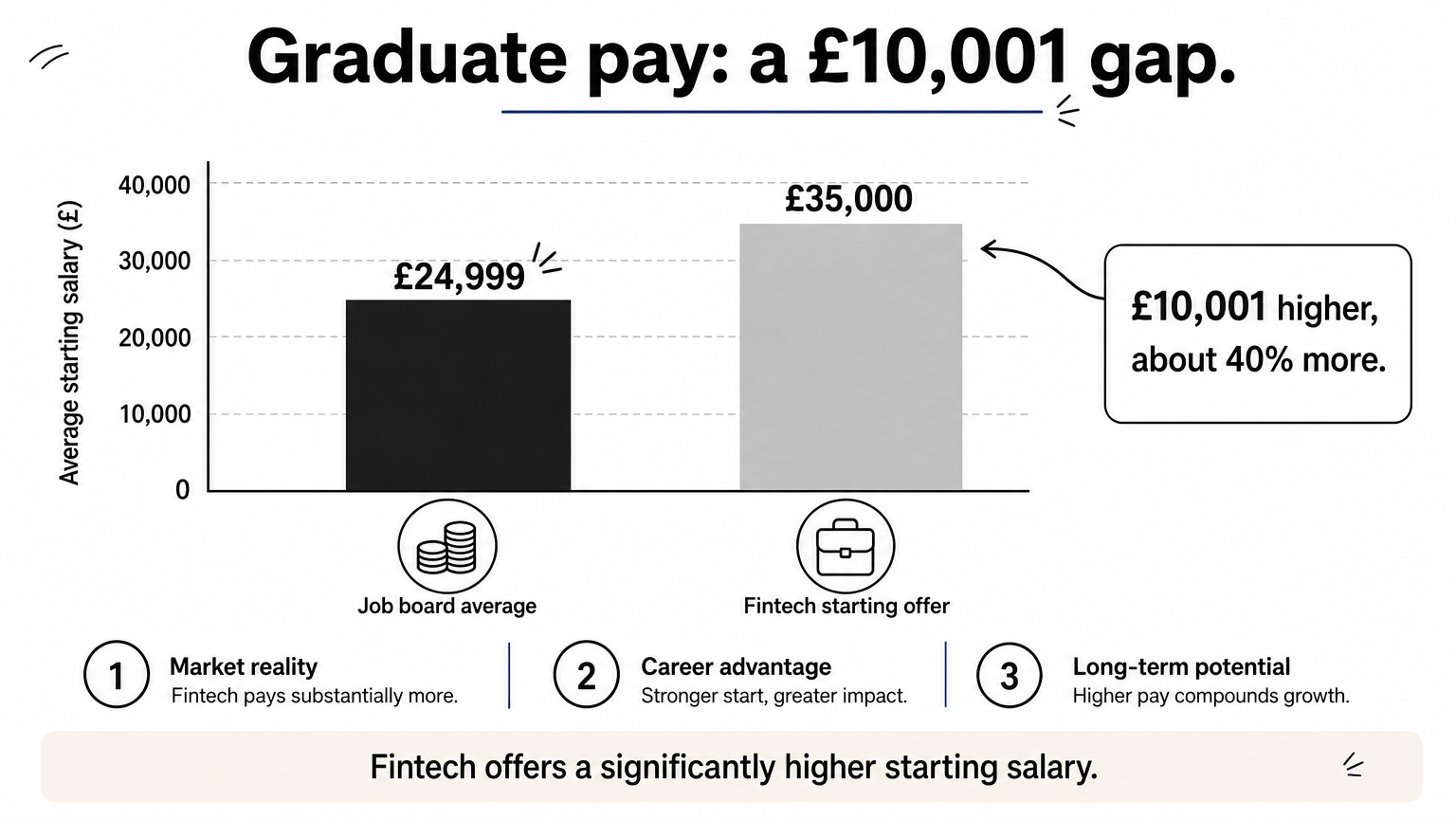
Here is what those figures mean in practice. One major graduate job board shows an average of £24,999 for graduate business analyst listings. A £35,000 offer is £10,001 higher, about 40% more. The board average rests on few listings that state a salary, so treat it as a floor and not a typical offer.
Requirements and who it suits
Expect a 2:1, strong analytical skills and a degree in a relevant subject. Finance, economics and maths help, but employers in this group also hire from business and technology degrees.
This route suits you if salary is your priority, you are comfortable in regulated settings and you can show you analyse data accurately.
If pay matters most, fintech and financial services listings give you the clearest figures to work from.
3. Data and insight graduate analyst roles
Data and insight roles are business analysis with more queries and spreadsheets, and they suit graduates who like numbers.

What the roles look like
Capgemini advertises a Graduate Insights & Data Consultant role. Isio advertises a 2027 Graduate Business Data Analyst role that includes professional qualifications and structured development support. Eversheds Sutherland hires a Graduate Legal Technology Analyst to work on AI, automation and data analytics in legal services, at £30,000 to £41,000. Not all of these say "business analyst" in the title. The work still turns business questions into data tasks and recommendations.
Skills, pay and who it suits
Data-leaning analyst listings commonly ask for Excel, SQL and Power BI, so learn them before you apply. If your degree had little data content, a structured course can close the gap. Our Certified Data Business Intelligence Analyst Course with Job Placement runs for six months at about five hours a week. It includes 6 months of e-learning access to Advanced Excel, SQL, Python, R, Tableau and Power BI.
This route suits maths, science, economics and social science graduates who are comfortable with numbers and want a technical edge.
A data-focused title does not rule out business analysis, because the requirements and stakeholder work are the same.
4. Industry graduate schemes in infrastructure and defence
Engineering, infrastructure and defence employers run graduate schemes where business analysis sits under titles such as risk analyst, commercial analyst or advisory graduate.

Programmes to look for
Balfour Beatty's Graduate Risk Analyst role covers project risk registers, qualitative and quantitative risk assessments and mitigation plans. It accepts degrees in finance, business or related subjects. WSP's 2027 Graduate Development Programme in Advisory asks for at least a 2:2 in a relevant subject. MBDA's 2027 undergraduate placements in commercial and digital excellence involve understanding business needs and processes. The commercial placement says strong performance could lead to a graduate role.
Pay, benefits and who it suits
The Balfour Beatty advert gives no pay figure, but it lists a permanent contract from day one, 25 days' holiday and bi-annual performance and pay reviews. It also offers support towards professional membership or chartership.
These schemes suit graduates with a real interest in a sector. The Balfour Beatty advert says it values potential over past experience, so show curiosity about the industry in your application.
Industry schemes often hide business analysis behind risk, commercial or advisory titles, so widen your search terms.
5. Placements, apprenticeships and junior analyst roles
If you have missed scheme deadlines or your degree is unrelated, placements, apprenticeships and junior roles are the realistic way in, and they often lead to graduate-level work.
Routes to look for
- Graduate apprenticeships: Barclays advertises a Technology Analyst Business Management Graduate Apprenticeship Programme for 2027.
- Placements: MBDA's 2027 undergraduate placements, open to students planning a year in industry.
- Junior roles: Capgemini has advertised a junior business analyst role in its data business, and investment firms post similar roles. Search "trainee business analyst" and "junior analyst" too.
Pay and who it suits
Pay on these listings is mostly "competitive". Treat junior roles as a stepping stone to the salaries in the financial services route, where a year of experience strengthens your case for a move.
This route suits second-year students, graduates with unrelated degrees and career changers who do not fit a scheme profile. It is also the most forgiving route if you started looking late.
A junior business analyst role is the least glamorous entry point and often the most reliable one.
How to search by area and compare pay
Search under several titles, filter by the distance you would travel or by remote work, and compare pay only against listings that state a figure.
Search by title, area and remote
Run each of these titles separately, because employers use different titles for similar work: graduate business analyst, junior business analyst, trainee business analyst, graduate consultant, technology analyst, graduate data analyst and graduate product owner. Set your radius to the commute you would accept. Add filters for remote business analyst jobs or hybrid work, since some graduate listings, such as the remote product owner role above, need no relocation. Scheme titles often include the start year, so treat 2027 in a title as your cue to apply early.
Compare pay before you apply
Advertised figures from the listings above sit in a narrow band. Use them as signals and not guarantees, because listings change.
| Route | Advertised pay in examples | Note |
|---|---|---|
| Fintech graduate business analyst | £35,000 starting | 2:1 asked for |
| Graduate scheme business analyst, hybrid | £33,500 to £35,000 | Accountancy careers board listing |
| Remote graduate product owner | £35,000 to £40,000 plus bonus | Development role |
| Graduate legal technology analyst | £30,000 to £41,000 | Data and automation focus |
| Consultancy and industry schemes | Usually "competitive" or not stated | Ask at application |
| Job board average | £24,999 | Based on few salaried listings |
Close skill gaps before you apply
Employers shortlist graduates who can show business analysis in action. A recognised foundation qualification and a project to point to on your CV both help, especially when your degree is unrelated. Our Certified AI Business Analysis Training Course takes three months at about five hours a week and needs no prerequisites. It includes two days of live training, the BCS Business Analysis Foundation certification exam and live business analysis project experience.
Prepare examples of communication, stakeholder work and process documentation, the skills that graduate business analyst listings ask for most.
Match your search to your degree and your pay floor, then prove the skills with a project.
Where to start your search
Graduate business analyst jobs sit across five routes, and each has a different trade-off. Schemes give structure but rarely state pay. Fintech and financial services roles give clear salaries from about £33,500 upwards. Data roles reward technical skills. Industry schemes reward sector interest. Placements, apprenticeships and junior roles get you in when other doors close.
Pick two routes, run the title searches above and apply early. If you want a recognised qualification and live project experience behind your applications, look at our programme for aspiring business analysts.


