


Business Intelligence Analyst Jobs: 8 Roles, Pay, Skills
Need More Help? Book Your FREE Strategy Session With Our Career Coaches Today!
The best business intelligence analyst jobs share three traits: a named reporting tool you can learn (Power BI, Tableau or Qlik), SQL as a core requirement, and a clear business owner for your dashboards. In recent UK adverts, permanent analyst roles cluster at £40,000 to £50,000, developer roles reach £60,000 and above, and banking or senior posts go higher. If you are changing careers, start with in-house analyst and public sector roles. If you already write SQL, aim for BI developer or senior analyst posts.
The trouble is that job boards bury you. One search returns data analysts, BI developers, finance reporting managers and consultants under the same title, and few adverts explain how the roles differ. This guide sorts them into eight types. For each type it shows what adverts pay, which skills employers ask for and who the role suits. It then compares pay side by side and explains where to search and how to apply.
We train career changers into data, BI and business analysis roles at Transform Learning Academy, so we read these adverts closely. Everything below reflects advertised ranges, not guaranteed salaries. Check each live advert before you apply.
1. In-house business intelligence analyst
The in-house BI analyst is the classic role: you work inside one organisation and turn its own data into reports that managers rely on. It is also the most common answer to a search for business intelligence analyst jobs, and the best starting point for most career changers.
What the role involves
You turn sales, customer and operational data into dashboards and recurring reports. One advert from a large UK infrastructure organisation asked for a commercially focused analyst to turn customer, revenue and commercial data into clear recommendations.
Most of your day is SQL queries, a dashboard tool and conversations with the people who read your numbers. Expect to spend as long clarifying the question as building the chart.
The in-house analyst role rewards people who can explain a number as well as calculate it.
Pay and skills employers ask for
Permanent adverts sat at £40,000 to £50,000. One posting advertised up to £50,000 plus a 20% bonus. Employers repeatedly ask for:
- SQL for pulling and shaping data
- One BI tool, usually Power BI, Tableau or Qlik
- Strong Excel
- Clear written and spoken communication with non-technical colleagues
- Commercial awareness of how the business makes money
Who it suits
This role suits analytical people from other fields, such as teachers, pharmacists and operations staff, because you already understand how an organisation uses data. You do not need to build data pipelines, which keeps the technical bar lower than for developer roles.
To stand out, build two or three dashboards from public datasets and describe each in business terms: the question, the finding and the decision it supports.
2. Finance-focused BI and reporting analyst
Finance teams hire analysts who can build reporting from accounting and systems data. These roles often carry the BI analyst title even when the work sits between finance and technology, so read the advert body, not just the heading.
What the role involves
One advert sought a finance systems reporting analyst and BI developer on a 12-month fixed-term contract covering maternity leave. The work was analytical reports and Tableau dashboards for finance and operational teams. A financial services advert for a business data analyst described supporting front office decisions through interpreting complex data.
You will reconcile figures, explain variances and automate reports that someone once built by hand each month.
Finance BI roles pay a premium for analysts who understand the numbers behind the dashboard.
Pay and skills employers ask for
The fixed-term finance reporting role advertised £40,000 to £50,000. The permanent financial services business data analyst role advertised £55,000 to £65,000. Skills requested included:
- Tableau or Power BI
- T-SQL and SQL Server
- Financial reporting knowledge
- Stakeholder management with finance leaders
- Comfort with data quality checks
Who it suits
Accountants, finance assistants and bookkeepers have a real advantage here. You already know what a month-end close looks like and why a figure that is out by pennies matters.
If that is you, add SQL and one dashboard tool to your existing finance knowledge. Fixed-term contracts also work as a door opener, because employers take a lower risk on someone new.
3. Public sector data and BI analyst
Councils, health bodies and government departments hire a steady flow of BI and data analysts. Pay is lower than in finance, but the roles are often permanent and come with strong benefits.

What the role involves
A council advert for a data analyst in adult and older people's services asked the postholder to lead reporting frameworks, Power BI dashboards and automated reporting. The same advert listed forecasting future demand, supporting workforce planning and contributing to service redesign.
Your audience is service managers and partner organisations, so your job is to make performance data easy to act on.
Public sector analyst roles trade some salary for stability, benefits and visible impact.
Pay and skills employers ask for
That council role advertised £42,228 to £48,633 for a permanent, 35-hour post. Across a public sector job site's BI listings, the advertised ranges ran from roughly £32,500 to £47,700. Typical requirements were:
- Excel, Power BI and Power Query
- Experience reporting performance data
- Clear communication with non-technical audiences
- Public sector or health and social care knowledge (often "advantageous")
Who it suits
If you value job security and a pension, this is a strong fit. The council advert listed a local government pension scheme and up to 33 days annual leave, so check the benefits as well as the salary.
Allow extra time to apply. That advert said not to submit a CV and asked for written answers on service improvement and communicating data to non-technical stakeholders. Some posts also need disclosure checks before an offer.
4. Business intelligence developer
A BI developer builds the data foundations that analysts report from. The role is more technical than an analyst post, and it pays more.

What the role involves
Adverts describe ETL processes, data pipelines and data models. One consultancy advert listed SQL Server, T-SQL, DAX calculations, SSAS cube development and dimensional modelling, including star schemas and Kimball methods. Another focused on creating and managing Qlik Sense and Qlik Cloud solutions in an industrial setting.
You spend more time in code and models than in meetings, though you still translate business requirements into technical designs.
If you enjoy building the plumbing more than the presentation, aim for BI developer roles.
Pay and skills employers ask for
Advertised pay ranged from £40,000 to £50,000 for an industrial BI developer up to £50,000 to £60,000 for consultancy and Qlik roles. A banking BI developer role advertised £63,000 to £77,000. Recruiters list these tools as in demand:
- SQL Server and T-SQL
- SSIS, SSRS and SSAS (the Microsoft stack)
- Tableau, Qlik, Looker or Power BI
- DAX and dimensional modelling
- Python, often described as advantageous
Who it suits
This role suits people with IT support, software testing or database backgrounds, and analysts who already write confident SQL. It is a harder first step for someone with no technical exposure.
A sensible plan is to start as an analyst, learn modelling on the job and move across within a couple of years. Consultancies also hire people from fast-paced project environments, not only from pure BI careers.
5. Senior analyst in a digital product team
Digital businesses hire senior analysts who work next to product managers and engineers. The title may say data analyst, but the daily work sits firmly in BI and measurement.
What the role involves
One advert for a senior data analyst at a large consumer platform listed defining product metrics and measurement frameworks, improving tracking and leading experimentation programmes. You evaluate A/B tests and present recommendations to senior stakeholders.
You also mentor junior analysts and help set standards for how the wider team measures success.
Senior analyst roles pay for judgement: choosing the right metric and defending your conclusion.
Pay and skills employers ask for
That advert offered £50,000 to £70,000 plus benefits for a hybrid role. Requirements included:
- Advanced SQL and strong Python
- Knowledge of statistical inference and experimental design
- Familiarity with digital tracking tools such as Google Analytics
- Experience working in cross-functional product teams
- Ability to explain complex analysis to non-technical colleagues
Who it suits
This is a step-up role for analysts with several years of experience, not a first job. If you already work in marketing analytics, e-commerce or product reporting, you are close.
Prepare examples of experiments you ran or evaluated, including what you recommended and what the business did. Employers want to see that your analysis changed a decision.
6. Business analyst with a BI focus
Many organisations blur the line between business analyst and BI analyst. If you search business intelligence business analyst jobs, you will meet roles where gathering requirements matters as much as building reports.
What the role involves
A capital markets advert asked a business analyst to gather, analyse and document business requirements for advanced analytics and client intelligence initiatives, in an Agile environment. A digital business analyst advert in the NHS focused on promoting consistent business analysis approaches.
Your output is requirements documents, process maps and clear specifications that BI developers can build from.
A business analyst who understands data and dashboards is easier to hire than one who does not.
Pay and skills employers ask for
Many of these adverts do not state pay, so ask the recruiter early. For comparison, a senior business analyst contract on an ERP programme advertised £450 to £500 per day. Skills that recur include:
- Requirements gathering and workshop facilitation
- Process mapping and BPMN
- Gap analysis and documentation
- Agile ways of working
- Enough SQL or dashboard knowledge to talk to developers
Who it suits
This route suits communicators and organisers who prefer people and process over code. It is also where many career changers land, since professional certification such as the BCS business analysis foundation exam is widely recognised.
Pairing business analysis training with a BI tool such as Power BI gives you a profile that fits both job titles.
7. Contract BI and analytics roles
Contract roles fill gaps quickly, and they pay by the day. They suit experienced analysts, because clients expect you to start producing work in days.
What the role involves
One advert sought a fraud analyst on a three-month contract to analyse transaction data in SQL and visualise it with BI tools. A public sector organisation advertised a temporary BI manager to lead its reporting team and deliver analytics programmes.
Contracts come with a defined scope and little onboarding. You are hired for a specific skill you already have.
Contract work rewards specialist depth, and it gives you little time to learn on the job.
Pay and skills employers ask for
The fraud analyst role advertised £275 to £300 per day, inside IR35, which generally means tax is deducted as if you were an employee. The temporary BI manager role advertised £300 to £500 per day. Employers wanted:
- Strong SQL on large datasets
- Looker, Tableau or Power BI
- Sector knowledge, such as fraud, payments or public sector
- Independence and fast delivery
- Stakeholder communication
Who it suits
Contracting suits analysts with three or more years of experience who can cope with gaps between assignments and no paid leave. It is rarely the right first move for a career changer.
Several contract adverts were remote within the UK, which widens your options if your local market is thin.
8. BI manager and team lead
Experienced analysts move into management roles that mix technical judgement with people leadership. These posts are rarer, so they fill slowly and pay well.
What the role involves
A BI manager leads a reporting team and owns delivery of critical reporting and data programmes. Related adverts included a people data and reporting manager running HR systems and data, and a data governance manager building a governance framework and operating model.
You manage priorities, stakeholders and budgets, and you stay close enough to the technology to review the work.
Management roles in BI still expect you to read a data model and challenge a number.
Pay and skills employers ask for
A people data and reporting manager role advertised £65,000 to £70,000. A data governance manager role advertised £50,000 to £55,000, and a 12-month head of data and analytics post advertised £85,000 to £95,000. A recruiter's data analysis and BI category showed salaries up to £115,000. Common requirements were:
- Team leadership and coaching
- Stakeholder engagement at senior level
- Technical BI expertise, often in a named tool
- Data governance and quality knowledge
- Programme or project delivery
Who it suits
This route suits analysts with five or more years of experience who enjoy developing others. Start collecting evidence now: mentoring, running a reporting process end to end, and presenting to senior leaders.
Project management skills help here, because delivery of data programmes is a large part of the job.
How business intelligence analyst pay compares
Advertised pay for business intelligence analyst jobs runs from the low £30,000s in public sector listings to well over £60,000 for banking and senior posts. Most mid-level analyst roles sit between £40,000 and £50,000.
Advertised pay side by side
The table pulls together the ranges quoted above. Each figure comes from a single advert or listing, so treat it as a guide to the market, not a salary scale.
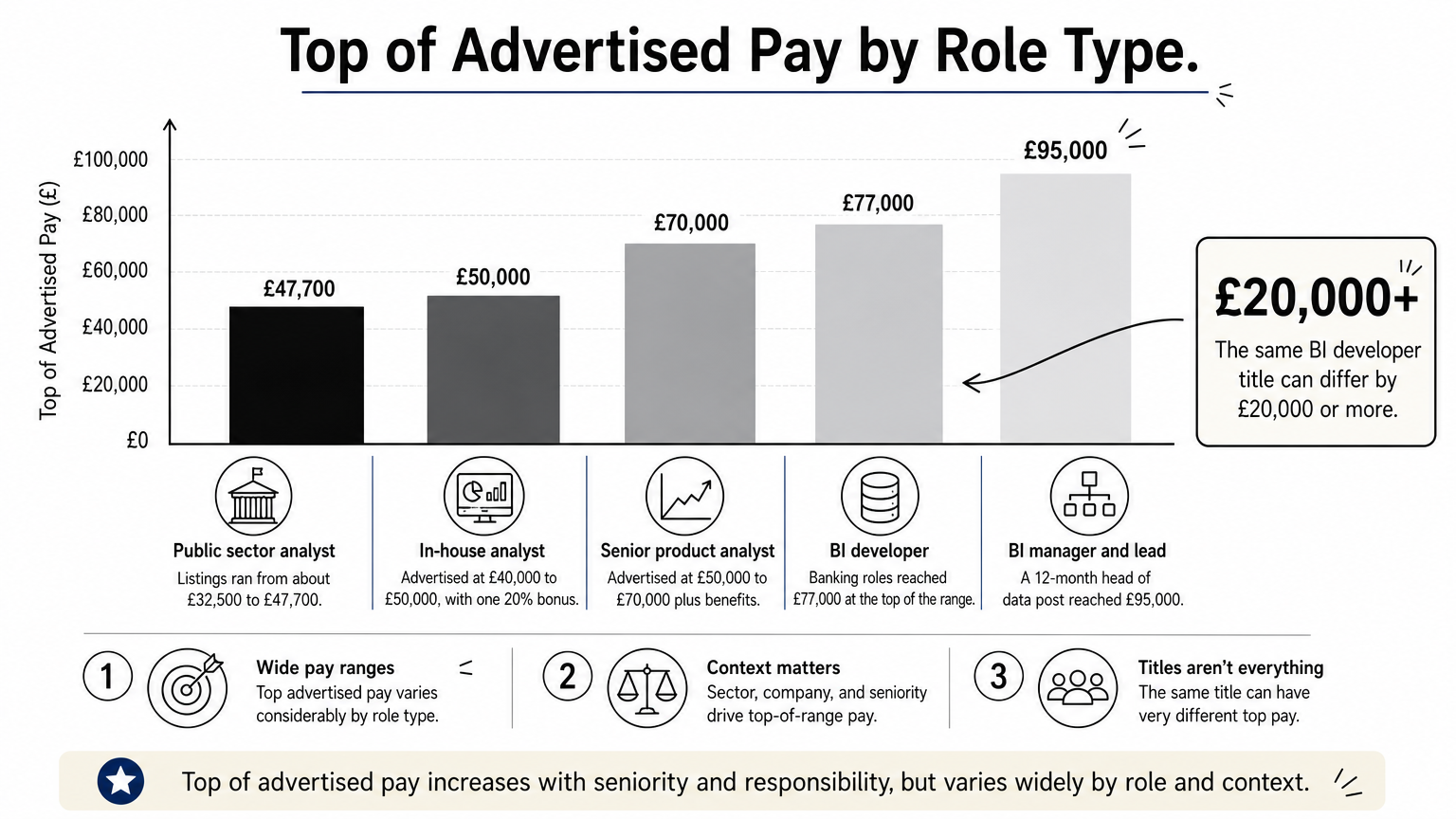
| Role type | Advertised pay | Notes |
|---|---|---|
| In-house BI analyst | £40,000 to £50,000 | One advert offered a 20% bonus on up to £50,000 |
| Finance-focused analyst | £40,000 to £50,000 (fixed term), £55,000 to £65,000 (permanent) | Financial services pays more |
| Public sector analyst | About £32,500 to £47,700 across listings | One council advert: £42,228 to £48,633 |
| BI developer | £40,000 to £77,000 | Banking at the top of the range |
| Senior product analyst | £50,000 to £70,000 plus benefits | Hybrid working |
| Business analyst, BI focus | Often not stated | ERP contract: £450 to £500 per day |
| Contract BI and analytics | £275 to £500 per day | Fraud analyst at the lower end |
| BI manager and lead | £50,000 to £95,000 | Head of data interim at the top |
What moves pay up or down
Sector and technical depth move pay most. A banking BI developer role advertised £63,000 to £77,000, while an industrial BI developer role advertised £40,000 to £50,000, so the same title can differ by £20,000 or more. Bonuses matter too: an advert offering up to £50,000 plus 20% means up to £10,000 extra, or £60,000 at best.
Day rates need a careful look. A three-month contract at £300 per day is roughly 60 working days, or about £18,000 before tax. Billing 220 days a year at £300 would give £66,000 gross, which looks higher than a £45,000 salary. But you would lose paid holiday, sick pay and pension and carry the risk of gaps between contracts.
How to find and apply for BI analyst vacancies
The fastest way to find business intelligence analyst jobs is to search several sources with several job titles, then tailor each application to the skills in the advert. Vacancies are spread across general boards, recruiters and employer sites.
Where to search
Use the large general job boards for volume, and set alerts so new adverts reach you quickly. Add specialist data recruiters such as those that focus on analytics and BI, because they advertise roles that never reach the general boards.
Do not skip employer sites. Council and NHS vacancies often appear on their own public sector portals, and large consultancies and banks post on their own career pages. Many adverts are hybrid, and some ask for set office days, such as three a week. Others are remote within the UK, so test your search both with and without a location filter.
Searching several sources with several titles beats refreshing one board with one phrase.
Search terms that surface more roles
Employers rarely use one title. Try these alongside "business intelligence analyst":
- Reporting analyst
- Insight analyst
- Customer insight analyst
- Business data analyst
- BI developer
- Regulatory reporting analyst
- Business systems analyst
- Data analyst
How to apply without BI experience
Lead with proof, not promises. Build two Power BI or Tableau dashboards from public data, write a short description of each, and put them on your CV next to the SQL you can already write. Mirror the wording of the advert, because employers often search CVs for tool names.
Read the application instructions twice. Some public sector posts ask for written answers instead of a CV, such as describing when your analysis led to a decision. Prepare two or three stories with a clear problem, action and result.
If you want a structured route, our Certified Data Business Intelligence Analyst Course with Job Placement is built for career changers. It runs for about six months at an average of five hours a week and has no prerequisites. It includes 12 months of e-learning access covering Advanced Excel, SQL, Python, R, Tableau and Power BI, plus a two-day live training and live project experience. Check the programme page for the current intake.
Where to start your search
Match the role to where you are today. Career changers should begin with in-house analyst, finance reporting and public sector roles, then move toward developer, senior or management posts as their SQL and project evidence grows. Contract roles come last, because they reward depth you build over years.
Whichever role you choose, the pattern is the same. Learn SQL and one dashboard tool, build visible projects, and apply to several job titles at once. If the business analyst route with a BI focus appeals, our business analysis training programme combines professional certification, hands-on project experience and career support for people with no tech background.


