


Junior Business Analyst Jobs: 8 Roles to Apply for in the UK
Need More Help? Book Your FREE Strategy Session With Our Career Coaches Today!
The best jr business analyst jobs in the UK are permanent junior analyst roles and graduate schemes, which typically pay roughly £25,000 to £40,000 depending on employer and region. A good pick pays a fair salary, puts you on live projects and gives you a senior analyst to learn from. Graduates suit the schemes, school leavers suit apprenticeships, and career changers with transferable skills can aim at junior permanent, IT analyst or contract roles.
The hard part is the search itself. Job boards return hundreds of postings under overlapping titles such as junior, graduate, associate and entry level. Many of them turn out to be senior roles, repeated agency adverts or paid courses dressed up as jobs. You can lose hours working out which ones a beginner can actually win.
This guide sorts entry level business analyst jobs into eight types, with what each involves, what it pays and who it suits. It then compares pay across UK cities, including London, Manchester, Birmingham and Leeds, and ends with a plan for getting shortlisted. It comes from Transform Learning Academy, which trains career changers into business analysis roles. The salary examples come from advertised roles, so treat them as guides, not guarantees.
1. Permanent junior business analyst roles
A permanent junior business analyst role is the most direct way in. One employer hires you, pays a salary and benefits, and pairs you with a senior analyst. Of all the jr business analyst jobs, these give the clearest path to promotion, so apply here first.

What the work involves
You support requirements gathering for a project team. That means taking notes in stakeholder meetings, writing user stories, mapping how a process runs today and how it should run, and helping users test changes before release.
Expect documentation-heavy work at first. Senior analysts lead the workshops while you draft, tidy and track. Postings often ask for process definition, requirements documentation and some experience on data-driven projects, so an applicant who is confident with spreadsheets stands out.
Typical pay
Advertised permanent roles have sat at £30,000 to £33,000 plus benefits, for example a hybrid role in Bradford with two office days a week. Wider salary data for the title puts the average near £32,500, with a range of roughly £25,000 to £37,500.
London postings tend to sit at the upper end of that range, and smaller regional employers at the lower end. Pension, holiday and hybrid working can matter as much as the headline figure.
A permanent junior role is the best-value first job because salary, training and progression come as one package.
Who it suits
This route suits people with some business exposure, even outside tech. Staff in operations, customer service, finance or the public sector already document processes and deal with stakeholders, and that is what hiring managers want to see.
- You can show process or requirements examples from your current job.
- You are comfortable with Excel and a tracking tool such as Jira.
- You can explain a problem clearly in writing.
2. Graduate business analyst schemes
Graduate schemes are the most structured of the jr business analyst jobs. A large employer hires a cohort, trains it together and places you on client or internal projects. Capgemini's Graduate Business Analyst 2027 programme is a typical example, advertised at £35,000 with an April intake.
What the work involves
Schemes mix classroom training with project placements. The Capgemini advert lists sites in Birmingham, Bristol, Inverness, London, Manchester, Treforest near Cardiff and Woking, so the same scheme can place you in several cities.
Consultancy programmes work slightly differently. The Capgemini Invent financial services programme hires associate consultants, which blends business analysis with wider consulting tasks. It asks for a minimum 2:2 degree, either achieved or in progress.
Typical pay
Where a figure is shown, £35,000 is a realistic benchmark for a graduate business analyst scheme. Many banks and consultancies simply print "competitive", so ask at the assessment stage or compare against offers from similar employers.
Schemes recruit many months ahead, so 2027 intakes were open for applications well before their start dates. Applying early matters more here than for any other route.
Graduate schemes reward early applications, so apply as soon as a cohort opens and not when the start date nears.
Who it suits
Schemes suit final-year students and recent graduates who want training and a peer group. Some also accept graduates from any degree subject, so read each posting for the degree rules and do not assume you are excluded.
- Check the degree classification asked for.
- Note the application deadline and intake month.
- Expect online tests and a video or assessment-centre stage.
3. Business analyst apprenticeships
Apprenticeships let you earn while working towards a recognised qualification, and they are the least crowded of the entry level business analyst jobs. Employers such as Chevron Traffic Management and Barclays have advertised analyst apprenticeships in London and Glasgow.
What the work involves
You split your time between real analyst tasks and study. The Chevron Traffic Management Apprentice Data and Business Analyst role is a 24-month fixed-term post, hybrid between London Wall and home, on a 37.5-hour week.
Larger employers run more formal programmes. Barclays advertised a 2027 Technology Analyst Business Management graduate apprenticeship in Glasgow, which spreads work across several technology functions.
Typical pay
Apprenticeship adverts often say "competitive" and leave out a figure. The Chevron post lists 25 days' holiday plus a birthday day, bank holidays and a company pension as benefits, so the package is more than the salary alone.
Whatever the advert says, the pay must meet the legal minimum for apprentices. You can check current rates on GOV.UK, and then ask the employer how pay rises once the apprenticeship year changes.
Ask for the apprentice pay rate in writing, because adverts often hide it behind the word competitive.
Who it suits
This route suits school leavers, college leavers and people without a degree who want a debt-free start. It also fits career changers who can accept a lower first-year salary in exchange for training and a long-term employer.
- You do not need a degree for most apprenticeship vacancies, but you do need to meet the entry requirements.
- Expect a longer commitment of one to two years.
- Apply through the employer's careers page, which usually lists the closing date.
4. Internships and placement years
Internships and placement years are short routes into jr business analyst jobs that employers often use as a hiring pipeline. They usually target students, but the work is genuine analyst work, which makes the experience valuable on a CV.
What the work involves
Interns shadow analysts and take on small deliverables. Howden advertised a Business Analyst Summer Internship 2027, and Mirakl advertised a Business Analyst Intern post in London.
Placement years run longer, often a full year. Cummins advertised IT business analyst placement students at several sites, including Huddersfield, Daventry and Wellingborough, learning how a large global organisation operates.
Typical pay
Pay is often unspecified or marked competitive in the advert. Do not assume it is unpaid, but do ask before you accept an offer, and compare the day rate against the cost of getting to the site.
Attendance expectations vary. One London defence-sector summer internship asks for three to five days a week on site, so check the working pattern before you plan your term.
Treat an internship as a paid audition, because many graduate offers go to the people who already worked there.
Who it suits
These posts suit students who are still in education and career changers who qualify through a part-time or distance course. If you are not a student, an internship is rarely open to you, so move on to other routes.
- Apply in the autumn or winter for the following summer.
- Keep a short log of tasks you completed, because it becomes your CV evidence.
- Ask at the end whether a graduate role or return offer is available.
5. Junior contract business analyst roles
Contract roles are the fastest-moving of the jr business analyst jobs, with short start dates and a day rate instead of a salary. They are more common in London and in financial services and retail, and agencies list most of them.

What the work involves
You join a project for a fixed period and do the same requirements and documentation work as a permanent junior. A Teksystems posting for a financial services client in Glasgow ran for six months with two days a week on site.
Contracts can be very short. A London junior technology business analyst post for an international retailer offered two to three weeks initially, then rolled on. Hybrid patterns of two to three office days are typical.
Typical pay
That London role paid £200 to £210 a day, and both it and the Glasgow role were marked inside IR35. Inside IR35 means you are taxed broadly like an employee but do not get paid holiday or sick pay.
Do the sums carefully. £200 a day over 220 working days is £44,000, but you fund your own gaps between contracts, holidays and sick days. A £33,000 permanent job with benefits can be worth more.
A day rate that looks generous often equals a modest salary once unpaid gaps and holidays are counted.
Who it suits
Contracts suit people who already have some analyst experience, or a career changer with strong domain knowledge, for example a retail or banking background. They are rarely the best first job for a total beginner.
- You have a project or two you can describe in detail.
- You can start quickly and cope without much induction.
- You can handle a gap between contracts.
6. Junior IT and business systems analyst roles
IT and business systems analyst roles sit close to business analysis and are a common back door into the field. Employers use titles such as support analyst, applications analyst or design analyst, and the skills overlap heavily with the other jr business analyst jobs.
What the work involves
You analyse how software systems support a business process and recommend changes. Elexon advertised an EMRS Junior Design Analyst role that supports analysis and design of changes across systems, data processes and services alongside experienced analysts.
Support-focused posts lean on the system itself. A Business Central Junior Support Analyst contract reported to an IT applications manager, while Cummins placement roles covered business applications and IT systems for different business segments.
Typical pay
That Business Central role paid £195 a day on an 18-month contract, hybrid with one day a week in the Clevedon office and inside IR35. Permanent design analyst posts at grade level usually print "competitive" instead of a figure.
Longer contracts give more stability than short ones, and 18 months is a useful stretch for building your CV. Compare the day rate against permanent pay using the same arithmetic as in the contract roles above.
Systems analyst titles are a back door into business analysis, because the requirements and testing skills carry across.
Who it suits
These roles suit people with an IT support, helpdesk or systems administration background who want to move closer to the business side. You already understand how software fails, which saves training time.
- Show experience with ticketing tools or system configuration.
- Learn to write a clear requirement from a user complaint.
- Be ready for hybrid or remote working patterns.
7. Junior data and business intelligence analyst roles
Junior data analyst roles are not strictly business analyst posts, but many employers hire from the same pool. They are useful when jr business analyst jobs in your city are thin, and the data skills help you later in any analyst career.
What the work involves
You clean, analyse and report on data so managers can decide. A London Junior Data Analyst post for a non-profit education organisation ran for three months with one office day a week, and a Graduate Revenue Operations Analyst role at a payments firm sits in the same family.
Day-to-day tasks usually include building dashboards, checking data quality and answering ad hoc questions. Spreadsheets, SQL and a reporting tool such as Power BI are the usual toolkit of business intelligence tools.
Typical pay
The three-month London data analyst post paid £17 to £19.50 an hour, which annualises to roughly £33,000 to £38,000 but only for a short term. The Revenue Operations graduate role advertised £30,000 with a 5% discretionary bonus.
Pay for data roles often edges above junior business analyst pay, partly because employers compete for technical skills. Always compare the contract term and bonus, not only the base figure.
If business analyst postings are scarce where you live, junior data roles keep your analyst career moving.
Who it suits
These roles suit people who enjoy numbers and patterns more than workshops. If you like finding the story in a dataset, you may prefer this route, and you can still cross into business analysis later.
- Build a small portfolio of dashboards from public datasets.
- Practise SQL and one reporting tool.
- Explain findings in plain language, not just charts.
8. Graduate product owner and product analyst roles
Product owner and product analyst roles are close cousins of business analysis. They are rarer among the jr business analyst jobs, but employers sometimes advertise them under business analyst titles, so you should know what they involve.
What the work involves
A product owner decides what a team builds next and why. Ashdown Group advertised a Graduate Product Owner role in a growing product team, described as a development-focused post designed to build skills towards a full Product Owner position.
Business analysts do much of the same groundwork. You write requirements, talk to users and prioritise a backlog of work, but you own more of the decisions about what the team delivers.
Typical pay
That graduate product owner role was advertised at £35,000 to £40,000 plus an annual performance bonus, and it was remote. Bonus schemes are common in product teams, so check what proportion of pay is guaranteed.
Titles do not always match the work. One advert was headed Graduate Business Analyst but described a Product Owner role, so always read the full description before you decide.
Read the duties, not the job title, because the same role is often advertised under two or three names.
Who it suits
This route suits analysts who like deciding priorities and talking to users, and who are happy to learn an agile way of working. Experience of writing user stories and running a backlog is the strongest evidence.
- Learn the basics of Scrum or Kanban.
- Practise explaining why one feature should come before another.
- Look for product teams in software and retail firms.
Junior business analyst pay and cities compared
Advertised pay for junior business analyst jobs generally runs from about £25,000 to £40,000 a year, or £195 to £210 a day on contract. London has the most vacancies, Birmingham and Manchester host graduate hubs, and Leeds often shows only a handful of postings at a time.
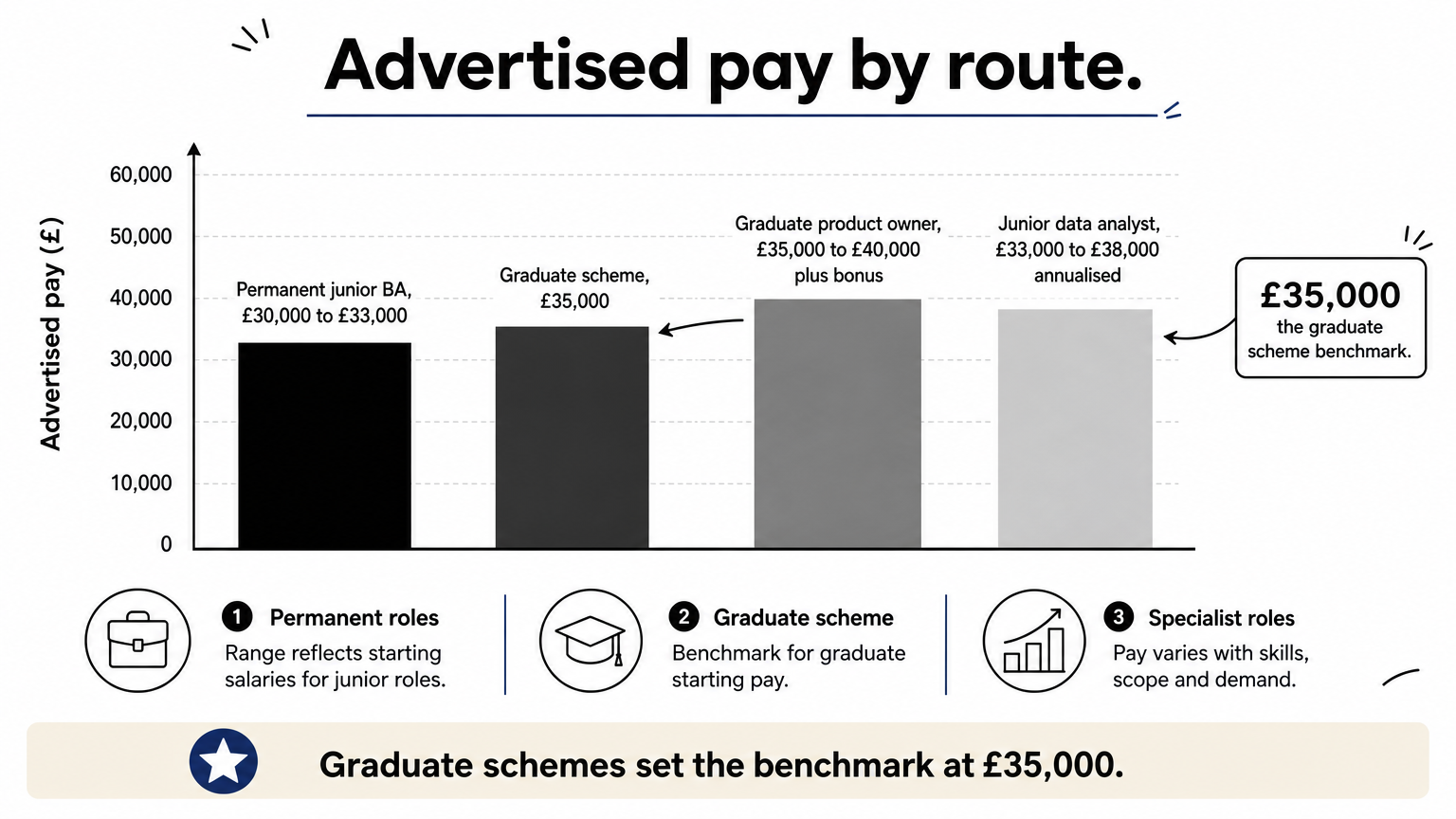
Pay across the eight routes
The table sets the advertised figures side by side, so you can compare routes quickly. The salary average for the title sits near £32,500 on graduate job-board data, with most advertised pay falling inside the range of about £25,000 to £37,500.
| Route | Advertised pay | Typical pattern |
|---|---|---|
| Permanent junior BA | £30,000 to £33,000 | Hybrid, two office days |
| Graduate scheme | £35,000 | Multi-city, April intake |
| Graduate product owner | £35,000 to £40,000 plus bonus | Remote |
| Contract junior technology BA | £200 to £210 a day | London, hybrid, inside IR35 |
| Contract support analyst | £195 a day | 18 months, hybrid or remote |
| Junior data analyst | £17 to £19.50 an hour | Three-month term, London |
| Apprenticeship, internship | Often "competitive" | Ask for the rate in writing |
London, Manchester, Birmingham and Leeds
London carries the largest volume of entry level business analyst jobs, with financial services, consultancies and retailers all hiring. Birmingham and Manchester appear on graduate scheme site lists, and Birmingham also shows a Capgemini junior business analyst posting.
Leeds is thinner. A search often returns a small number of junior or temporary roles, so widen your radius to nearby Bradford, where a hybrid junior BA role appeared, and include remote and hybrid vacancies in your filters.
Other cities worth searching
Glasgow has financial services contracts and a large bank apprenticeship, and Belfast has consultancy roles from the larger firms, though many of those are aimed at experienced analysts. Cardiff and Treforest, Bristol and Sheffield also show graduate and fixed-term posts.
Defence and government roles, for example around Cheltenham, may require security clearance, and clearance eligibility is often tied to residency history. Check the requirement before you invest time in an application.
The best city to search is the one with the most hybrid roles within a realistic commute, not the biggest name.
How to find and win your first junior role
You win a junior role by searching under every title employers use, ignoring listings that are really courses, and showing requirements evidence on your CV. A short, targeted search routine beats browsing the same boards for hours without a plan.
Search with the right job titles
Employers rarely use one phrase. Run these searches in turn and save them as job alerts so new postings reach you the same day.
- Junior business analyst and jr business analyst
- Entry level business analyst and associate business analyst
- Graduate business analyst and trainee business analyst
- Business systems analyst and junior systems analyst
- Junior data analyst and junior product owner
Avoid listings that are really courses
Some advertised "jobs" are self-funded training programmes with fees. One advert repeated across ten cities promised a data analyst job guarantee but stated that fees apply. That is a course, not employment, so read the small print before you apply.
A real job pays you from your first day and does not ask for money. Check the employer on its own careers page, and treat any post that is vague about pay and duties with caution.
Build a CV that gets shortlisted
Recruiters scan for requirements evidence, not just job titles. Lead with a short summary, using a proven CV template, then show two or three examples of mapping a process, writing requirements or supporting testing, even if the work was unofficial. Name the tools you used, such as Jira, Excel and Microsoft Office.
Qualifications help when you lack experience. The BCS Foundation Certificate in Business Analysis and the IIBA entry certificate (ECBA) are recognised starting points among business analyst certifications. Transform Learning Academy's programme combines certification, hands-on projects and career support such as CV reviews, for people who need practical experience before they apply.
Employers hire evidence of analyst work, so a CV with two real examples beats one with a long skills list.
Pick one route and start applying
Junior business analyst jobs come in eight main forms, from permanent roles and graduate schemes to apprenticeships, contracts and adjacent data or product posts. Pay mostly sits between £25,000 and £40,000, London has the most openings, and the right route depends on whether you are a graduate, a student or a career changer.
Choose the route that matches your situation, set up alerts under the job titles above, and tailor each CV to the posting. Skip listings that ask you to pay, and keep a log of applications so you learn which versions of your CV get replies.
If you want recognised certification, real project experience and CV support before you apply, take a look at the Business Analysis Programme at Transform Learning Academy.


