


What Course Should I Do to Become a Business Analyst?
Need More Help? Book Your FREE Strategy Session With Our Career Coaches Today!
The best answer to what course should I do to become a business analyst is the BCS Foundation Certificate in Business Analysis, taken once you have mapped your existing skills and followed by hands-on project work. You do not need a specific degree or a tech background to start. A degree or apprenticeship is a valid route if you are early in your career, but a recognised certificate plus real project evidence gets most career changers to interviews faster.
The problem is that every source gives you a different answer. One tells you to get a degree, another sells a certificate, and a third lists diplomas with acronyms that mean little yet. Meanwhile, job adverts ask for experience you have not had a chance to gain. It is easy to pay for the wrong course, or to spend years on a route you did not need.
This guide fixes that in four steps: audit your skills and pick a route, pass a foundation qualification, build project experience, then add a second qualification and apply. Transform Learning Academy trains people with no tech background to become business analysts, so the advice reflects what UK career changers need in order to get hired.
What to know before you choose a course
You need neither a specific degree nor prior business analysis experience to start. You do need a recognised qualification and some evidence that you can do the work.
Do you need a degree to be a business analyst?
No. The National Careers Service says any degree that teaches analytical skills can be useful. It lists business information systems, business management, computing and computer science as subjects some employers prefer. A preference is not a requirement. Plenty of analysts come from law, teaching, pharmacy and policing, because the job rests on analysis, communication and organisation rather than on one subject.
A degree helps most with graduate schemes and large employers that filter by qualification. For many other roles, a professional certificate plus project evidence is a credible alternative.
Do you need experience first?
Not in business analysis itself. Adverts ask for experience, but employers read the word broadly. Gathering requirements, mapping a process, handling conflicting stakeholders or analysing data in any job all count. Direct applications usually suit people with several years in project management, consulting or IT.
If that is not you, your target is simple: move from "no experience" to one real project and one recognised exam as quickly as you can. Steps 2 and 3 do exactly that.
The five routes compared
Each route suits a different starting point. The entry requirements below come from the National Careers Service.
| Route | Typical entry requirement | Best for | Main drawback |
|---|---|---|---|
| University degree | 2 to 3 A levels, or equivalent | School leavers with time to study | Several years and tuition fees |
| Postgraduate degree | A degree in a relevant subject | Graduates who want to specialise | Cost and time out of work |
| Apprenticeship (Business Analyst Level 4 Higher, or Project Manager Level 6 Degree) | 4 or 5 GCSEs at grades 9 to 4, plus A levels or equivalent | Early-career people who want a wage while learning | You need an employer to take you on |
| Professional certificate (BCS Foundation) | No formal entry requirements | Career changers without a relevant degree | Employers still want practical evidence |
| Internal move or direct application | Several years in project management, consulting or IT | Current IT and project staff | Only works if you already have the background |
A degree opens the door slowly, a certificate opens it quickly, and project evidence is what gets you through it.
Step 1. Map your skills and choose a route
Write down what you already do that matches the analyst job, then pick the route that fits your age, savings and background. This takes an evening, and it stops you buying a course you do not need.
List your transferable skills
Business analysis is mostly communication, structure and judgement. For each skill below, write one real example from your current or past work, with a number where you can.

- Analysis: a time you used data to change a decision, such as spotting that 30% of tickets came from one cause.
- Communication: explaining something complex to people who were not experts.
- Stakeholder handling: a project where two groups wanted opposite things and you found a compromise.
- Documentation: a procedure, report or process you wrote that others still use.
- Organisation: a deadline you managed across several people.
- Technical comfort: spreadsheets, databases or any system you learned quickly.
If you can fill four of the six, you are closer than you think. The gaps tell you what Steps 2 and 3 must cover.
Pick a route with three questions
Answer these in order and stop at the first yes.
- Do you have several years in IT, project management or consulting? Look for internal analyst vacancies first, then apply directly. Add a certificate to show you know the formal techniques.
- Are you finishing school or college with A levels and want a wage while you learn? Search the Business Analyst Level 4 Higher Apprenticeship on the government's Find an apprenticeship service.
- Are you in an unrelated career with no relevant degree? Take the certificate route in Steps 2 to 4.
A teacher with eight years of experience, for example, already handles parents, managers and assessment data. She answers no to questions one and two, so she follows the certificate route. Her skills list gives her three strong examples before she opens a textbook.
Choose your route by what you already have, not by what looks most impressive.
Step 2. Pass the BCS Foundation Certificate
Take the BCS Foundation Certificate in Business Analysis, the standard entry qualification for UK analysts, and study it with an accredited provider that includes the exam in the price. It is the single course I would pick first if you have no relevant degree.
What the Foundation Certificate covers
BCS, The Chartered Institute for IT, sets the qualification, and UK employers recognise it. It teaches the analyst's role, how to investigate a business situation, stakeholder analysis, process modelling, requirements and business cases. The exam is multiple choice, and there are no formal entry requirements.
The main alternative is the IIBA's Entry Certificate in Business Analysis (ECBA), which also needs no experience. It is well known internationally. For UK job adverts, BCS is the name you will see more often, so start there unless the roles you want name the IIBA.
How to choose a training provider
Two providers can both teach the BCS syllabus and still give you very different results. Check each against this list.
- BCS accreditation, so the exam is recognised.
- Whether the exam fee is included, and what happens if you fail. Resit policies differ, and some providers charge extra.
- Live sessions with practising analysts, not only recorded videos.
- Real project work, not theory alone.
- CV, interview and job search support.
- Refund terms and whether you can pay in instalments.
For comparison, Transform Learning Academy's Certified AI Business Analysis Training Course runs for three months at an average of 5 hours a week. It includes a 2 day live training, the BCS business analysis foundation exam and live project experience, and it has no prerequisites. Resits are not included and cost extra. Courses carry a 14-day money-back guarantee, and payments can be split over 3, 6 or 12 months interest free.
A 65-hour study plan
Three months is about 13 weeks. At 5 hours a week, that gives you roughly 65 hours. Here is a sensible split.
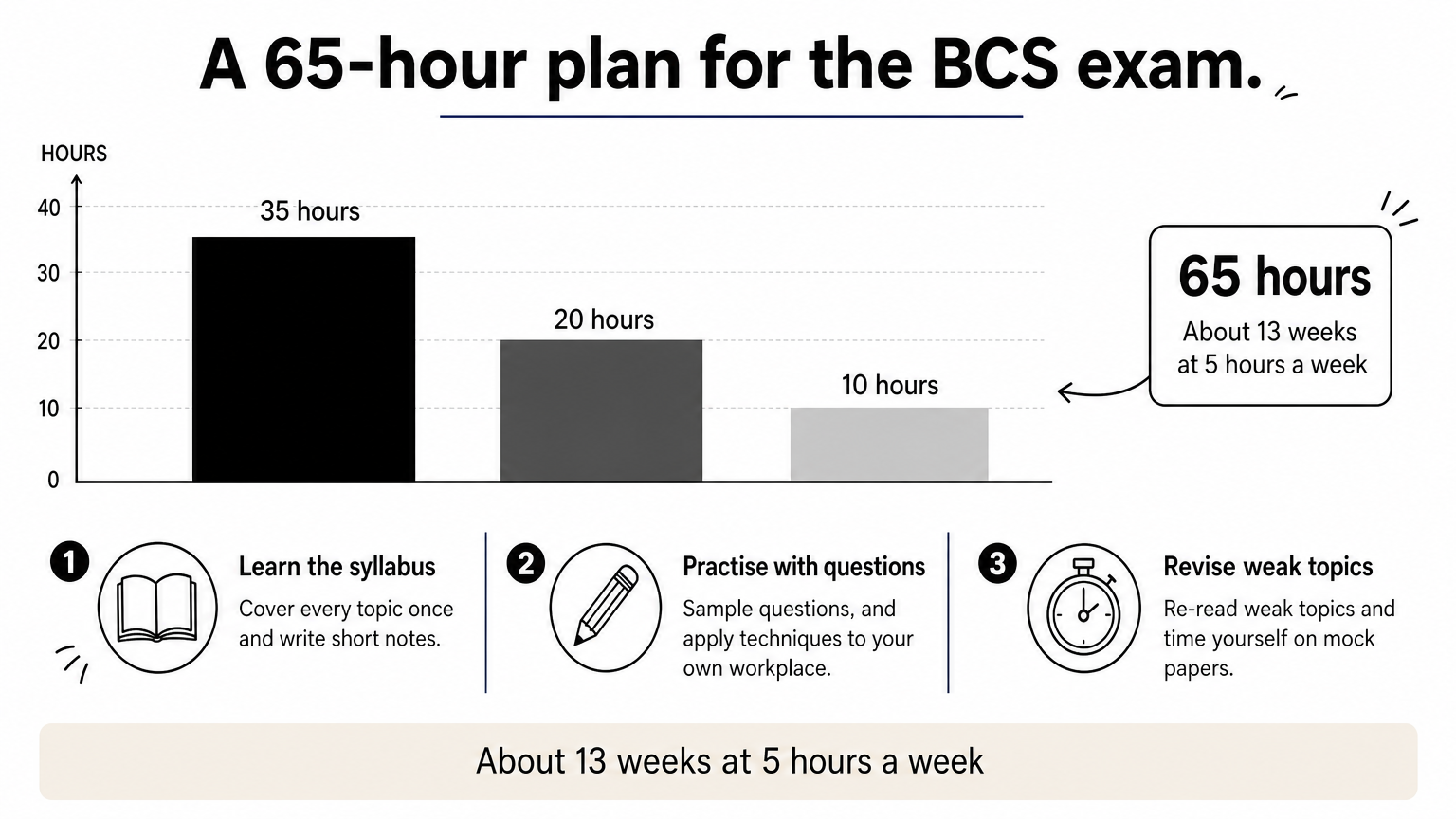
| Phase | Hours | What you do |
|---|---|---|
| Learn the syllabus | 35 | Cover every topic once and write short notes |
| Practise | 20 | Sample questions, and apply techniques to your own workplace |
| Revise | 10 | Re-read weak topics and time yourself on mock papers |
| Total | 65 |
Pick the provider whose exam fee, resit terms and project work you have checked in writing, not the one with the loudest advert.
Step 3. Build project experience and tool skills
Complete at least one real project and keep the documents you produce, so you can show them at interview. A certificate proves you know the method. A portfolio proves you have used it.
Get real project exposure
Start where you work. Ask your manager whether you can support a project in a small role, such as taking notes in requirements workshops or mapping the current process. You will learn how developers, testers and sponsors talk to each other, which no course fully teaches.
If you are not employed, volunteer for a charity or non-profit. Choose a task that mirrors the job, such as mapping how donations are processed and suggesting two improvements. Alternatively, pick a course that includes live project work, as that gives you a documented case without needing an employer's permission.
Produce four portfolio documents
Aim for these four. Each one answers a question an interviewer is likely to ask.

| Document | What it shows | Tool |
|---|---|---|
| Stakeholder map | You know who matters and why | Spreadsheet or diagram |
| Current and future process map | You can model how work flows | Diagramming tool such as Microsoft Visio |
| Requirements list with priorities | You can turn needs into clear statements | Spreadsheet or document |
| User stories with acceptance criteria | You can work in agile teams | Jira or a spreadsheet |
Here is a copy-ready user story format.
As a [role],
I want [goal],
so that [benefit].

Acceptance criteria:
- Given [starting condition], when [action], then [result].
- Given [starting condition], when [action], then [result].
Remove any real client names from documents before you share them.
Learn the tools employers list
Open ten analyst adverts and tally the tools. Excel will appear almost every time, so learn lookups and pivot tables. A diagramming tool such as Visio comes next, followed by basic SQL, which lets you pull data without waiting for someone else. Agile teams also use boards such as Jira, and the National Careers Service suggests learning agile project management methods.
Learn only what the adverts ask for. Two hours a week on SQL for a month is more useful than a vague tour of five tools.
Three documents you can explain beat ten certificates you cannot talk about.
Step 4. Add a second qualification and apply
Choose a second qualification that matches the adverts you see, then apply under every job title analysts hide behind. Do not collect certificates for their own sake. One well-chosen addition is enough to start applying.
Choose the second qualification
Let the adverts decide. Match what they mention to the table below.
| If adverts mention | Consider | Why |
|---|---|---|
| Scrum teams, agile delivery | AgileBA | Shows you can analyse in agile projects |
| Project offices, programme work | PRINCE2 or APM PFQ | Shows you understand project structure |
| IT service teams | ITIL | Covers IT service management |
| Heavy reporting and data | A data or BI course | Adds tools such as SQL, Tableau and Power BI |
| Senior roles, years of practice | BCS Diploma in Business Analysis | Builds on the Foundation Certificate |
Transform Learning Academy's Certified Data Business Intelligence Analyst Course with Job Placement runs for six months at an average of 5 hours a week. It includes 12 months of e-learning access to Advanced Excel, SQL, Python, R, Tableau and Power BI. It suits you if the adverts lean towards data.
Search for the right job titles
Many analyst roles are not advertised with that title. Search these as well:
- business systems analyst
- process analyst
- systems analyst
- requirements engineer
- product owner
- business intelligence analyst
Look inside your current employer first. An internal move is the lowest-risk route because people already trust you. Published UK salary figures vary by source, with starting pay from about £23,000 to £32,500, mid-level roles near £50,000 and experienced analysts earning £55,000 or more.
Prepare your CV and interview
Put your certificate, your project and your tools in the top third of your CV. Describe the project in results, for example "mapped a four-step approval process and removed one step, cutting waiting time". Transform Learning Academy offers CV reviews and job placement assistance, and any provider you choose should offer something similar.
In interviews, start from the business problem, not the solution. When asked how you would approach a new project, describe identifying stakeholders, gathering information, defining requirements and weighing options. Then tell a short story from your portfolio.
Match your second qualification to the adverts you actually see, then start applying before you feel ready.
Your next move
Start with the BCS Foundation Certificate, back it with one real project, and add a second qualification only when the job adverts ask for it. A degree is optional, and so is prior experience, as long as you can show recognised training and work you have actually done.
If you want a structured route that combines the BCS exam, live training and project experience, look at Transform Learning Academy's Business Analysis Programme. Whichever provider you choose, check the exam fee, resit terms and project work first.


